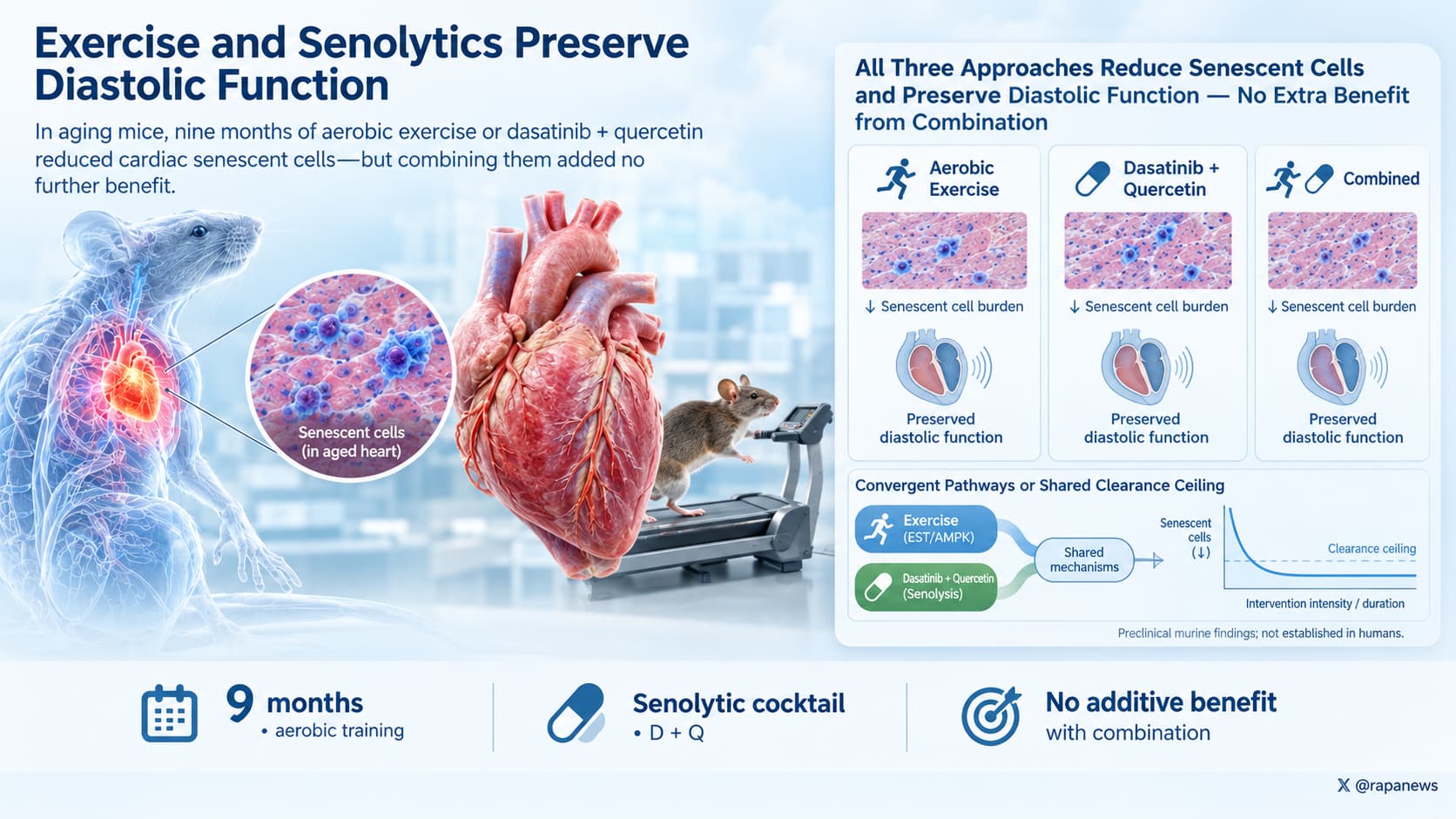
Nine months of aerobic exercise or the senolytic cocktail Dasatinib and Quercetin successfully clear senescent cells from the aging murine heart and preserve diastolic function. However, administering both interventions simultaneously provides no additive or synergistic benefits, suggesting that physical training and pharmacological senolytics operate along convergent mechanistic pathways or encounter a shared clearance ceiling in early-stage cardiac aging.
Cellular senescence is a primary biological driver of structural and functional decay in the mammalian heart. As the myocardium ages, localized populations of senescent cardiomyocytes and interstitial cells accumulate. These permanently arrested cells express elevated levels of cyclin-dependent kinase inhibitors, specifically p16 and p21, and excrete a senescence-associated secretory phenotype (SASP). This SASP drives local inflammation, fibrosis, and ventricular stiffening. The resulting phenotype is characterized by severely impaired left ventricular relaxation, a hallmark of age-related diastolic heart failure. Interventions that selectively induce apoptosis in these damaged cells, termed senolytics, offer a direct strategy to mitigate cardiac decline. Concurrently, aerobic exercise has been widely observed to induce systemic rejuvenation, prompting the question of whether exercise inherently acts as a senolytic and if its effects can be amplified by pharmacological agents.
Researchers tested this hypothesis using a 9-month longitudinal intervention on 12-month-old middle-aged mice, continuing until they reached 21 months of age. The subjects were divided into a naturally aged vehicle control cohort, an aerobic exercise group, a Dasatinib plus Quercetin (D+Q) senolytic group, and a combined exercise and senolytic group.
At the cellular level, the monotherapy interventions were highly successful. Both the exercise regimen and the D+Q treatment dramatically reduced the burden of senescent cardiomyocytes and interstitial cells compared to the untreated aged controls. The reduction in these pathological cells correlated tightly with preserved myocardial performance. Notably, the untreated aging mice exhibited profound diastolic dysfunction, whereas the treated mice maintained ventricular relaxation metrics nearly identical to young, 4-month-old healthy controls.
The central surprise of the study is the absolute failure of the combined therapy to outperform either monotherapy. The resulting data indicate that exercise alone is as effective a senolytic as the gold-standard D+Q cocktail for the aging heart. When combined, the lack of synergy suggests the two interventions likely target the same vulnerable pool of senescent cells or saturate a shared physiological clearance limit.
Furthermore, a paradox emerged between the cellular and whole-organ analytics. While histological staining confirmed the clearance of senescent cells in specific tissues, whole-heart protein lysates showed no significant reduction in overall p16 or p21 expression, and systemic circulating SASP markers remained unchanged. This discrepancy highlights the deeply localized, heterogeneous nature of cardiac aging. Senescence appears to cluster in specific ventricular regions, meaning that resolving it requires cellular-level precision rather than bulk tissue analysis. The absence of elevated systemic SASP at 21 months further suggests that early-stage cardiac aging initiates localized paracrine damage well before systemic inflammation becomes clinically detectable.
Actionable Insights
For individuals seeking to optimize cardiovascular healthspan, this research validates two accessible protocols but demonstrates that combining them is unnecessary. Aerobic exercise functions as a potent natural senolytic. Implementing a consistent aerobic training routine limits the accumulation of damaged cells in the heart muscle to the exact same degree as targeted pharmaceutical interventions. If a rigorous cardiovascular exercise program is already in place, adding a senolytic protocol like Dasatinib and Quercetin provides no additional prophylactic benefits for cardiac senescence.
The real-world magnitude of these interventions is exceptionally large. Untreated aging resulted in a 40 percent deterioration in ventricular relaxation time. The exercise group experienced an absolute improvement of 10.2 milliseconds in relaxation speed over the controls, yielding a standardized effect size of 2.39 (Cohen’s d). Furthermore, exercise reduced senescent cardiomyocyte burdens by up to 48 percent (Cohen’s d of 2.33). These are not marginal statistical artifacts; they represent a fundamental rescue of physical heart function back to youthful baselines. Choose either a dedicated aerobic protocol or a senolytic regimen to protect the heart, but investing resources into doing both simultaneously is redundant. Given the identified potential issues of D&Q having a negative impact on the brain, exercise is likely the preferred option. See: Dasatinib and Quercetin as Senolytic May Cause Brain Damage
Context and Source
- Open Paper: Chronic Senolytic Treatment and/or Aerobic Exercise Reduce Senescence and Improve Myocardial Function During Aging in the Heart, Published 07 October 2026.
- Institution: McMaster University and Brock University
- Country: Canada
- Journal: Aging Cell
- Impact Evaluation: The impact score of this journal is 7.7, evaluated against a typical high-end range of 0 to 60+ for top general science, therefore this is a High impact journal.