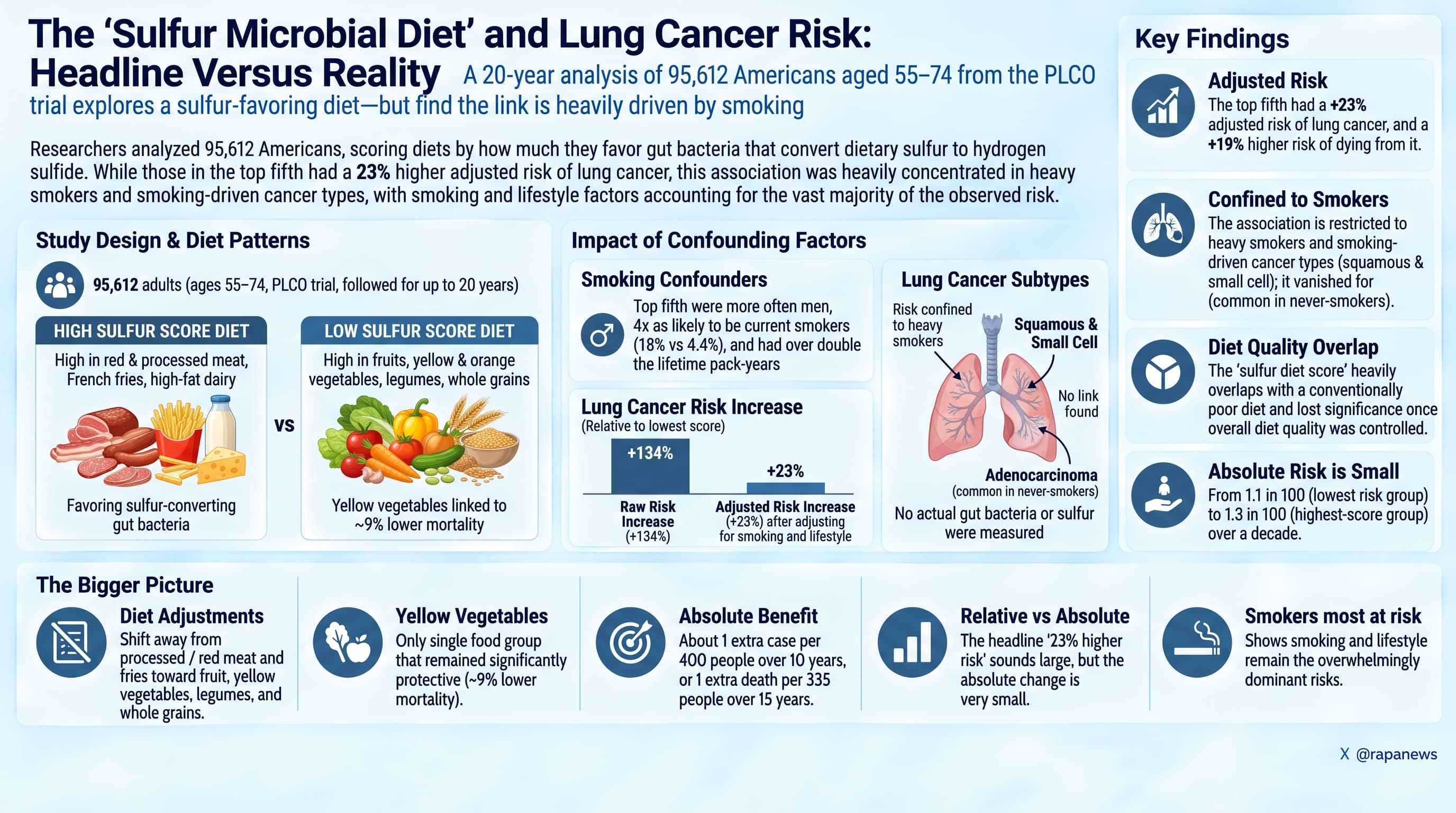
Researchers in Chongqing looked again at 95,612 Americans aged 55 to 74 from the PLCO cancer screening trial. They scored each person’s diet by how much it favors gut bacteria that turn dietary sulfur into hydrogen sulfide (the “sulfur microbial diet” score, which is high in red and processed meat, fries and high-fat dairy, and low in fruit, yellow vegetables and whole grains). People in the top fifth had about 23% higher adjusted risk of lung cancer and 19% higher risk of dying from it than people in the bottom fifth.
The gut-lung axis is one of the more seductive ideas in current biology. Microbes in the colon shape inflammation and immunity throughout the body, so perhaps what feeds them also shapes disease in distant organs. This study tests that idea for lung cancer using a dietary fingerprint first built at Harvard. In earlier work, researchers paired food questionnaires with stool sequencing and found which foods track with sulfur-reducing bacteria such as Bilophila wadsworthia. Those bacteria produce hydrogen sulfide, a gas that at high concentrations damages DNA and weakens the gut lining.
The new analysis applied that fingerprint to a large American cohort followed for up to 20 years. On the raw numbers, the pattern looks dramatic. Lung cancer rates were about 2.5 times higher in the top fifth of the score than in the bottom fifth. But the people eating this way were also different in ways that matter enormously for lung cancer. They were more often men, four times as likely to be current smokers (18% versus 4.4%), and carried more than double the lifetime pack-years.
Once the researchers adjusted for smoking and other factors, the excess risk shrank from 134% to 23%. That remaining signal held up reasonably well across several checks, but it softened further when the researchers used competing-risk models, which matter in older people who often die of other causes first. It also lost statistical significance once overall diet quality was taken into account, because the sulfur score largely mirrors a conventionally poor diet.
The most revealing results are in the subgroups. Among people who never smoked, a higher score was, if anything, linked to slightly lower lung cancer mortality. The association was concentrated in people with more than 20 pack-years. And it appeared only in squamous cell and small cell carcinoma, the two cancers most tightly tied to tobacco, while adenocarcinoma showed nothing.
The authors read this as possible effect modification: smoke-damaged airways might be more sensitive to inflammation coming from the gut. That is plausible, but the simpler reading is that smoking was not fully captured. Pack-years and a three-way smoking category miss intensity, years since quitting, secondhand smoke and occupational exposure. In heavy smokers, even a small error in measuring tobacco exposure can generate an apparent dietary effect of this size.
There are other reasons for caution. Diet was measured once, around the late 1990s, by food questionnaire. A quarter of the original trial was excluded for invalid dietary data. People in the top quintile reported eating fewer calories despite being heavier and more often male, a classic sign of under-reporting. And nobody’s microbiome was measured, so the “microbial” label is a statistical inference built in a different population.
The Big Idea is still worth taking seriously. Diet patterns that favor sulfur-reducing microbes have now been linked to colorectal, esophageal and possibly lung cancer in prospective data. But this paper does not show that gut sulfur chemistry causes lung cancer. It shows that heavy smokers who eat a Western-style diet die of lung cancer more often than heavy smokers who eat more plants, which most clinicians would have guessed.
Actionable Insights
The practical message is modest and familiar. Shifting away from processed and red meat, fries and high-fat dairy toward fruit, yellow and orange vegetables, legumes and whole grains is consistent with this paper and with decades of broader evidence. Yellow vegetables were the only single food group that stayed significant, linked to about 9% lower lung cancer mortality per step up in intake.
How big is the benefit? In the lowest-risk group, roughly 1.1 people in 100 developed lung cancer over about nine years. After adjustment, the highest-score group would expect about 1.3 in 100. That is roughly one extra case for every 400 people eating the most sulfur-favoring diet for a decade, and about one extra lung cancer death per 335 people over 15 years. The headline “23% higher risk” sounds large; the absolute change is small.
The larger signal falls on heavy smokers, where the diet association was clearest. For anyone with a smoking history, quitting and getting low-dose CT screening (if eligible) dwarf any dietary effect in this paper by more than an order of magnitude. Diet is a reasonable add-on, not a substitute.
Nothing here supports sulfur-specific interventions such as cutting sulfur supplements or targeting gut bacteria directly.
Context and Source
- Open access: Association of sulfur microbial diet with lung cancer incidence and lung cancer-related mortality in 95,612 American adults: a prospective cohort study from the PLCO trial, published online 12 October 2026.
- Institution: The First Affiliated Hospital of Chongqing Medical University (lead author also affiliated with Erasmus University Medical Center, Rotterdam)
- Country: China (analysis of United States cohort data)
- Journal: Nutrition Journal (BMC / Springer Nature)
- Impact evaluation: The impact score of this journal is a CiteScore of 6.1, evaluated against a typical high-end range of 0 to 60+ for top general science journals (roughly 0 to 15 within nutrition and dietetics), therefore this is a Medium impact journal.