How will you do that?
Same here. Massive - massive - fiber intake (100g+), tea, coffee, cacao, polyphenols up the wazoo, no red meat (though fish twice a week).
Recently changed slightly in order to recover from ACDF surgery and facilitate bone fusion: added vitamin C 100mg and switched from soy protein powder to whey concentrate. But then again: added calcium and magnesium powders.
I will retest all my iron related bloodwork before determining how to boost ferritin to about 30-50. I’ll likely start with lactoferrin supps.
In two months I raised it from 11 to 31 with 120mg of iron bisglycinate w/vit c and 600mg of lactoferrin split into 2 daily doses every other day. Not as much progress as I had hoped but Gemini told that was actually a decent increase. Timing it apart from coffee and a few other iron blockers that I refused to give up was a pain, so have switched to a combo of Profferin and iron bis. Profferin is a heme-source with better bioavailability, resistant to iron blockers (allegedly), and less likely to trigger oxidation.
To determine my protocol, I relied on this forum (thank you guys), and this nifty tool: Iron Status Interpreter
Besides generating a protocol specific to your iron levels, the site lists the optimal ferritin levels of several experts.
5 Likes
Its optimal ferritin values has some odd entries, but it is good to have an iron level calculator
My experience with Proferrin was extremely disappointing. Tried it in combo with bisglycinate for a couple of months and and it had no discernable effect. At an exorbitant price. Perhaps you will get better results. Recommend establishing a baseline with bis only, and then adding Proferrin and measure the incremental change.
1 Like
You have to bear in mind that cystatin-c is affected by inflammation, and ferritin is also an acute phase marker (like, patients with covid have sky high ferritin, which has nothing to do with iron levels). Creatinine is affected by muscle mass, protein intake etc. So all of these can be externally influenced by things that have nothing to do with kidney function.
And hematocrit is massively determined by your hydration level. 48.5% doesn’t indicate much IMO except you were maybe a bit dehydrated.
None of these biomarkers are perfect, and you have to be careful about LLMs creating links where there probably aren’t any.
And also just keep in mind that people have natural variation around reference ranges. Like, your MCV may never go down no matter how much iron you take in, and there’s noting wrong with that. (Though I do think you did the right thing by supplementing to raise your ferritin level).
3 Likes
Very useful thoughts. Appreciate you taking the time to share them.
1 Like
eGFR by cystatin C was recently 82. Creatinine based eGFR was 92 from same blood draw. Both OK for my age (71) but will be looking at ways to keep it from declining more (maybe FMD). According to Gemini AI Pro: many nephrologists now recommend the 2021 CKD-EPI Creatinine-Cystatin C combined equation . This equation factors in both serum cystatin C and serum creatinine alongside age and sex. Using both biomarkers together is currently considered the most accurate, precise, and rigorous non-invasive method for estimating kidney function.
2 Likes
The Iron Status Interpreter says I have an 80% chance of being dead in 10 years. This sounds like a fair shake to me. I’d rather be dead than decrepit.
1 Like
63 y.o. male
eGFR creatinine is 55
Creatinine is 125
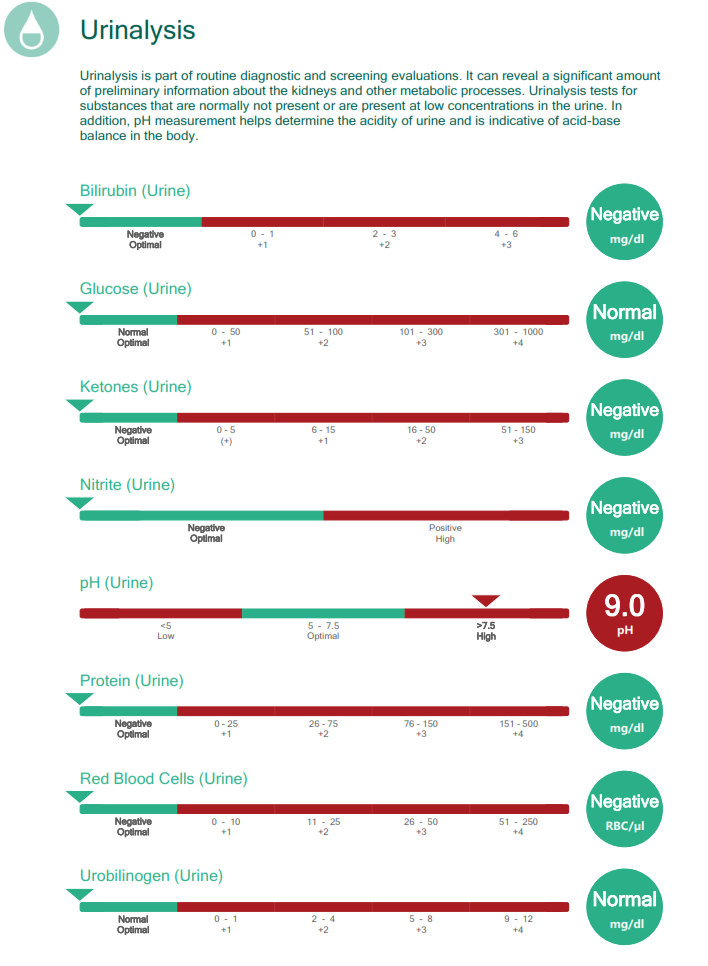
It may be worth keeping track of your urinary pH. You could have difficulty with urate clearance which might lead to gout. Worth looking at serum urate (aka Uric Acid) as well as other kidney biomarkers.
On the other hand it may be that the test took a while to be done and metabolised whilst waiting.
My urate is also high at 443 umol/L with the range being 200-500. I see a nephrologist in June for a new assessment.
I am not a massive fan of “the range”. A nice urate is around 300 or less. Over 400 and I would be worried about crystalisation of urate. The problem is that there is a limit to the solubility of urate in serum (which should have a pH around 7.4).
If I were you I would get your urinary pH tested. You can do this approximately with pH strips and a cup. I rip the strips into quarters which enables me to do a lot of tests.
With a urate of over 400 (mcmol/l) or 6.8 mg/dL there are dangers at physiological pH. The body has a capacity to absorb quite a bit of urate in interstitial fluid and lymph before depositing crystals, but it is best not to take a chance with it.
I don’t necessarily recommend this manufacturer, but it is a good example of litmus strips.
2 Likes
In January my urine pH was 7 and last August it was at a high of 8. I’ll have to see what can be done about that.
That should be ok. Above 6.8 should clear urate.
Good to know, thanks.
It does vary during the day.
I wonder, however, why your urine is alkaline. There can be good and bad reasons for this.
I take some meds and some supplements but have never looked at urine alkalinity effects. I know my urate is high because my kidneys are under functioning.
This makes my body somewhat toxic unfortunately.
Yes. I personally am a fan of alkalininity, but I recognise that it can be a sign of a problem. It is worth working out what the problems are if any. Older people tend to have more acidic urine.
With urate a bit of a no brainer is xanthine oxidase inhibition to reduce the production of urate. If your urine is pH 6 or lower then you should also look at urinary pH. It does vary during the day so it is worth keeping an eye on for a few days to make sure you know what is happening.
Then you have a question of the volume of urine being excreted. You can also test how much urate is in the urine.
Some things increase urate production (purine metabolism). In particular Brewers Yeast extract will increase urate for a day or two.
It is worth keeping it to reasonable levels as if you start going down the gout route that is a reasonably nasty experience depending upon how bad it gets.
As a matter of interest:
1 Like