Thanks for the link to the calculator. According to my values, I should supplement 72 mg of iron biglycinate EOD. Did you work out what your equivalence would be in heme?
I ended up using a combo - 1 Proferrin with 25-50mg of iron bisglycinate and 600mg lactoferrin EOD. I’ll be retesting next month to see how much it moved the needle.
Per Claude, looks like 1 Profferin (10.5mg heme) might do the trick:
72 mg iron bisglycinate → ~20% elemental iron = ~14–15 mg elemental iron → absorbed at ~20% = ~3 mg actually absorbed
Proferrin ES at ~30% absorption: 3 mg ÷ 0.30 = ~10 mg elemental heme iron needed
That’s essentially 1 tablet of Proferrin ES (10.5 mg elemental), which would likely deliver equivalent or slightly better absorbed iron than 72 mg bisglycinate.
One tablet is also conveniently the minimum recommended dose, so it’s a clean swap.
2 Likes
From all of the research I have reviewed, get your levels just inside the lowest acceptable level at which you feel appropriately well. From some causal and considerable population evidence, low-ish ferritin, etc. is geroprotective.
My levels are in check now but I can validate the “nasty experience” for those who have not experienced it. Mine centered on one big toe. I had no earthly idea that a toe could be so painful. It was excruciating and I have a decently high pain threshold.
It can be a lot more painful and disabling than that.
On the other hand it is an incredibly simple problem to define. I am not sure the reason exactly why it happens has been properly researched. I think it probably links to a movement in metabolism that drives people to be more acidic, but that has not as far as I know been researched.
I asked a couple of questions of chatGPT and will copy the response below. However, I think it misses the fact that urate is more soluble in neutral or alkaline urine (as long as there is enough volume). Hence even if stones are not created less urate will be excreted in acidic urine.
chatGPT:
The best evidence supports this distinction:
Acidic urine is well linked to uric acid kidney stones in people with gout or hyperuricaemia, but it is not established as a primary cause of gouty arthritis itself. Gout is primarily driven by systemic urate burden and monosodium urate crystal deposition in joints and tissues; low urine pH mainly changes what happens in the urinary tract, where it promotes uric acid crystallization. (PMC)
On the kidney stone side, the evidence is strong. Reviews consistently describe low urinary pH as the major or overriding determinant of uric acid stone formation. This is because acidic urine shifts dissolved urate toward the less soluble protonated form, uric acid, making crystallization much more likely; risk is especially high around urine pH ≤5.5. (PMC)
On the gout side, the key driver is different. Reviews of gout pathophysiology describe gout as arising when serum/tissue urate supersaturation leads to monosodium urate crystal formation in and around joints, followed by inflammation. Those sources do not treat acidic urine as a main determinant of joint gout in the way it is for uric acid stones. (PMC)
There is also direct evidence that many patients with gout do indeed have low urinary pH. A 2022 study found that about half of the gout patients studied had acidic urine, and more acidic urine was associated with nephrolithiasis and worse renal findings. A systematic review likewise notes that gout is associated with lower urinary pH, which theoretically predisposes to stones. (PMC)
Mechanistically, the best-supported explanation is impaired urinary buffering, especially reduced renal ammonium excretion, often in the setting of insulin resistance/metabolic syndrome. That explains why gout, obesity, diabetes, and uric acid stones often cluster together. It also explains why acidic urine is more strongly tied to stone risk than to articular gout itself. (PMC)
One especially useful piece of evidence on causality is that lowering serum urate does not necessarily normalize urine pH. In a prospective study of gout patients treated with febuxostat for 6 months, serum urate fell substantially, but urine pH did not significantly change. That argues against a simple model where gout or hyperuricaemia alone directly causes acidic urine; instead, low urine pH appears to reflect a related metabolic/renal phenotype that often coexists with gout. (PubMed)
There is some literature suggesting that local acidity in tissues could favor monosodium urate crystallization or inflammation, but that is different from urine becoming acidic. The strongest evidence you asked for points to this conclusion: acidic urine is mainly a marker and mechanism for uric acid nephrolithiasis, not a proven direct driver of gouty arthritis. (PMC)
My bottom line:
- Best-supported link: gout ↔ low urinary pH ↔ higher risk of uric acid stones. (PMC)
- Much weaker / not established: low urinary pH as a direct cause of joint gout. Gout itself is mainly about systemic urate supersaturation and MSU crystal deposition in tissues, not urinary acidity. (PMC)
A practical way to think about it is:
- Serum urate / tissue urate supersaturation → gout risk
- Urine pH, urine volume, urinary uric acid load → uric acid stone risk (PMC)
I can also turn this into a compact table: “evidence for acidic urine causing stones” versus “evidence for acidic urine causing gout,” with the strongest papers in each column.
Ya, my goal is 50.
BTW, you may have noticed, but for others, they added a thyroid calculator and male hormone calculator at https://www.longevity-tools.com/.
1 Like
My pH naturally runs close to five . I prefer that end of the scale but closer to 6.0-6.5. I found that switching my magnesium formulation from glycinate to citrate (1 tab AM/2 tanb evening for a total of 400 mg elemental) maintains pH ~6.0.
I would panic at 5
1 Like
With urine pH around 5, monitor your serum bicarbonate and anion gap. Low bicarbonate (<22) indicates metabolic acidosis, which can increase uric‑acid stone risk - maintaining adequate citrate and hydration is important.
2 Likes
Thank you. I grew suspicions of the one stick does all test strips I was using and even more so after the only urinalysis I could locate in the past decade read 6.0. I then purchased specialized PH sticks that are much easier to read and which provide finer gradations. These reading were consistently 6.0 to 6.25. Then, switching my magnesium source to citrate form, the readings edged up to 6.75-7.0. I’ll probably stop there. For whatever reason, I have no tendency to develop symptomatic stones but one can also develop unhealthy crystalline structures that may have no symptoms.
That is true. With my monday, wednesday, friday all day fasting (which stops when someone want to go to the pub with me or eat out) I can get as low as 6.5 (because on Wednesday and Friday I don’t take citrate. However, I can hit 9 and possibly 10 on big days. This has gone on for years. Hence I don’t think 7.5 for people is that much of an issue. There are people with really low renal function who should be more careful, however.
1 Like
How much citrate do you take and what form?
I have talked about this a lot on this forum. It is a really complex issue as it drives underlying cellular functon.
I found your discussion. Thank you.
I had mine tested last week and it came in at 7.5, which I’m happy with.
It is likely to vary during the day.
Declining kidney function is the most overlooked cause of death
Only 55,000 US deaths/yr are attributed to it, yet ~37M have chronic kidney disease & this speeds heart disease, infection, frailty & early death.
Markers to watch: Cystatin C & urine albumin
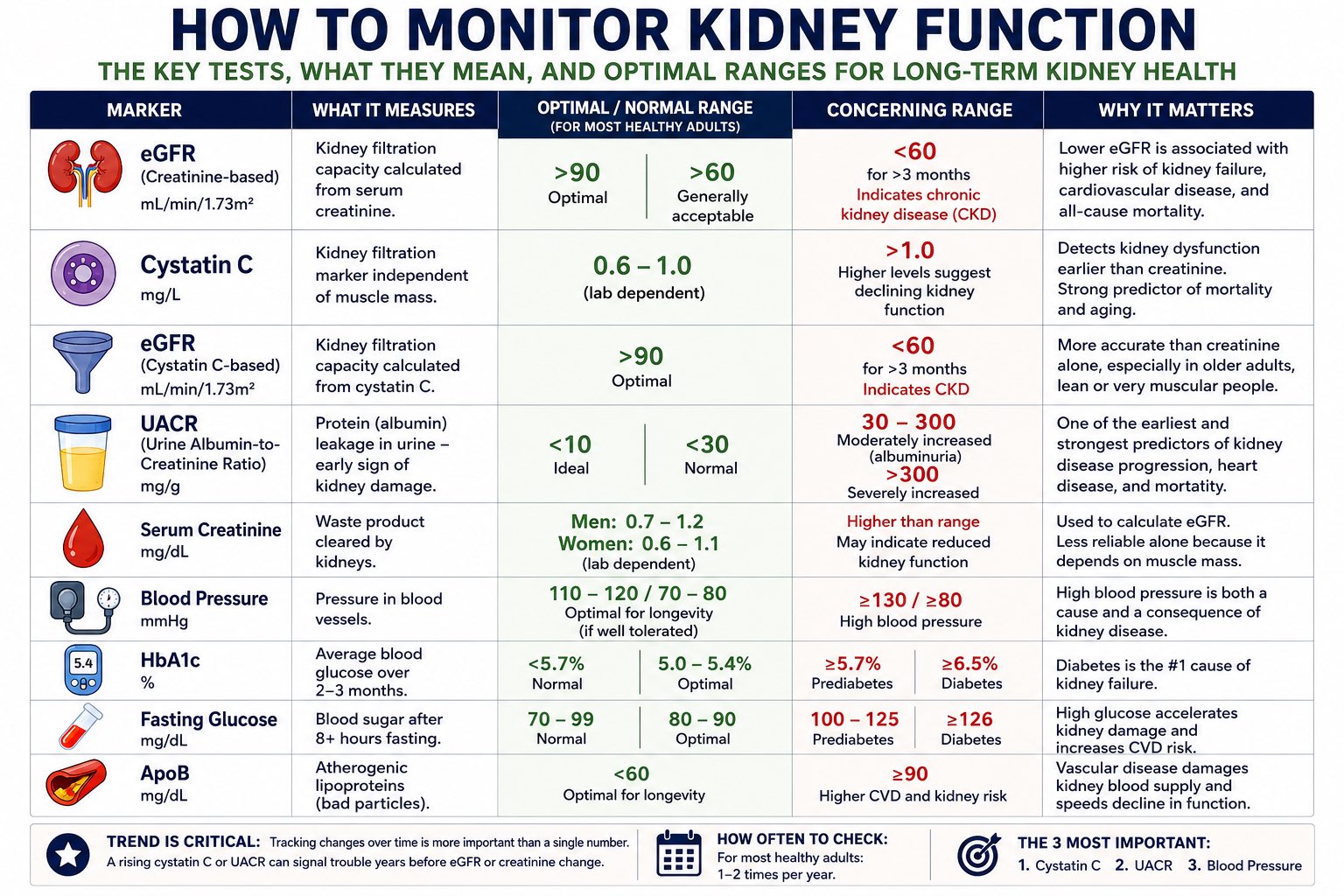
Source: https://x.com/JoinLifespan/status/2061067298715173338?s=20
1 Like
1 Like
Recently had blood tests, CMP, CBC all came in normal except for BUN/Creatinine Ratio of 8. Also, have been testing urine with test strips last couple days indicating a pH of 5.5-5.8 which has me concerned. I haven’t discussed the pH with MD yet but they weren’t concerned about the BUN ratio. Any thoughts?
What is your uric acid/urate measurement? Although 5.5 is in the “normal range” for pH I think there are issues with that, but I have ludicrously alkaline urine a lot of the time. When I woke up this morning I had a slight level of ketosis from fasting yesterday and a pH of 7.0, but I expect to hit 10 or at least 9 by about 10am today.
A very obvious effect of acidic urine is lower excretion of urate.