Study: Most NMN and Urolithin-A Supplements are Crap


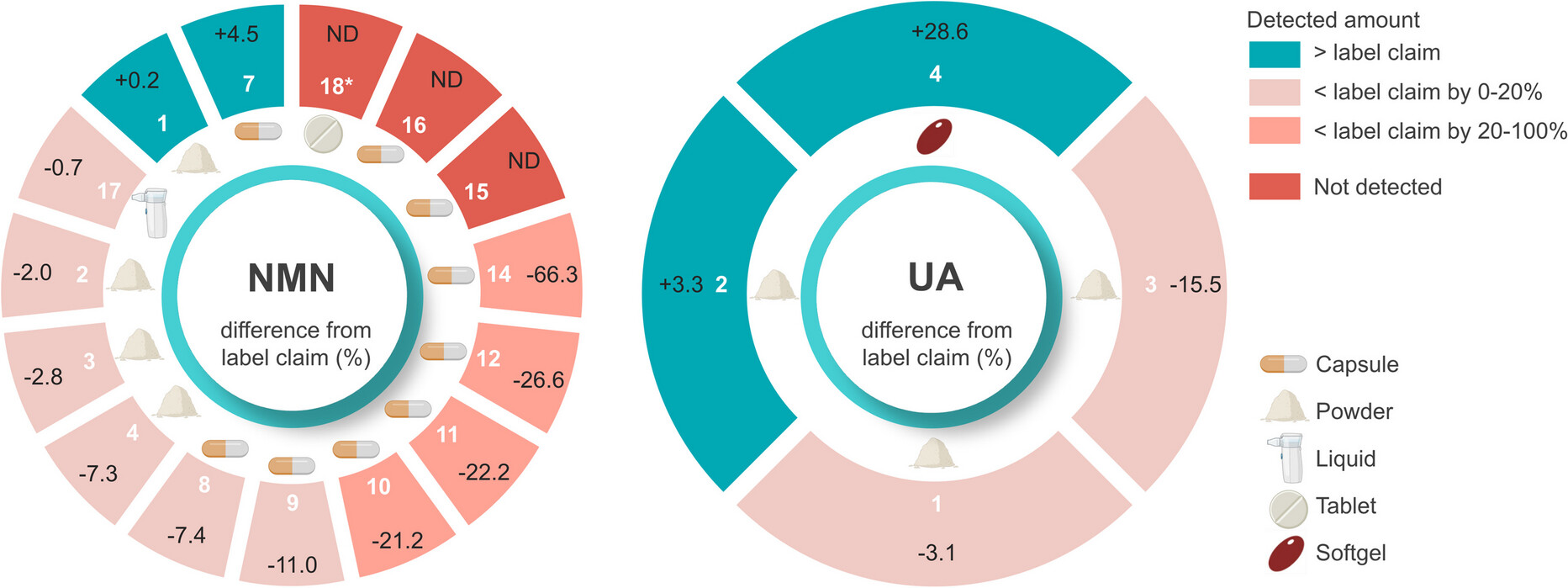
From Testing the amount of nicotinamide mononucleotide and urolithin A as compared to the label claim. The white numbers are the code numbers for the (unidentified) NMN and UA products purchased online and from pharmacies.


Half of the NMN You Buy Isn’t Really There: The Longevity Supplement Quality Scandal

Scientists at the National University of Singapore bought 18 nicotinamide mononucleotide (NMN) and 5 Urolithin A (UA) supplements from online stores, pharmacies, and manufacturers, then used a validated laboratory method (mass spectrometry) to measure the true active-ingredient content. The results were poor. Product content ranged from 28.6 percent more than the label claimed all the way down to nothing detectable at all (minus 100 percent). Most products contained less than advertised, and two NMN capsules and one UA product contained no measurable active ingredient despite what the label promised. The take-home is uncomfortable but simple. The geroprotective supplement market has a serious quality-control problem, and the number on the bottle is not a reliable guide to what you are actually swallowing.

The longevity field has spent a decade arguing about whether molecules like NMN and Urolithin A can slow aging. This study asks a more basic and more awkward question. Before we debate whether these compounds work, are consumers even getting the compounds at all?

The answer, disturbingly often, is no. A team led by Elena Sandalova and Andrea Maier at the National University of Singapore, alongside longevity researcher Brian Kennedy, assembled 23 real products, blinded and randomly coded them, and put each through high-performance liquid chromatography coupled to triple quadrupole mass spectrometry. This is the analytical gold standard, sensitive and specific enough to quantify tiny amounts of a molecule. The team also validated recovery, precision, accuracy, and matrix effects, so the finding cannot be waved away as a lab artifact.

Across the 18 NMN products, the measured content diverged wildly from the label. Some were close. Several were not. Two capsules contained no detectable NMN whatsoever. One so-called NMN powder held barely 13 percent of what it claimed. On average the NMN products fell short of their labels by roughly a quarter of the stated dose. The Urolithin A products were somewhat better but still inconsistent, with one softgel overshooting its label by nearly 30 percent and another running 15 percent short.

Why does this happen? The authors point to a regulatory vacuum. Under the US Dietary Supplement Health and Education Act, supplements are not tested for label accuracy before sale. Safety authorities check only for banned substances, not for whether the active ingredient is present in the promised amount. Some shortfalls likely reflect genuine chemical degradation over time, since NMN is unstable and hard to manufacture. Others suggest the ingredient was simply never added in full. A few products contained more than labeled, a practice called overage, where manufacturers deliberately overfill to survive shelf-life breakdown.

The bigger idea reaches beyond any single molecule. It exposes a structural weakness at the heart of the consumer longevity economy. Clinical trials that show a benefit almost always test a single, pure, correctly dosed compound. If the bottle in your cabinet does not match that dose, the trial evidence may not apply to you at all. The authors call for coordinated action between professional societies, industry, and regulators. Until that happens, the burden of verification falls on the buyer.

4 Likes

Yes. Most NMN supplements are crap. The only one I trust is NMN from DoNotAge. It has been tested and found to be the real deal.

1 Like

I wish I could trust DNA. They seem sincere, work with Dr. Gorbunova, and make certificates of analysis available — but there’s information missing on their labels (including manufacturing dates) and they’re not enrolled in any independent quality monitoring program like USP, NSF, or ISO.

4 Likes

Exactly! When it comes to supplements, stay with the ones that have in-house labs, and are tested by ConsumerLab.

1 Like

Well, then there’s the experiential aspect. When I take DNA NMN, I don’t get jetlagged when I travel. If I don’t take it, I waste 2 days in a jetlagged stupor. It’s probably the real deal.

1 Like

I wish the study “named and shamed” the ignoble suppliers of poor product! I guess they didn’t want the threat of litigation.

The fraudulence of the NMN suppliers, 87.5% of the list, far outweighed that of the UA suppliers (50%). UA is “relatively” easy to produce so there’s little reason to cheat the buyer.

This study is interestingly timed. I have just completed my own test of one Urolithin A supplier discused in this thread. I’m not sure if Aeternum were tested in the UA group, but by deduction they could be No2 in the graphic above.

I also found a well researched and written UA review and it included both Aeternum and Mitopure in their recommended products.

I am currently in the 2nd month of a planned 3 month Rapa holiday so I took the opportunity to do the UA test. I’ve now taken two doses of Aeternum UA, one week apart. The recommended dose is 500-1000mg, I took 500mg on each occasion. The result: very promising, I am usually as regular as clockwork with my morning constitutional visit. The day following my UA doses I had immensely satisfying and extended purges. I think this was gut mitophagy stimulated by the Urolithin A. I had no other side effects or sleep loss.

I have had a similarly rewarding purge response from Rapa but this mostly happened when I began Rapa a few years ago, or occasionally after a decent break. I presume that there is more material for autophagy to act upon ie damaged and nonfunctional cell parts, badly folded proteins, pathogens like viruses and bacteria, etc.

@John_Hemming has also tried the Aeternum product and he reported a sense that it had worked for him.

The fast witted among you will recognise the irony of my “purging” from the last word of the title of this thread. Ha!

1 Like

How am I supposed to know what this is? Can you please translate it and let us know what/how you felt. Thanks,

Sorry @SNK I thought this would be apparent, it is commonly used English term used when referring to bowel movements.

1 Like

Most supplement companies do not make their own base compounds. That is a very expensive and difficult business to get into and requires a high level of investment in equipment, facilities and people to produce quality base compounds.

Because of that, 90% of supplement companies do not “make” what they sell. Mine included. When you see “manufactured by” on a supplement label, all that claim requires is to put the raw materials in a cap, pill or gummie, and package it to use the “manufactured by” label. Which we, and many others do.

If you see “manufactured for” as you will often see in brands like Kirkland (costco) it is done in a white label facility that may (highly unlikely) or may not (the norm) make the base compounds. They manufacture to a specification and source the raw materials from dozens of companies that actually make the base compounds.

Fortunately my suppliers of base compounds are all top tier and their materials have all tested good.

It took me a while to sort through the dross to find companies I could trust like Sabinsa, Hygeia, Jiaherb and a few others. These companies supply many brands you may be familiar with.

And the companies that do manufacture the base compounds certainly can vary in quality.

The supplement supply chain is a very sophisticated and often complex system, from farmers of raw materials, like bark, fruits, etc. then to brokers of the raw materials, to the processors of those raw materials into base compounds, to bulk suppliers to small supplement companies to contract manufacturers, eventually to a brand and off to the consumer.

1 Like

Here is one of the top NMN manufacturers, they supply many of the good brands you may be aware of :slight_smile:

Well, if you truly believe Aeternum is a reliable brand, it does look like you can get it as 15, 30 and 100 gram bulk powder off Amazon. 100 grams is $200. At 0.5 grams/day dosing, that’s only $1 per day and would last you ~200 days.

1 Like

I checked their site out. They supply the NMN bulk to DoNotAge.Org
Which is endorsed by many of the YouTube gurus

3 Likes

I thought amazon stopped selling it? Not seeing it anywhere on amazon? There is somethig called NMNH
but not NMN?
Please provide the link

I tried NMN from several suppliers. As far I could tell it did zilch for me,
no increased energy no obvious change in my blood markers.

I will give it a second try, but using NMNH, which is relatively new in animal and in vitro studies, it appears to be better than NMN. It certainly is cheaper, but the same problems apply to getting a brand that contains the dose on the label.

“Even at concentrations significantly lower than NMN, NMNH demonstrated a nearly 10-fold increase in cellular NAD+ levels, showcasing its remarkable efficacy.”

"Based on the available research, NMNH appears to be a more potent and effective NAD+ enhancer compared to NMN.

"Key Findings
Cellular NAD+ Levels

In vitro studies have shown that NMNH treatment (100 μM) increased cellular NAD+ levels by 5-7 folds in HepG2 cells, while the same concentration of NMN only slightly increased NAD+ levels.

Even at concentrations significantly lower than NMN, NMNH demonstrated a nearly 10-fold increase in cellular NAD+ levels, showcasing its remarkable efficacy.

Enzymatic Pathways

NMNH is the reduced form of NMN, and it appears to be more efficiently converted to NAD+ by the enzyme nicotinamide mononucleotide adenylyltransferase (NMNAT).

Stability

NMNH is more stable than NMN under alkaline pH and low-temperature conditions.

However, NMNH is less stable than NMN at neutral pH in solution, with a half-life of approximately 2.4 days at room temperature and pH 7.0.

“NMNH increased the reduced NAD (NADH) levels in cells and in mouse livers. Metabolomic analysis revealed that NMNH inhibited glycolysis and the TCA cycle. In vitro experiments demonstrated that NMNH induced cell cycle arrest and suppressed cell growth.”

“Together, our data highlight NMNH as a new NAD+ precursor with therapeutic potential for acute kidney injury, confirm the existence of a novel pathway for the recycling of reduced NAD+ precursors and establish NMNH as a member of the new family of reduced NAD+ precursors.”

3 Likes

Sorry but I was looking at the bulk Urolithin-A powder by Aeternum on Amazon, not NMN.

ah, got it. thanks,…

I do think they are a reliable brand.

I agree @desertshores although given the news that most NMN supplements don’t deliver the NMN as described, it’s hard be sure! I’ve discontinued all interest in NMN until there’s better supporting science that supplementation works.

1 Like

Thanks, great info and good to know.

For what it’s worth, I’ve used MNM from Do Not Age for some time. I took their NAD blood test recently and scored 110 ug/gHb which is in the middle of their range (62 - 160 ug/gHb). I do know that my NAD levels have gone up as a result of supplementation.

I’ve switched recently to NR from Do Not Age and am planning on taking another NAD test to see if the NR works as well for me.

I haven’t been following the studies closely, but I gather that even if the NAD levels in the blood are acceptable / high, that does not necessarily mean that it’s in the tissue and / or impacting longevity. So it feels like a “soft call” as they say.

1 Like