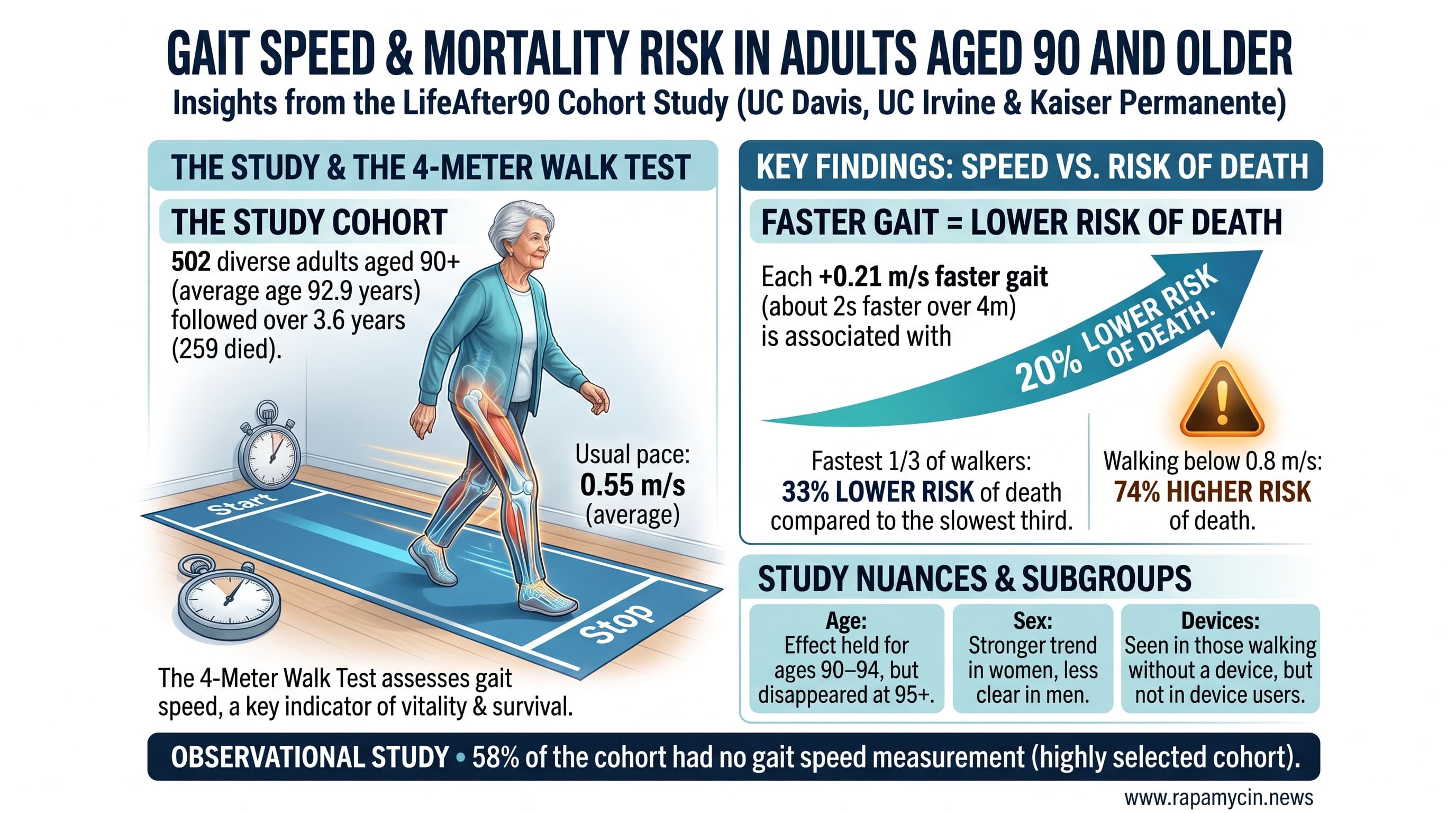
Researchers at UC Davis, UC Irvine and Kaiser Permanente studied 502 adults aged 90 and older in LifeAfter90, a racially and ethnically diverse cohort of Kaiser Permanente Northern California members. Participants averaged 92.9 years and walked at a usual pace of 0.55 m/s on a 4-meter walk test. Over an average of 3.6 years, 259 died. After adjustment for age, sex, race and ethnicity, and education, each 0.21 m/s faster gait speed (about 2 seconds faster over 4 meters) was associated with 20% lower risk of death. The fastest third of walkers had 33% lower risk than the slowest third, and walking below 0.8 m/s carried about 74% higher risk. The association held for those aged 90 to 94 but disappeared at 95 and older. It also appeared in women but not clearly in men, and in people walking without a device but not in device users, though formal tests found no differences by sex, race and ethnicity, or device use.
Gait speed is sometimes called the sixth vital sign. Large studies of older adults show that how fast someone walks at a comfortable pace predicts disability, dementia and death about as well as complicated risk models. Most of that evidence, though, comes from people in their 60s, 70s and 80s, mostly white. Adults over 90, the fastest-growing age group in many countries, are rarely studied.
This brief report from the LifeAfter90 study, based in the San Francisco Bay Area and Sacramento, helps fill that gap. Researchers visit participants at home every six months. Some 64% of the analyzed participants were non-white, including large Asian, Black and Latinx groups, a rare level of diversity for the oldest-old.
Participants walked 4 meters at their usual pace twice, using a cane or walker if they needed to. Their average speed was 0.55 meters per second, about 7 seconds for the 4 meters. Men walked slightly faster than women. Two in five used a walking aid.
Over roughly 3.6 years, just over half the participants died, an annual mortality rate of about 14%. Faster walkers clearly fared better. Each step up of about two seconds on the 4-meter walk went with 20% lower risk of death. Those in the fastest third lived noticeably longer, with survival curves separating within the first two years. People walking slower than 0.8 m/s, a common clinical threshold, had about 74% higher risk than faster walkers.
The pattern was not uniform. Among people aged 90 to 94, faster walking was linked to 30% lower risk per two-second improvement. Among those aged 95 and older, the association vanished. At that extreme age, the authors suggest, death may depend more on acute events than on physical reserve, or the survivors may already be a uniquely hardy group. The association was evident in women and in people walking without a device, but not clearly in men or device users. Statistical tests did not confirm these as true differences.
The study’s most important weakness is who was measured. Of 1,364 participants, 790 had no gait speed recorded, mostly because the test was skipped to reduce visit length and fatigue. Another 72 were excluded because they couldn’t or didn’t attempt the walk, or needed physical help. The analysis therefore represents a somewhat healthier subset. The researchers also adjusted only for demographic factors, not for disease, so gait speed may partly stand in for heart failure, lung disease or cognitive decline.
The practical message is straightforward. A quick, cheap walk test remains informative into the tenth decade of life, at least until about 95, and could help clinicians identify the oldest patients who need closer attention.
Actionable Insights
- Time your 4-meter walk at a comfortable pace. Below 0.8 m/s (more than 5 seconds for 4 meters) was associated with about 1.7 times the mortality risk in this 90+ group (HR 1.74).
- Small differences matter. About 2 seconds faster on the 4-meter walk (0.21 m/s) corresponded to 20% lower death risk. That is consistent with large studies showing about 12% lower risk per 0.1 m/s in younger older adults.
- In absolute terms, by my reading of the survival curves, about 30% of the slowest third died within 2 years versus roughly 10% of the fastest third. That is a large absolute gap in a high-risk group. [Confidence: Low to Medium]
- Gait speed reflects reserve. Whether improving it extends life is unproven. Resistance and balance training reliably improve strength in very old adults, as Fiatarone’s nonagenarian study showed, but typically raise gait speed only modestly (about 0.05 to 0.1 m/s).
- After 95, walking speed was not predictive here, so don’t over-interpret it at that age.
Context and Source
- Paywalled Paper: Gait Speed and Survival in Those With Exceptional Longevity: The LifeAfter90 Study
- Institutions: University of California, Davis; University of California, Irvine; Kaiser Permanente Northern California (Pleasanton)
- Country: United States
- Journal: Journal of the American Geriatrics Society
- Impact evaluation: The impact score of this journal is approximately 6.3, evaluated against a typical high-end range of 0 to 60+ for top general science and medicine, therefore this is a Medium impact journal. It is the leading specialty journal in clinical geriatrics.