Stiff Arteries Softened: Pulse Wave Velocity Falls 13 Percent With a Daily Longevity Supplement Blend

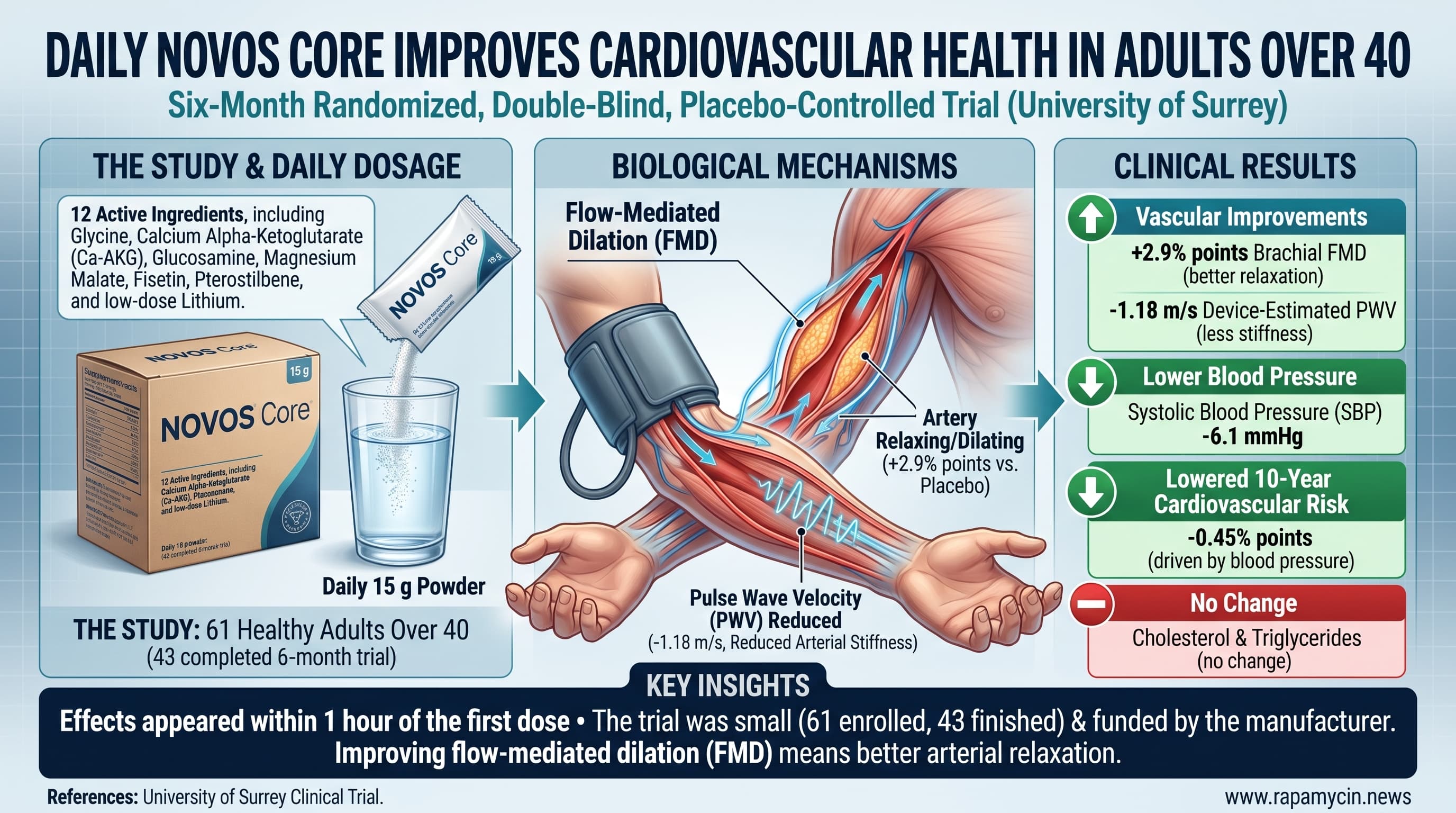
A six-month randomized, double-blind trial from the University of Surrey tested NOVOS Core, a daily 15 g powder combining twelve ingredients including glycine, calcium alpha-ketoglutarate, glucosamine, magnesium malate, fisetin, pterostilbene and low-dose lithium, in 61 healthy adults over 40. Among the 43 who finished, the supplement raised brachial flow-mediated dilation, a measure of how well arteries relax, by 2.9 percentage points more than placebo. It also reduced device-estimated pulse wave velocity by 1.18 m/s and lowered systolic blood pressure by 6.1 mmHg. Cholesterol and triglycerides did not change. Modeled 10-year cardiovascular risk fell by 0.45 percentage points, driven almost entirely by blood pressure. Effects appeared within one hour of the first dose. The trial was small, funded by the manufacturer, lost 30% of participants, and cannot say which ingredients matter.

Arteries age before people notice. Long before a heart attack or stroke, the inner lining of blood vessels loses its ability to release nitric oxide and relax, the aorta stiffens, and systolic blood pressure creeps upward. These three changes form the core of what cardiologists call vascular aging, and each predicts future cardiovascular events independently.

A team led by vascular physiologist Christian Heiss at the University of Surrey asked whether a supplement built on geroscience principles could push these markers in the right direction. The product, NOVOS Core, mixes twelve compounds that have each shown some anti-aging promise in worms, flies, mice or small human studies. The list reads like a longevity forum shopping cart: glycine, alpha-ketoglutarate, glucosamine, fisetin, pterostilbene, magnesium, vitamin C, L-theanine, Rhodiola, ginger, hyaluronic acid and a microdose of lithium.

Sixty-one healthy, non-smoking volunteers aged over 40 were randomly assigned to the powder or a taste-matched placebo for six months. The main measure was flow-mediated dilation, an ultrasound test that tracks how much the brachial artery widens after a cuff is released. Heiss’s lab is among the most experienced in the world at this test.

The results were significant. In people taking the supplement, artery dilation rose from about 5.5% to 8.1%, while the placebo group stayed flat. Systolic blood pressure dropped about 6 mmHg more than with placebo, roughly what a standard dose of a single blood pressure drug achieves. A device-based estimate of arterial stiffness also improved. Cholesterol did not budge.

Perhaps the most telling detail is timing. Artery function jumped within an hour of the very first dose, by an amount slightly larger than the six-month effect. That pattern suggests the product works mainly through a fast-acting effect on blood vessel tone that is renewed with each daily dose, rather than by slowly rebuilding aged arteries. The six-month measurements were taken about 24 hours after the last serving, so the study cannot tell lasting repair apart from lingering pharmacology.

There are good reasons for caution. Only 43 people completed the trial. The placebo group started out about five years older. The manufacturer funded the work, and one of its employees is a co-author. The effect on artery dilation is two to three times larger than what is typically seen with well-studied foods like cocoa flavanols or beetroot nitrate, and small trials with surprisingly large effects often shrink when repeated. The stiffness measure came from a cuff device that agrees poorly with the gold-standard method.

Still, the trial was properly randomized and blinded, the primary outcome was declared in advance, and the measurements came from a lab with a strong track record. If the blood pressure effect held up over years, large drug trials suggest it would cut heart attacks and strokes by around a tenth.

The next step is clear: a larger, independent trial with ambulatory blood pressure, gold-standard stiffness measurements and an attempt to identify which of the twelve ingredients is doing the work.

Actionable insights

For adults over 40 with normal to high-normal blood pressure, this trial suggests a specific daily blend may improve how arteries relax and modestly lower systolic pressure. The artery relaxation test improved by 2.9 points from a starting average of 5.5, about a 50% relative gain. In standardized terms that is a Cohen’s d of roughly 1.6, where anything above 0.8 counts as large. Treat that number with suspicion, since effects this big in small trials usually shrink on replication.

Systolic pressure fell about 6 mmHg more than placebo (d about 0.7, medium to large). Large drug-trial meta-analyses link each 5 mmHg drop to about 10% fewer heart attacks and strokes, so if sustained for years this could mean roughly 12% lower relative risk. In absolute terms, for a typical participant with 3% ten-year risk, that is about one event prevented per 220 to 280 people over a decade.

Practical steps: if you try this or any vascular supplement, take home blood pressure readings for two weeks before and after 8 to 12 weeks of use, since your own response is the most useful data you will get. Do not substitute it for prescribed medication. Expect no cholesterol benefit. Single ingredients with independent replication, such as magnesium, dietary nitrate and cocoa flavanols, remain reasonable lower-cost alternatives.

Context and source

  • Open Access Paper: Acute and 6-month vascular effects of a multi-component nutritional supplement: a randomized controlled trial
  • Institution: Faculty of Health and Medical Sciences, University of Surrey, Guildford, with Royal Surrey NHS Foundation Trust and Surrey and Sussex Healthcare NHS Trust; one co-author from NOVOS Labs, New York
  • Country: United Kingdom
  • Journal: European Heart Journal Open (European Society of Cardiology, Oxford University Press)
  • Funding: NOVOS Labs supplied product and placebo and made an unrestricted research contribution
  • Impact evaluation: The impact score of this journal is 4.3 (Clarivate JIF 2025), evaluated against a typical high-end range of 0 to 45+ for top cardiology journals (the flagship European Heart Journal sits near 45), therefore this is a Medium impact journal.
2 Likes

The 12 active ingredients

NOVOS Core has 12 active ingredients. The doses below are per daily serving, taken from Table 1 of the STAMINA trial paper (one 15 g scoop per day).

# Ingredient Dose per serving Notes
1 Glycine 2,000 mg Largest single active by mass
2 Magnesium malate about 2,004 mg total Gives 304 mg elemental magnesium plus 1,700 mg malate
3 Calcium alpha-ketoglutarate (Ca-AKG) 1,100 mg Gives 231 mg elemental calcium; the AKG portion is the rest
4 Glucosamine sulfate (GreenGrown, vegan) 1,000 mg Non-shellfish source
5 Rhodiola rosea root extract 300 mg Standardized to 3% rosavins and 1% salidroside (about 9 mg rosavins, 3 mg salidroside)
6 L-Theanine 150 mg
7 Vitamin C (ascorbic acid) 100 mg
8 Hyaluronic acid 100 mg
9 Fisetin 100 mg
10 Organic ginger root extract 100 mg Standardized to 2% gingerols (about 2 mg gingerols)
11 Pterostilbene 50 mg
12 Lithium aspartate 20 mg Gives 1 mg elemental lithium

Other (inactive) ingredients: erythritol, malic acid, natural flavors, sodium bicarbonate, silicon dioxide, calcium silicate, and stevia. The placebo in the trial contained these same excipients.

A few practical notes:

  • The actives add up to roughly 7 g per serving. In the trial’s 15 g scoop, about 8 g was excipients. The label lists erythritol first among them, so it is probably the largest share, but the exact amount is not disclosed.
  • The retail product appears to be sold in pre-measured packets rather than the tub used in the trial. Current retail labels show a 1-packet (13 g) serving for the orange flavor, with 100 mg vitamin C and 305 mg magnesium (as magnesium malate), and 8 g packets for the unflavored version. The actives look essentially the same as in the trial. The difference in serving weight most likely comes from flavoring and sweetener. I only confirmed vitamin C and magnesium on a current label, so check the box before assuming every dose matches the trial exactly.
  • Stevia is not in every flavor. NOVOS notes that stevia is only in the Orange and Tropical Passion versions, not in Unflavored.

Sources:

Follow-on Prompt:

Which of these supplements have the best scientific and clinical evidence of the vascular benefits identified in this study?

Claude Opus 5.5 Response:

The short answer: only magnesium has meaningful human trial evidence for these vascular effects at roughly the dose in NOVOS Core. Several other ingredients have real evidence, but at doses 3 to 30 times higher than what the product contains. Most of the rest have little or no human vascular data.

Evidence ranking, adjusted for the dose actually in NOVOS Core

Rank Ingredient (dose in Core) Best human evidence for FMD, PWV or BP Dose match Verdict
1 Magnesium (304 mg) Meta-analyses of RCTs for BP; mixed RCTs for PWV and FMD Good Strongest, but effects are small
2 Vitamin C (100 mg) Meta-analysis of 44 RCTs on endothelial function Poor (needs over 500 mg) Real effect at higher doses, likely inactive here
3 Ginger extract (100 mg, 2 mg gingerols) Meta-analysis of 6 RCTs on BP Very poor (needs about 3 g) Likely inactive here
4 Pterostilbene (50 mg) One RCT on BP Poor (effect at 250 mg) Weak evidence, likely inactive here
5 Fisetin (100 mg daily) Strong mouse vascular data, no published human vascular RCT Wrong regimen Promising mechanism, wrong dosing pattern
6 Glucosamine (1,000 mg) Large observational cohort only Plausible Interesting signal, no causal evidence
7 Glycine, Ca-AKG, L-theanine, Rhodiola, hyaluronic acid, lithium Little or no human vascular RCT evidence that I’m aware of n/a Rationale is preclinical or about other aging outcomes

Ingredient details

Magnesium. This is the best-supported ingredient. A meta-analysis of 34 double-blind RCTs (2,028 participants) found that a median 368 mg/day for about 3 months reduced systolic BP by 2.00 mmHg and diastolic by 1.78 mmHg. The analysis also suggested 300 mg/day for one month is enough to raise serum magnesium and lower BP, which closely matches the 304 mg in Core. The benefit may be confined to people who are magnesium-deficient or insufficient.

For arterial stiffness, the picture is mixed. In one 24-week trial, 350 mg/day improved carotid-femoral PWV by 1.0 m/s versus placebo in overweight adults, with no change in office or ambulatory BP. A larger follow-up trial from the same research network gave 450 mg/day of three different magnesium forms to 164 people and found no effect on PWV or BP.

For FMD, a meta-analysis found no significant overall effect (mean difference 2.13 points, CI crossing zero). In subgroups, magnesium did improve FMD in trials longer than 6 months, in unhealthy participants, in people over 50, and in those with BMI 25 or higher. A separate 24-week RCT of 350 mg/day found no FMD change. [Confidence: High that magnesium modestly lowers BP. Low that it explains the FMD result.]

Vitamin C. A meta-analysis of 44 trials found a moderate improvement in endothelial function overall (standardized effect 0.50), with a dose-response relationship. However, 90 to 500 mg/day did not affect endothelial function; only doses above 500 mg did. The benefit was seen in people with diabetes, atherosclerosis and heart failure, not in healthy people or those with hypertension. At 100 mg, given to healthy adults, vitamin C is unlikely to contribute. [Confidence: Medium-High]

Ginger. A meta-analysis of 6 RCTs (345 participants) found systolic BP fell by 6.36 mmHg and diastolic by 2.12 mmHg, but heterogeneity was very high. The benefit was concentrated in trials using 3 g/day or more for 8 weeks or less. Core contains 100 mg of extract standardized to 2% gingerols. Even accounting for concentration, that is far below the effective trial doses. [Confidence: Medium that it is inactive at this dose]

Pterostilbene. The main human trial randomized 80 adults with high cholesterol. Only 250 mg/day significantly lowered BP (7.8 systolic, 7.3 diastolic mmHg). The lower 100 mg/day dose lowered systolic BP only when combined with grape extract. The trial also found LDL rose by about 25 mg/dL with pterostilbene, less so in people on statins. Core contains 50 mg/day, half the dose that did not work on its own. Notably, the STAMINA trial showed a non-significant LDL rise of about 7 mg/dL. [Confidence: Medium that 50 mg contributes little to BP]

Fisetin. This has the most elegant vascular mechanism data of any ingredient, but all of it comes from animals. In old mice, intermittent fisetin dosing reduced vascular senescence, improved endothelial function by increasing NO and lowering oxidative stress, and reduced arterial stiffness. Genetic senolysis experiments confirmed the benefit came from clearing senescent cells. The mouse regimen was 100 mg/kg/day in an intermittent pattern. Core gives 100 mg daily and continuously, roughly one-sixth of the human-equivalent dose, and not in pulses. So it is not testing the senolytic hypothesis. Also, a senolytic effect would not produce the 1-hour FMD jump seen in STAMINA. [Confidence: High that the animal data do not translate to this regimen]

Glucosamine. In UK Biobank (about 466,000 people), habitual glucosamine use was linked to 15% lower total CVD events and 9% to 22% lower risk of individual events. But the dataset had no information on dose or duration, and glucosamine use may simply mark a healthier lifestyle. There are no randomized vascular trials that I’m aware of. [Confidence: Low for causality]

Glycine, Ca-AKG, L-theanine, Rhodiola, hyaluronic acid, lithium. Their inclusion rests mostly on lifespan studies in worms, flies or mice, or on non-vascular outcomes such as skin, sleep or stress. I’m not aware of any human RCTs showing these compounds improve FMD, PWV or office BP at these doses. L-theanine has small studies on BP during acute stress, which is plausible for an acute effect but thin. [Confidence: Medium that no meaningful human vascular evidence exists, although small studies may have escaped my search]

What this means for the STAMINA result

If you add up the ingredient-level evidence at the doses actually in Core, you would predict roughly a 2 mmHg drop in systolic BP (mostly from magnesium) and little or no FMD change in healthy adults. The trial reported 6.1 mmHg and a 2.9-point rise in FMD, with most of the FMD gain appearing within an hour.

There are three possible explanations:

  1. Genuine synergy between ingredients.
  2. An acute vasoactive effect from an ingredient whose effect isn’t well characterized at these doses.
  3. Overestimation from a small sample, as noted in the critique.

Without a factorial or component-removal trial, there is no way to tell which. From a Bayesian standpoint, the third explanation should carry substantial weight. [Confidence: Medium]

If your goal is vascular benefit specifically, the evidence-backed single-ingredient options are magnesium (about 300 to 400 mg/day, particularly if your intake is low), vitamin C only at 500 mg or more if you have cardiometabolic risk, and cocoa flavanols or dietary nitrate. Of those, only magnesium is in Core at an effective dose.

Sources:

2 Likes

I take all of these supplements except Pterostilbene - none of it has moved the needle on pwv. The one supplement that did was niacin at 2 gms dropped it 14% but i broke out in hives so i had to stop it. niacinamide has had a minor small decrease 5%

1 Like

I dont think malate is “inactive”

Lately, I’ve observed consistent transient reduction in pwv by using growth hormone releasing hormone. Never fails to come down when I increase my dose, usually the first 2 weeks.

What seems to have kept my pwv unchanged and well under 6m/s for the last 3 years seems to be cardio and weight lifting. For my age group, a typical pwv range is 6. 6 to 7m/s.The addition of a GLP1 and SGLT-2 inhibitor in the last year or so can’t hurt either.

1 Like