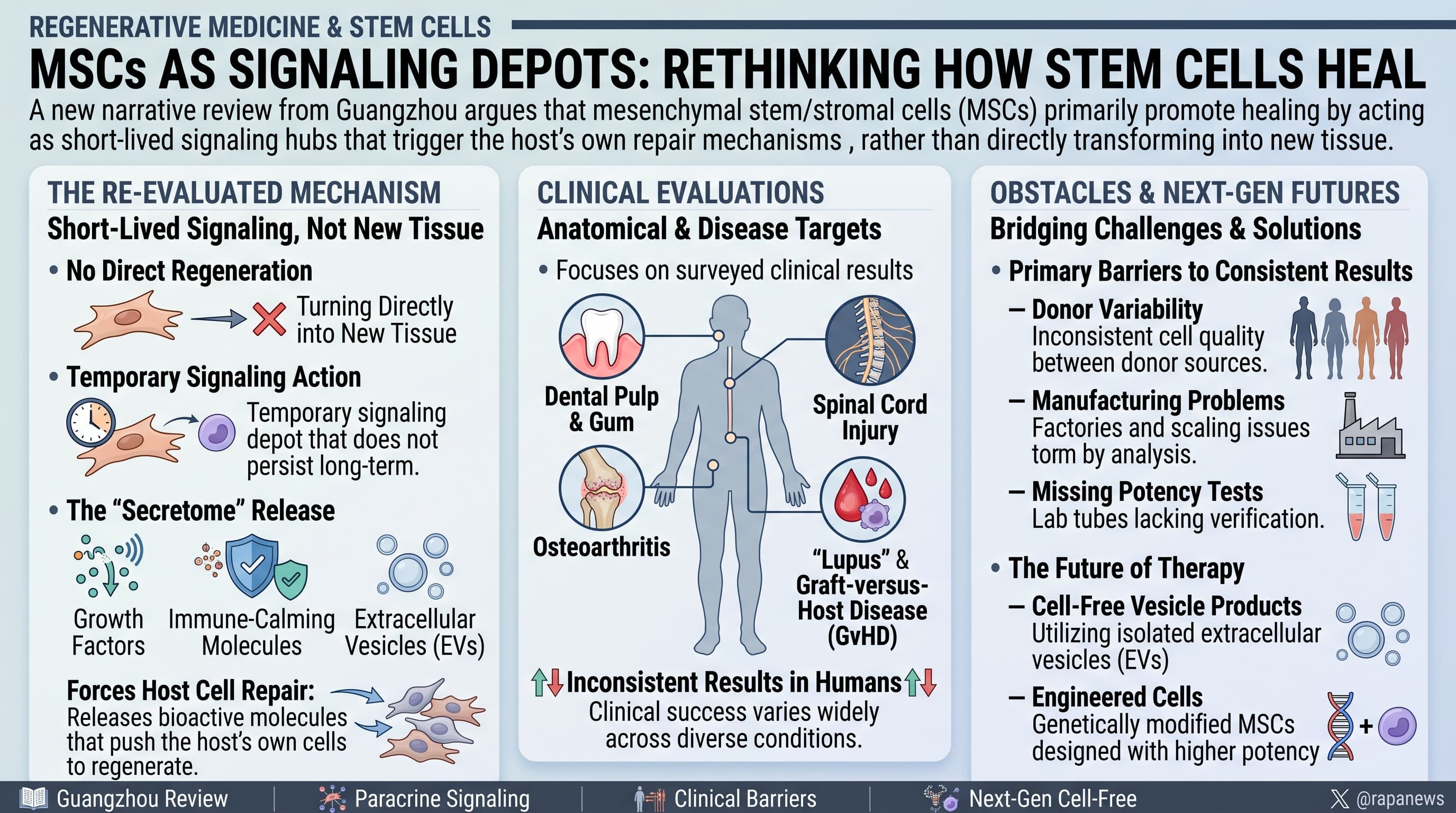
This narrative review from Guangzhou argues that mesenchymal stem/stromal cells (MSCs) do not heal mainly by turning into new tissue. Instead, they act as short-lived signaling depots, releasing growth factors, immune-calming molecules and extracellular vesicles (EVs) that push the host’s own cells to repair. The authors survey clinical results in dental pulp and gum regeneration, osteoarthritis, spinal cord injury, lupus and graft-versus-host disease (GvHD). They conclude that inconsistent human results stem from donor variability, manufacturing problems and missing potency tests, and that the future lies in cell-free vesicle products and engineered cells.
For thirty years, the pitch for mesenchymal stem cells was simple: inject them, they travel to the damage, and they become the bone, cartilage or nerve you lost. A new review in Science Bulletin says that picture is largely wrong, and that the field has known it for some time.
The authors, a dental stem cell group at Sun Yat-sen University, describe a different mechanism. Injected MSCs mostly die. The review puts their working life in the body at under six hours and notes that transplanted cells undergo extensive apoptosis soon after delivery. What they leave behind is a burst of signals: proteins that grow blood vessels, molecules that quiet inflammation, and tiny membrane packets called extracellular vesicles that carry RNA and proteins into neighboring cells. On this view, the cell is a delivery vehicle and the cargo does the work.
That reframing explains a long-standing puzzle. MSC therapies look impressive in young, healthy lab animals with surgically created injuries, then deliver patchy results in older humans with chronic disease. If the benefit depends on how host tissue responds to a signal, the state of the host matters enormously. The review offers one telling example: tooth pulp regeneration with stem cells from baby teeth worked better in adolescents than in adults.
The clinical tour is sobering once the adjectives are removed. The strongest evidence is in GvHD, a dangerous complication of bone marrow transplants, where MSC products have regulatory approval in several countries. Even there, the headline result cited (an 82% response rate in 92 patients) came from a study with no control group, and a separate trial reported responses in only 36% of patients. In lupus, the foundational study had four patients. In spinal cord injury, the best figures come from uncontrolled case series. For osteoarthritis, the vesicle approach rests on one treated volunteer.
The dental work is the most concrete. Small randomized trials suggest that a patient’s own tooth-derived stem cells can regrow living pulp, with nerves and blood supply, inside a dead tooth, and can improve bone fill in gum disease. These are local, structural repairs that can be measured on a scan, which may be why they look cleaner than systemic uses.
Where does the field go next? The authors favor dropping the cell entirely and giving purified vesicles, including vesicles shed by dying cells, which they argue may be the true active ingredient. They also describe engineering tricks: starving cells of oxygen to change what they secrete, attaching targeting molecules so vesicles home to inflamed joints, and gene editing. One mouse study cut the required dose tenfold with a targeting tag.
The review is candid about what is missing: no agreed way to measure a product’s potency, large batch-to-batch differences, little long-term safety tracking, and few large blinded trials. Readers should treat this as a well-organized position paper from a group with a stake in vesicle and dental stem cell research, and not as a neutral verdict.
Insights
Practical points that do follow:
- Commercial “stem cell” infusions for general rejuvenation have no support here. The review’s own account is that injected cells are cleared within hours and that results vary widely between products and patients.
- Evidence strength is ranked by condition. GvHD has approved products. Dental pulp and periodontal repair have small randomized trials. Osteoarthritis, spinal cord injury and lupus rest mostly on small or uncontrolled studies.
- The size of the benefit is uncertain even in the best case. In GvHD, one uncontrolled study reported 82 of every 100 patients responding, while another trial reported 36 of every 100. That 46-point spread between studies is larger than most treatment effects in medicine, which tells you the product, patient mix and study design drive the number as much as the therapy does.
- Host age matters. Regeneration worked better in adolescents than adults, which is a caution for older users expecting results seen in young subjects or animals.
- Exosome and vesicle products remain experimental. Outside one GvHD case and one osteoarthritis case, the human evidence cited is essentially zero.
Context and Source
- Paywalled Paper: Mesenchymal stem/stromal cells and regenerative medicine, 10 September 2026.
- Institutions: Hospital of Stomatology, Guanghua School of Stomatology, Sun Yat-sen University; Stomatological Hospital, Southern Medical University; Key Laboratory of Stem Cells and Tissue Engineering, Ministry of Education
- Country: China (Guangzhou)
- Journal: Science Bulletin (Elsevier and Science China Press),
- Impact evaluation: The impact score of this journal is approximately 21 (2025 JIF, reported as 20.7 by one source and 21.1 by another), evaluated against a typical high-end range of 0 to 60+ for top general science, therefore this is a High impact journal.