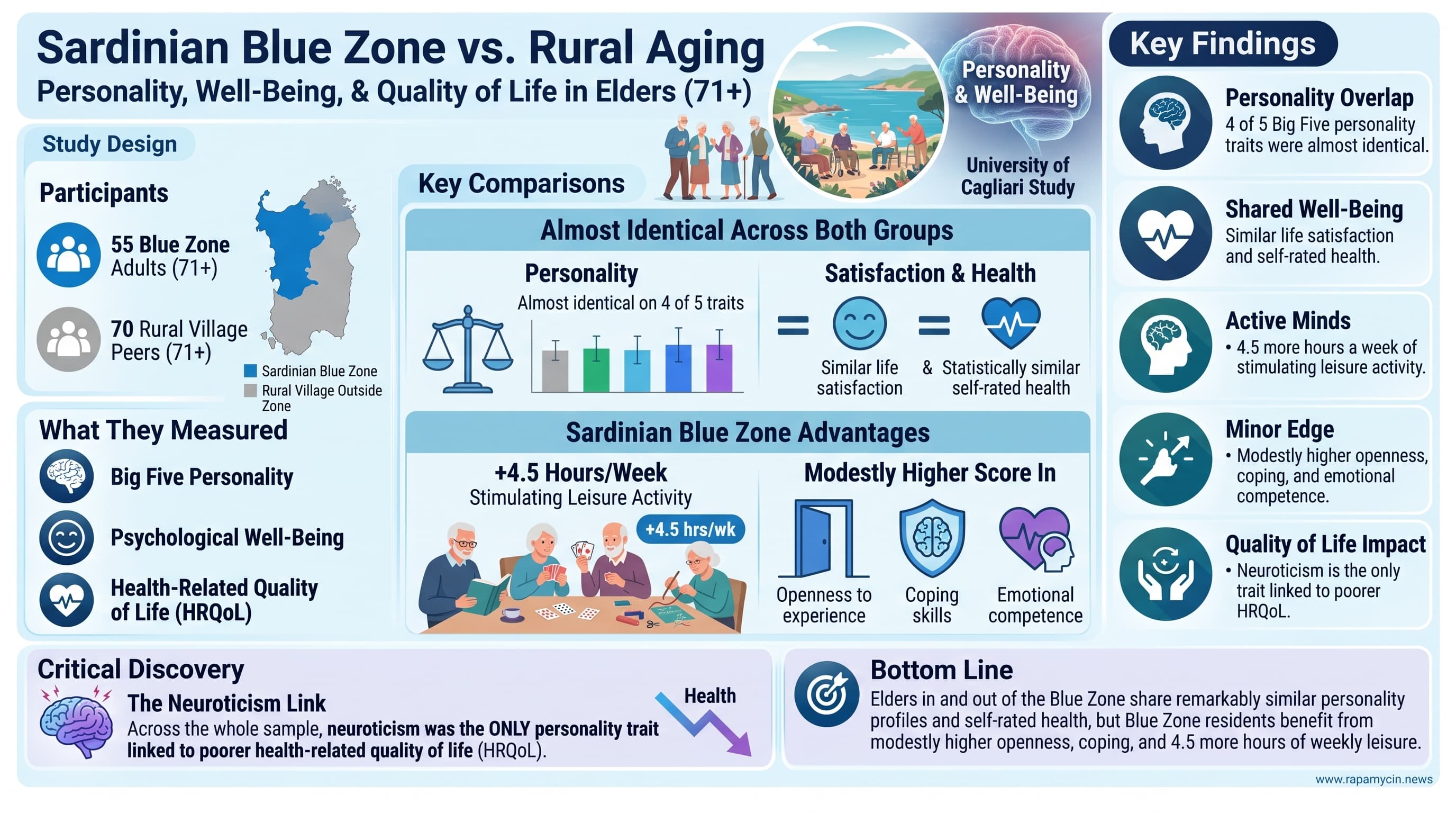
Researchers at the University of Cagliari compared 55 adults aged 71 and over from the Sardinian Blue Zone with 70 peers from a nearby rural village outside it. They measured Big Five personality traits, psychological well-being, and health-related quality of life (HRQoL). The two groups had almost identical personalities on four of the five traits, similar life satisfaction, and statistically similar self-rated health. Blue Zone residents scored modestly higher on openness to experience, coping skills, and emotional competence, and reported about 4.5 more hours a week of stimulating leisure activity. Across the whole sample, neuroticism was the only personality trait linked to poorer HRQoL.
Sardinia’s mountainous interior is one of the world’s best-documented longevity hotspots, a place where unusually many people, men especially, reach very old age. Researchers have long debated how much of that comes from genes, diet, hard physical work, or the tight social life of its villages. A new study from the University of Cagliari asks a narrower question: do the oldest residents of the Sardinian Blue Zone think and feel differently from their neighbors?
The team interviewed 125 people aged 71 to 101 in their homes. Fifty-five lived in the Blue Zone. Seventy lived in another rural Sardinian village outside it, with a similar farming and herding economy and the same free national health care. Each person completed a short Big Five personality test, a well-being questionnaire, and a standard quality-of-life survey covering mobility, self-care, daily activities, pain, and mood.
The main finding is mostly one of similarity. On four of the five personality traits (extraversion, agreeableness, conscientiousness, and neuroticism), the two groups were nearly identical. Blue Zone elders were no calmer, no more sociable, and no more disciplined. Their life satisfaction and overall well-being did not differ in a statistically meaningful way, and neither did their self-rated health.
They did stand apart in three areas: openness to new experiences, coping skills (how well people feel they solve everyday problems), and emotional competence (the ability to understand and share feelings). Each gap was modest, a small-to-medium effect. The largest practical difference was in how people spent their time. Blue Zone residents reported about 11 hours a week in stimulating hobbies, sports, or group activities, compared with under 7 hours in the comparison village.
Across the whole sample, personality tracked well-being in predictable ways. People higher in conscientiousness and openness reported better well-being and coping, and more open people spent more time on hobbies. Neuroticism, the tendency toward worry and negative emotion, was the only trait linked to poorer self-rated health. It accounted for about 12 percent of the variation in that score. Better coping was also tied to better health ratings.
The authors read this as support for long-standing ideas in aging research: staying active and engaged, and adapting your goals to your remaining abilities, helps protect well-being late in life. That interpretation is reasonable but not established here. The study took a single snapshot. It cannot say whether curiosity and coping lead to an active life, whether an active and healthy life breeds curiosity and confidence, or whether both simply reflect better health and more schooling. Blue Zone participants had more years of education, scored higher on a cognitive screening test, and were more often women. Any of these could shape the results.
No lifespan, mortality, or biological data were collected, so the study does not show that any of these traits help anyone live longer. What it offers is a modest, well-described psychological portrait of a famous longevity population. It also suggests that if the Blue Zone advantage has a psychological component, that component may lie less in temperament than in habits of engagement and coping that can, in principle, be learned.
Actionable Insights
These are associations from a small snapshot study, not proven causes. Treat them as low-cost, low-risk habits that fit the data.
- Protect a weekly block of engaging, social activity. Blue Zone elders logged 11.3 hours a week versus 6.8, which is 4.5 extra hours, or about 66 percent more. The statistical effect is small to medium (Cohen’s d about 0.44). In plain terms, a randomly chosen Blue Zone resident out-hobbied a randomly chosen neighbor about 62 percent of the time, against 50 percent by chance.
- Treat coping as a trainable skill. Coping scores were about 9 percent higher in the Blue Zone (d about 0.45). Across everyone, coping accounted for about 5 percent of the differences in self-rated health. Structured problem-solving and cognitive behavioral approaches target exactly this.
- Take chronic worry seriously. Neuroticism was the strongest single predictor of poorer quality of life, explaining about 12 percent of its variation. Personality is not fixed: therapy produces modest, measurable shifts, with the largest changes in emotional stability.
- Feed curiosity. Openness was about 15 percent higher in the Blue Zone (d about 0.44), and more open people spent more time on hobbies and coped better.
Overall magnitude: small-to-medium effects that are real but leave most of the variation in well-being unexplained.
Context and Source
- Open Access Paper: Health Related Quality of Life and Personality Characteristics for Aging Well: Evidence from the Sardinian Blue Zone
- Institution: Department of Pedagogy, Psychology, Philosophy, University of Cagliari
- Country: Italy
- Journal: International Journal of Applied Positive Psychology (Springer Nature)