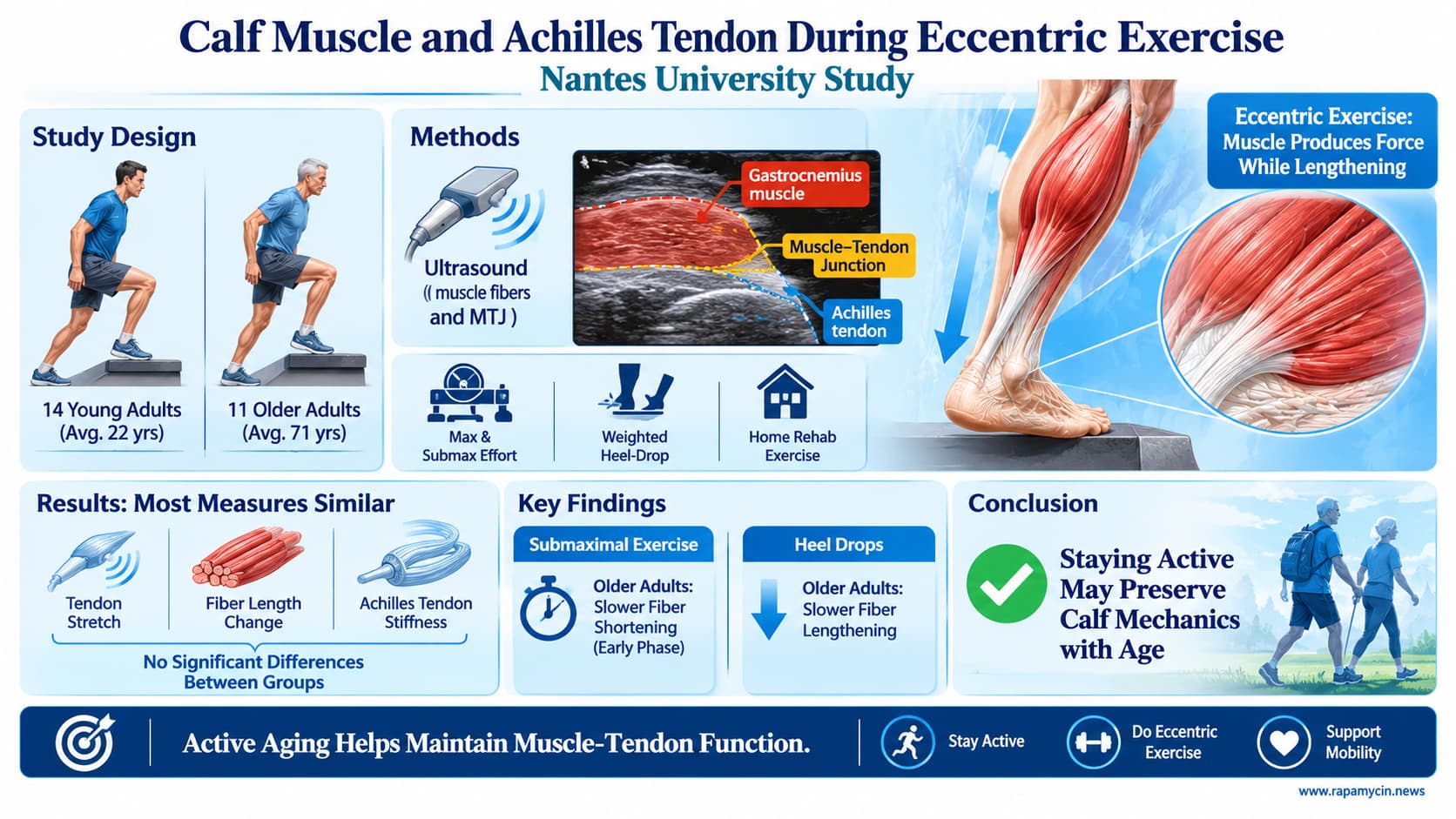
Researchers at Nantes University in France compared how the calf muscle and Achilles tendon behave during eccentric exercise, where a muscle produces force while it lengthens, in 14 young adults (average age 22) and 11 physically active older adults (average age 71). Using ultrasound, they tracked the gastrocnemius muscle fibers and the point where muscle meets tendon. Participants exercised on a dynamometer at maximal and submaximal effort, then did a weighted heel-drop, a common home rehab exercise. For most measures, including tendon stretch, fiber length change and Achilles tendon stiffness, the two groups showed no statistically significant differences. Older adults did show slower fiber shortening early in the submaximal exercise and slower fiber lengthening during heel drops. The authors suggest staying active may preserve calf mechanics with age.
Eccentric exercise is a staple of rehabilitation for older adults. In movements like lowering yourself slowly from tiptoe, muscles produce high force for relatively little effort and energy cost. Heel drops in particular are widely prescribed to strengthen the calf muscles, which matter a great deal for balance, walking and avoiding falls. Yet surprisingly little is known about how an aging calf muscle and Achilles tendon share the work during these exercises.
This study set out to fill that gap. The researchers recruited young and older volunteers who scored as physically active on a standard questionnaire, aiming to isolate the effect of age itself rather than the effect of inactivity. The older participants were screened as non-frail or pre-frail.
Using two ultrasound probes, the team watched the gastrocnemius muscle fibers lengthen and shorten while also tracking how far the Achilles tendon stretched. Participants performed eccentric calf exercises on a motorized dynamometer, once at maximal effort and once at a guided 30 percent of maximal muscle activation. They then did slow heel drops off a step while wearing weighted belts equal to 10 percent of their body weight.
An eccentric exercise is not always eccentric at the level of the muscle fibers. When the dynamometer movement started from rest, the muscle fibers first shortened briefly as the slack tendon took up tension, then lengthened through the rest of the movement. In heel drops, where the calf was already working to hold people on tiptoe, the fibers lengthened from the start.
Across almost every measure, the groups looked similar. Tendon stretch, the amount the muscle fibers changed in length and tendon stiffness all differed by amounts too small to distinguish from chance. The older adults’ calves were also less weak than expected. Their absolute strength was not significantly lower, though when adjusted for body weight it was about 26 percent lower.
The differences that did emerge involved speed. In the submaximal dynamometer exercise, older adults’ muscle fibers barely shortened quickly at the start, while young adults’ fibers shortened rapidly. In heel drops, older adults’ fibers lengthened about a third more slowly at peak. These findings fit a broad body of evidence that the ability to generate force rapidly declines with age earlier and more steeply than maximal strength.
The authors conclude that remaining active may protect calf muscle and tendon behavior with age. That interpretation is plausible, but this study cannot test it, because it included no inactive older adults.
The practical message is modest but useful. In active older adults, heel drops appear to load the calf and Achilles tendon in broadly the same way they do in young people. That supports prescribing them to both groups, while paying special attention to the speed and power that age erodes first.
Actionable Insights
- Heel drops appear mechanically similar across ages in active people. Achilles tendon stretch differed by only about 2 percentage points between groups, and fiber lengthening by about 6 mm. Neither difference was significant, though both estimates are imprecise.
- Even active 70-year-olds had about 26% lower calf strength relative to body weight than active 22-year-olds. The effect size was large (Cohen’s d of 0.83), meaning a typical young participant was stronger than about 80% of older participants. Staying active did not erase this gap.
- Speed declined most clearly. Peak fiber lengthening speed during heel drops was about 34% lower in older adults (d of 0.84). During the submaximal exercise, early fiber shortening speed was about 90% lower (d of 1.28). That fits the broader case for adding faster, power-oriented calf work, such as brisk calf raises or hopping where safe, alongside slow eccentric drops.
- Older participants started heel drops at about 72% of maximal calf activation, versus 48% in young adults. The same exercise is relatively harder for older people, so build up load and repetitions gradually.
- Eccentric work costs less energy for the same mechanical output. That makes it a good fit for people with limited cardiorespiratory or mitochondrial capacity.
Context and Source
- Paywalled Paper: Gastrocnemius medialis muscle-tendon behavior during eccentric exercise in young and active older adults
- Institutions: Nantes Université, Movement, Interactions, Performance laboratory (MIP, UR 4334); CHU Nantes, Clinical Gerontology Department
- Country: France
- Journal: GeroScience (Springer), published online 28 September 2026
- Impact evaluation: GeroScience has a 2025 impact factor of 5.4 and is ranked Q1. The impact score of this journal is 5.4, evaluated against a typical high-end range of 0 to 60+ for top general science, therefore this is a Medium impact journal.