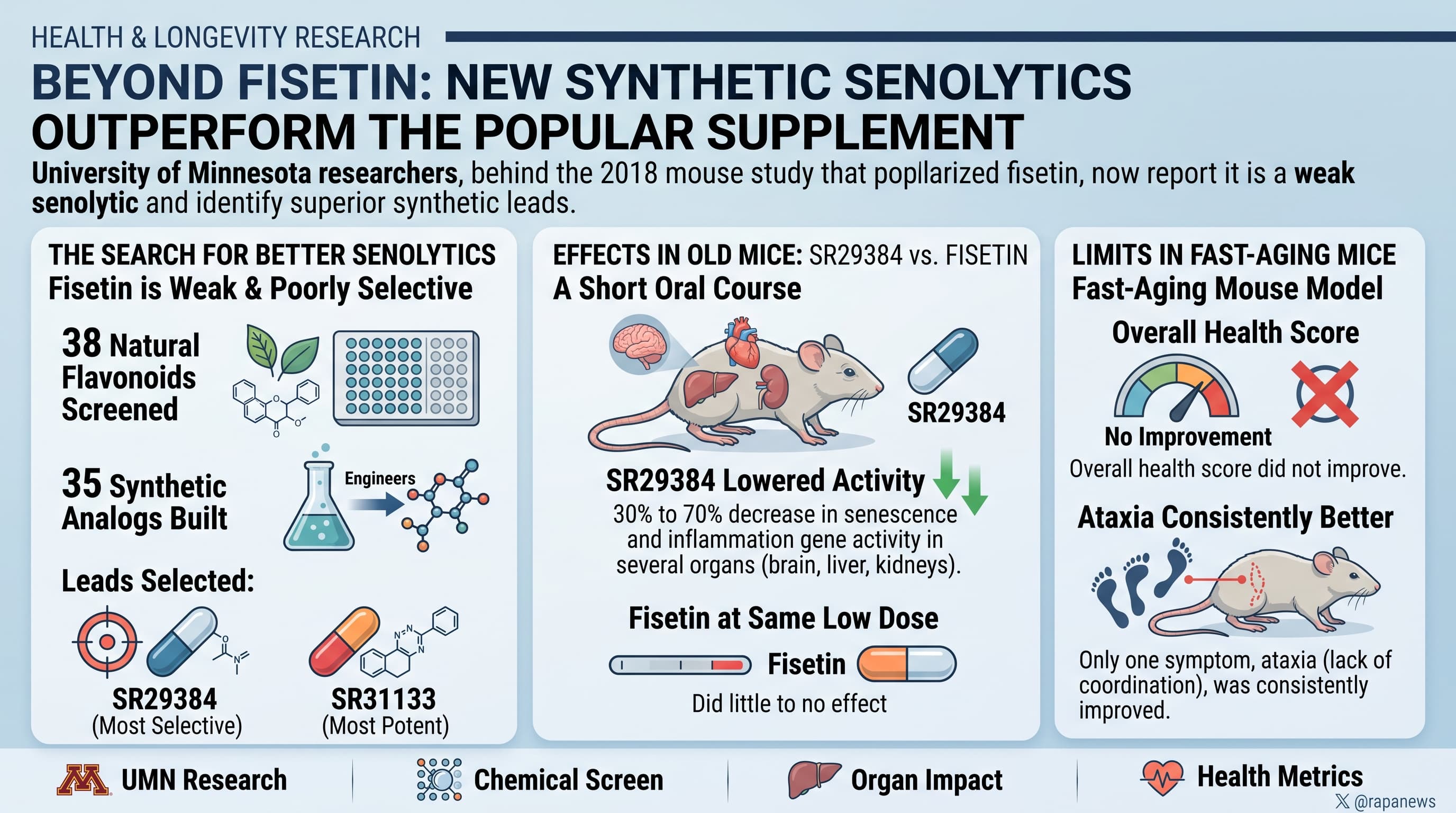
University of Minnesota researchers, the same group behind the 2018 mouse study that made fisetin a popular supplement, now report that fisetin is a weak and poorly selective senolytic. They screened 38 natural flavonoids, built 35 synthetic analogs, and selected two leads: SR29384 (most selective) and SR31133 (most potent). In old mice, a short oral course of SR29384 lowered senescence and inflammation gene activity in several organs by roughly 30 to 70 percent, while fisetin at the same low dose did little. In fast-aging mice, the overall health score did not improve and only one symptom, ataxia, was consistently better.
Fisetin, the strawberry flavonoid sold widely as a senolytic supplement, has a problem that its own champions now acknowledge: it is not very good at the job. A team led by Paul Robbins and Laura Niedernhofer at the University of Minnesota reports in Aging Cell that fisetin is a weak killer of senescent cells, and describes two synthetic replacements designed to do better.
Senescent cells are damaged cells that stop dividing but refuse to die. They build up with age and leak inflammatory signals that harm neighboring tissue. Senolytics are drugs meant to remove them while sparing healthy cells.
The team first tested 38 natural flavonoids on senescent mouse cells. Fisetin needed about 23 micromolar to kill half of them, and it was only 1.5 times more toxic to senescent cells than to healthy ones. Luteolin, found in celery and parsley, did slightly better. Using those results as a map of which parts of the molecule matter, chemists then made 35 new compounds. Two stood out. SR29384 was about three times more potent than fisetin and nearly nine times more toxic to senescent cells than to normal ones. SR31133 was 27 times more potent, but with a much narrower margin between killing senescent cells and killing healthy ones.
In 28-month-old mice, roughly equivalent to people in their late seventies, five daily oral doses of SR29384 cut kidney activity of p16, a standard senescence gene, by about 65 percent and the inflammatory gene Il6 by about 70 percent. Fisetin at the same dose did almost nothing. That comparison flatters the new compounds, because fisetin is normally given to mice at five times that dose.
The harder test came in mice engineered to age rapidly. After five weeks of treatment, senescence and inflammation genes fell by 30 to 55 percent in kidney, liver and lung. But the overall health score, which the authors name as the primary outcome, did not differ from untreated mice at any time point. Only ataxia, a loss of coordination, was reliably better late in treatment.
How the compounds work is also unsettled. Computer modeling and enzyme tests point to two proteins: PARP1, which helps repair DNA, and CDK2, which controls cell division. Yet the concentrations needed to block those enzymes were mostly higher than the concentrations that killed senescent cells, which suggests something else is contributing. The expected target, BCL-xL, was ruled out.
Much is missing. Nobody measured how much drug reached the blood or tissues, whether it caused harm, or whether senescent cells were physically removed as opposed to quieted. Two senior authors co-founded a company developing senolytics, and several authors hold a patent filing on these molecules.
The result is a credible chemistry starting point and a notable downgrade of fisetin by the people who put it on the map. It is not yet evidence that the health of an aging animal improves.
Insights
- Nothing here can be taken or bought. SR29384 and SR31133 are patented research chemicals with no human, safety or blood-level data.
- The paper weakens the case for fisetin supplements. In the authors’ own cells, fisetin was only 1.5 times more toxic to senescent cells than to healthy ones, and at 20 mg/kg in old mice it changed senescence genes by roughly 0 to 10 percent. Earlier positive mouse work used 100 mg/kg, which scales to about 570 mg for a 70 kg adult, and fisetin is poorly absorbed.
- Luteolin beat fisetin in the dish (14 versus 23 micromolar), but those concentrations are far above what oral supplements are known to reach in blood. This is not a reason to switch.
- Size of benefit for the lead compound: senescence and inflammation genes dropped 30 to 70 percent in mouse organs. That is a very large shift in statistical terms (the average treated mouse scored lower than about 93 percent of untreated mice), but it is based on 4 to 6 animals per group, so the true effect could be far smaller. The whole-animal health score did not improve.
- One likely target, PARP1, is a DNA repair enzyme. Chronic blockade in healthy people carries plausible risk.
Context and Source
- Open Access Paper: Novel Flavonoid Senotherapeutics Identified by Phenotypic Drug Discovery Reduce Senescence and Improve Multiple Markers of Healthspan, Published 06 October 2026.
- Institutions: Masonic Institute on the Biology of Aging and Metabolism, University of Minnesota (lead); University of Georgia College of Pharmacy; Herbert Wertheim UF Scripps Institute; University G. d’Annunzio of Chieti-Pescara
- Country: USA, with one Italian affiliation
- Journal: Aging Cell (Wiley, for the Anatomical Society), 2026, volume 25, e70736
- Impact evaluation: The impact score of this journal is 7.7, evaluated against a typical high-end range of 0 to 60+ for top general science, therefore this is a High impact journal. Within aging biology specifically it is a top-tier specialty venue.