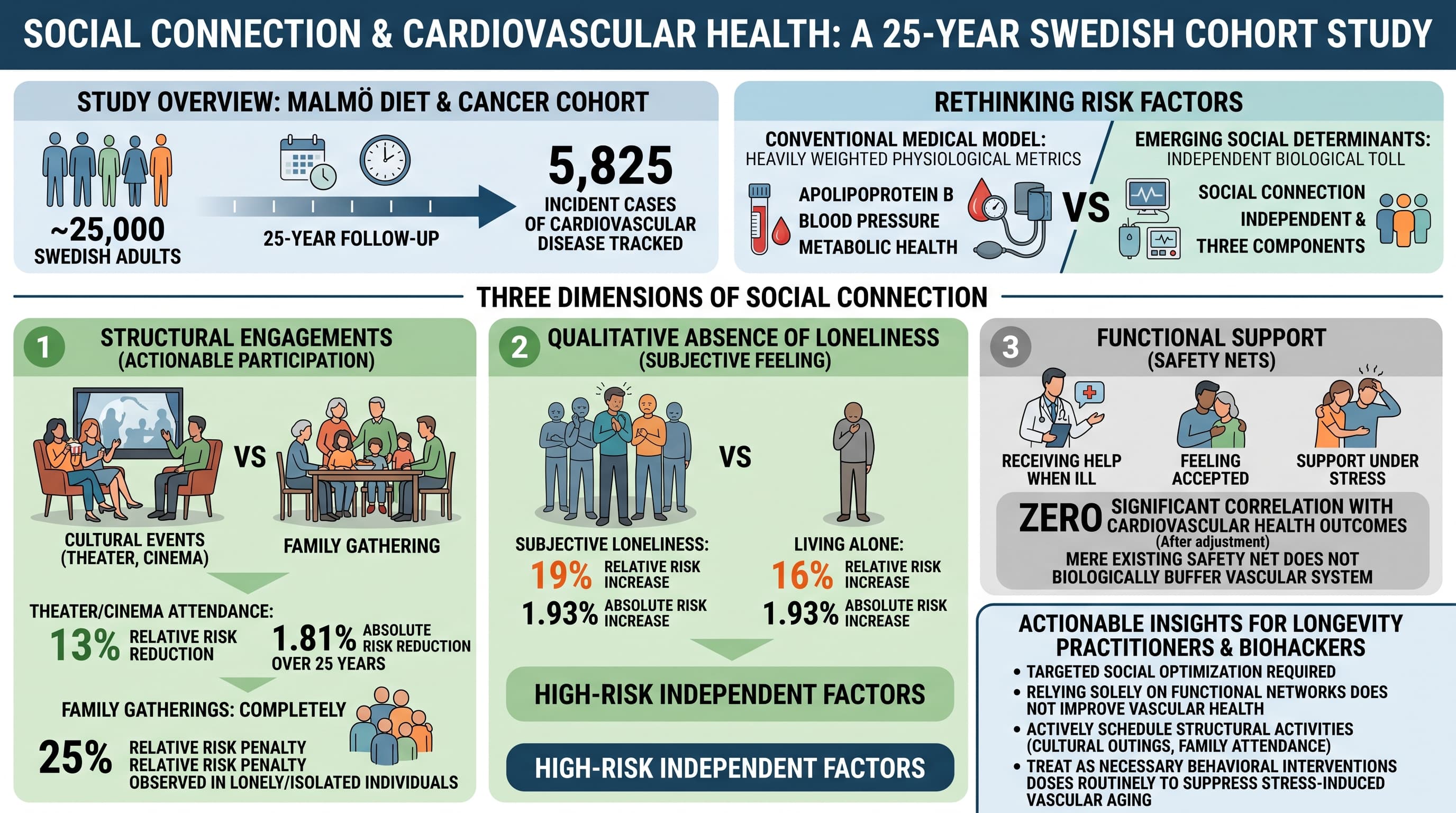
A 25-year prospective cohort study of nearly 25,000 Swedish adults reveals that distinct dimensions of social connection independently modulate cardiovascular disease risk. While functional support showed little impact, structural engagements like attending cultural events or family gatherings, alongside the qualitative absence of loneliness, significantly reduced the incidence of cardiovascular events.
The conventional medical model heavily weights physiological metrics like apolipoprotein B, blood pressure, and metabolic health when calculating cardiovascular risk. The Malmö Diet and Cancer cohort study introduces long-term epidemiological data demonstrating that social environment architecture exerts a biological toll comparable to traditional risk factors. Over a 25-year follow-up of 24,863 participants, researchers tracked 5,825 incident cases of cardiovascular disease. Instead of treating social isolation as a monolithic variable, the research team segregated social connections into three distinct components: quality, function, and structure.
The findings indicate a stark divergence in how these components impact health. Qualitative deficits, specifically subjective loneliness and lack of solidarity with relatives, reliably predicted an increased risk of cardiovascular disease. Structural isolation, measured by living alone, also correlated with higher disease incidence. Conversely, participants engaging in specific structural activities, notably attending the theatre, cinema, art exhibitions, and nightclubs, demonstrated a statistically significant reduction in cardiovascular risk.
Most surprisingly, the functional component of social connection, defined as receiving help when ill, feeling accepted, or having support under stress, showed zero significant correlation with cardiovascular health outcomes after statistical adjustment. This suggests that the mere existence of a safety net does not biologically buffer the vascular system. Instead, active participation in cultural gatherings and the subjective feeling of integration are the primary drivers of the cardiovascular benefit.
The paper identifies a critical interaction effect. The elevated cardiovascular risk associated with subjective loneliness was observed exclusively in individuals who did not attend family gatherings. Lonely individuals who maintained family attendance experienced no increased risk. This points to a biological neutralizing effect where structural familial engagement blocks the pathogenic downstream effects of subjective isolation. From a clinical perspective, identifying lonely patients who lack family contact may pinpoint a highly vulnerable subpopulation requiring targeted cardiovascular prophylaxis.
Actionable Insights
For longevity practitioners prioritizing cardiovascular health, social optimization requires a targeted approach based on structural and qualitative engagements. Relying solely on the knowledge that you have emergency support networks will not improve your vascular health. Instead, you must actively schedule specific structural activities.
The data shows that attending the theatre or cinema provides a relative cardiovascular risk reduction of 13 percent, translating to an absolute risk reduction of 1.81 percent over 25 years. Subjective loneliness increases relative risk by 19 percent, creating a 1.93 percent absolute increase in disease probability. Living alone mirrors this damage with a 16 percent relative increase and a 1.93 percent absolute risk increase.
To mitigate these risks, prioritize familial gatherings. The data demonstrates that attending family events completely neutralizes the 25 percent relative risk penalty observed in lonely individuals who isolate themselves from family. Biohackers should treat regular cultural outings and family attendance as necessary behavioral interventions, dosed routinely to suppress stress-induced vascular aging.
Context/Source
- Open Access Paper: Social connections and risk of cardiovascular disease: a 25-year population-based cohort study. , Published: 16 September 2026.
- Institution: Lund University, Kristianstad University, Lanzhou University.
- Country: Sweden and China.
- Journal Name: BMC Medicine.
- Impact Evaluation: The impact score of this journal is 9.3, evaluated against a typical high-end range of 0–60+ for top general science, therefore this is a High impact journal.