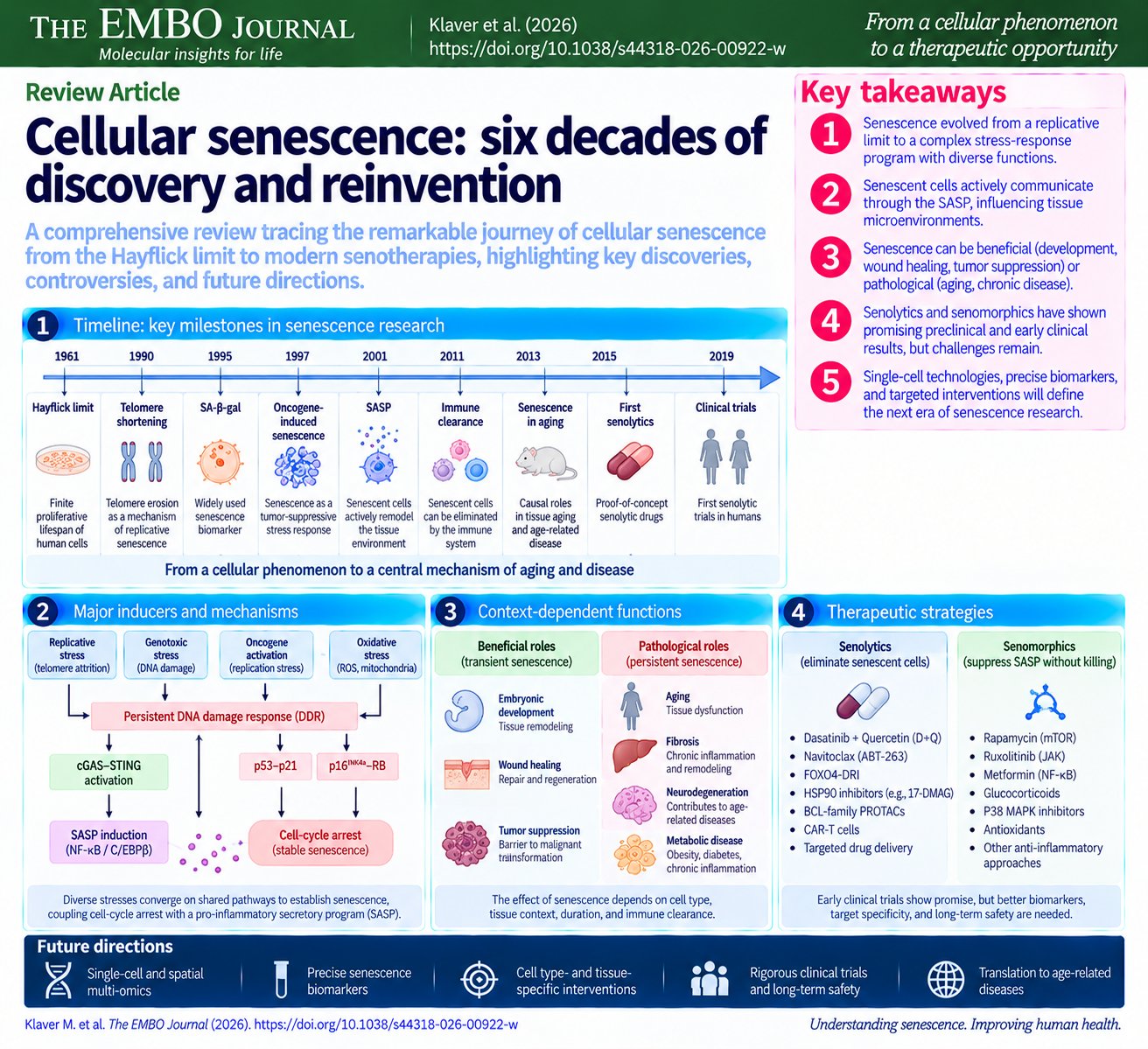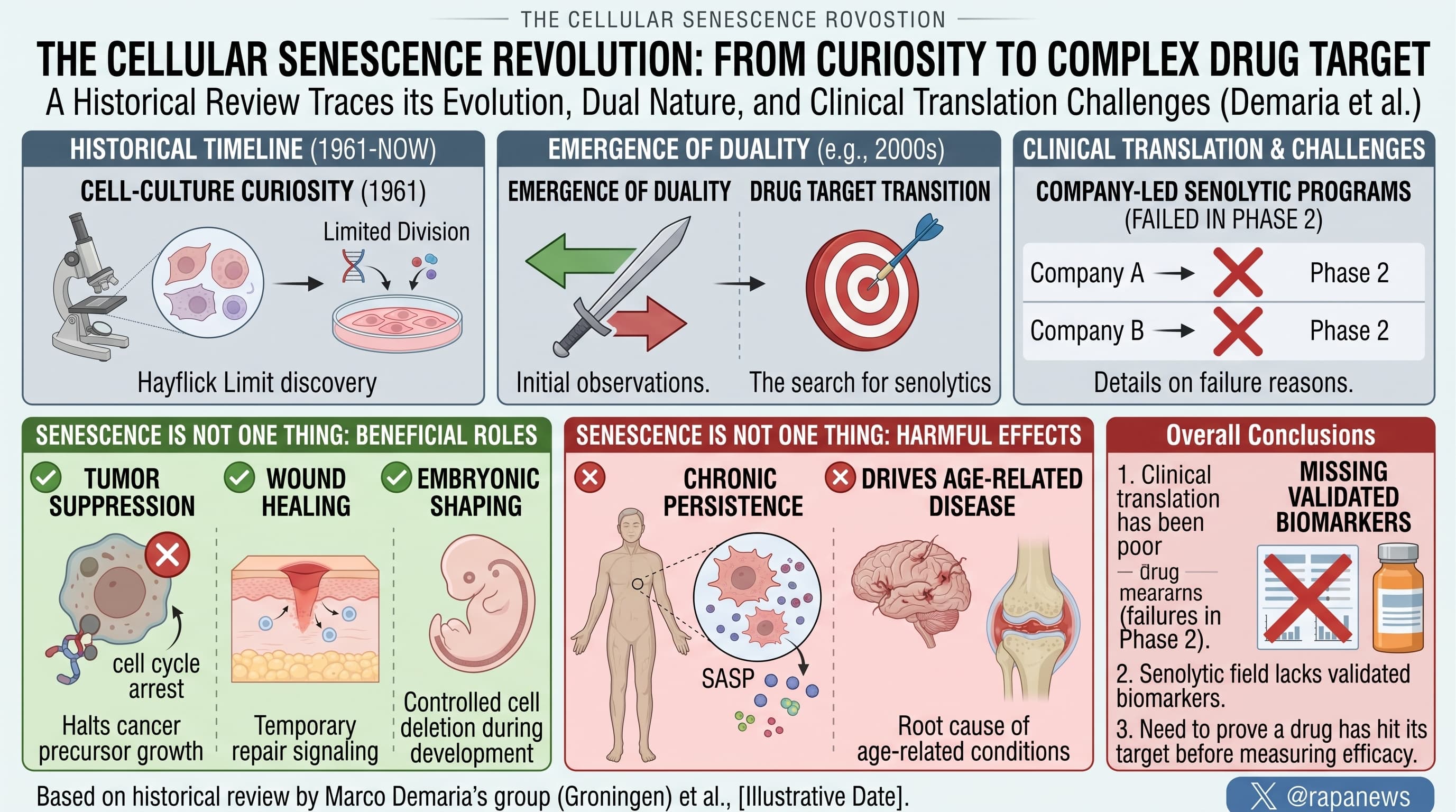
This is a historical review from Marco Demaria’s group in Groningen. It traces how cellular senescence went from a cell-culture curiosity in 1961 to a drug target. The main message is that senescence is not one thing. It suppresses tumors, helps wounds heal and shapes embryos, yet when senescent cells persist they drive inflammation and age-related disease. The review concedes that clinical translation has been poor: two company-led senolytic programs failed in Phase 2, and the field lacks validated biomarkers to show a drug has hit its target.
In 1961, Leonard Hayflick and Paul Moorhead showed that normal human cells in a dish divide a limited number of times and then stop for good. That observation overturned fifty years of belief that cultured cells were immortal. A new review in The EMBO Journal follows what happened to the idea over the next six decades, and the story is one of repeated redefinition.
First came a mechanism. In 1990, shortening telomeres were proposed as the counting device behind the division limit. Then came a purpose. In 1997, researchers found that switching on a cancer gene pushed normal cells into the same arrested state, which recast senescence as a defense against tumors. Radiation, chemotherapy and oxidative stress turned out to do the same thing.
The third shift mattered most for aging research. Senescent cells do not sit quietly. They release a mix of inflammatory signals, growth factors and tissue-digesting enzymes known as the senescence-associated secretory phenotype, or SASP. This secretion explains how a small number of arrested cells can disturb a whole tissue, and why the same process can stop a tumor in one setting and feed one in another.
The causal evidence arrived in 2011 and 2016, when engineered mice allowed researchers to kill cells expressing the senescence marker p16. Clearing those cells delayed age-related disease and, in one study, lengthened life. Drugs followed in 2015 with the combination of dasatinib and quercetin, and later with navitoclax and others.
The review gives equal weight to the awkward findings. Senescent cells help close wounds. They limit liver scarring. They appear on schedule in the embryo and are cleared by immune cells. One mouse study found that removing p16-expressing cells damaged the liver. The working model is now one of balance: senescence is helpful when brief and harmful when the cells linger, either because damage keeps producing them or because an aging immune system stops removing them. Senescent cells can also hide from immune attack using a surface molecule called HLA-E.
On treatments, the authors describe two routes. Senolytics kill senescent cells. Senomorphics, which include rapamycin, metformin and JAK inhibitors, quiet the secretions without killing the cells.
The human record so far is weak, and the review says so. Early trials of dasatinib and quercetin showed the approach was feasible. But the osteoarthritis senolytic UBX0101 failed in Phase 2, and UBX1325 for diabetic eye disease missed its main goal in Phase 2b. The authors blame the absence of reliable biomarkers. Without them, nobody can confirm that a drug cleared senescent cells in a person.
Readers should know that the senior author holds equity or board positions in three senescence-targeting companies.
Actionable Insights
This review offers no evidence that would justify self-treating with senolytics, and it reports no effect sizes for any human benefit.
- No senolytic has shown clinical efficacy in a controlled human trial. The two programs that reached Phase 2 efficacy testing failed.
- The mouse results are real but modest in translation value. From the original studies (not this review, and from my recollection), genetic clearance of p16-positive cells raised median lifespan by roughly 24 to 27 percent, and late-life dasatinib plus quercetin raised remaining lifespan by about 36 percent. A gain in remaining lifespan from old age is a much smaller share of total lifespan.
- Senescent cells do useful work. Removing them slowed wound healing in mice. Senolytic dosing around surgery, injury or active wound healing carries a plausible risk.
- You cannot currently measure your own senescent-cell burden in a meaningful way. Commercial “senescence” panels rely on markers the field itself calls insufficiently specific.
- Rapamycin and metformin reduce senescent-cell secretions in the laboratory. Human trials of these drugs did not measure senescent cells, so that mechanism is unconfirmed in people.
Context/Source
- Open Access Paper: Cellular senescence: six decades of discovery and reinvention
- Institution: European Research Institute for the Biology of Ageing (ERIBA), University of Groningen and University Medical Center Groningen
- Country: Netherlands
- Journal: The EMBO Journal, published 2 October 2026
-
Competing interests: Demaria has board membership and equity in Rubedo Life Sciences, a board and advisory role at Oisin Biotechnologies, and equity in Cleara Biotech
Impact evaluation: The impact score of this journal is 8.3, evaluated against a typical high-end range of 0–60+ for top general science, therefore this is a High impact journal.