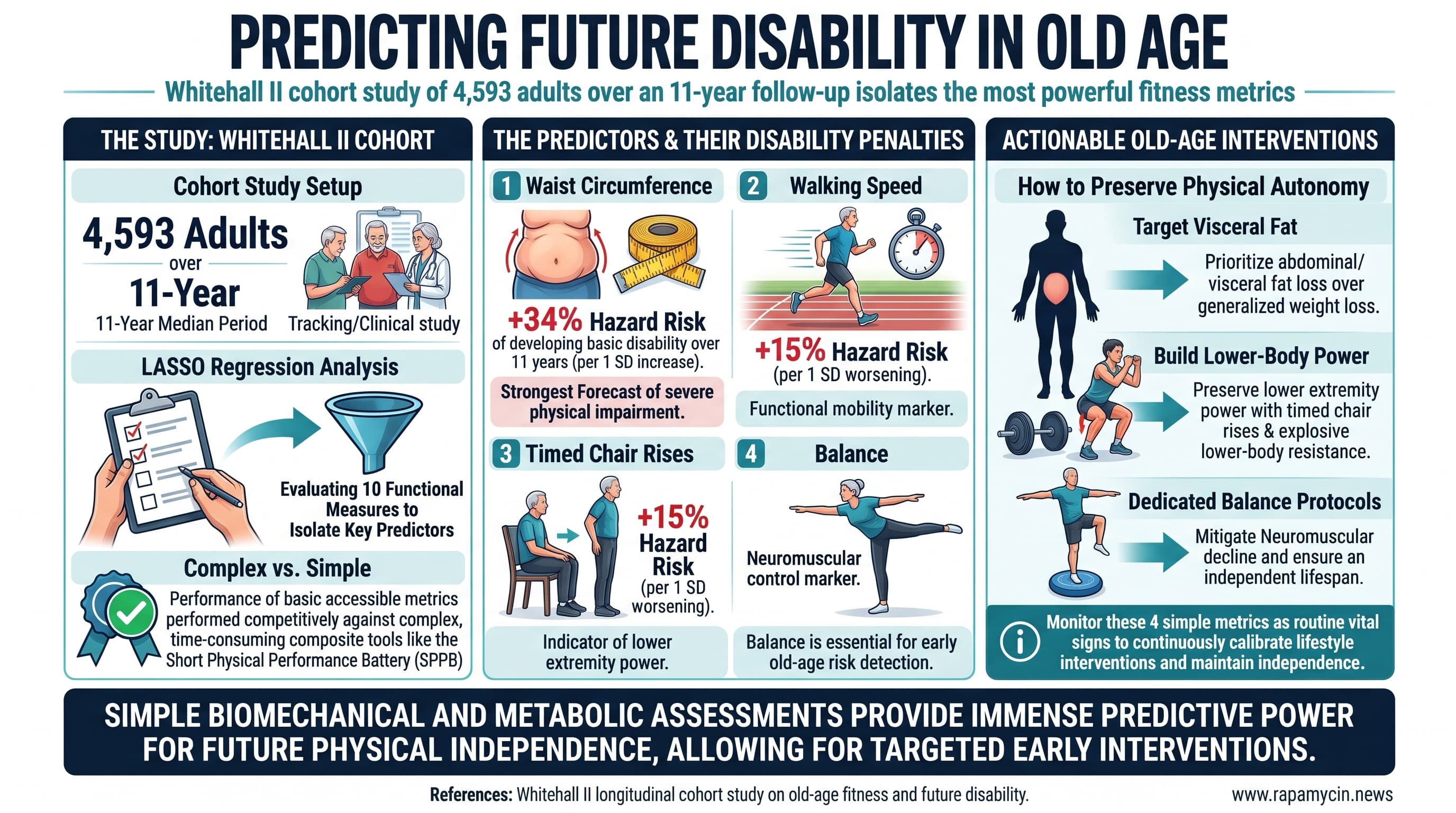
Population aging has increased the prevalence of late-life disability, yet early risk detection remains difficult. This longitudinal cohort study followed 4,593 adults from the Whitehall II study over an eleven-year median period to determine which early old-age fitness metrics best predict future disability and mortality. Researchers evaluated ten functional measures and applied LASSO regression to isolate the most powerful predictive variables. Simple measures including waist circumference, timed chair rises, and balance assessments effectively predicted disability. These basic metrics performed competitively against complex composite metrics like the Short Physical Performance Battery. The findings strongly suggest that clinicians and longevity enthusiasts can rely on a highly accessible screening protocol to forecast long-term physical decline. Implementing this predictive tool allows for targeted early interventions to preserve physical autonomy.
As humans consistently live longer, scientific focus is shifting toward identifying actionable early warning signs of physical decline before severe disability occurs. Most existing prognostic tools rely on extensive questionnaires or composite frailty scores that are difficult to implement outside specialized geriatric centers. A recent analysis of the Whitehall II cohort reframes this diagnostic approach.
The core finding reveals that highly complex diagnostic criteria are largely unnecessary for predicting long-term independence. Researchers tracked 4,593 individuals with a mean age of 65.3 years for over a decade. They evaluated ten distinct functional tests to see which variables most accurately predicted whether a person would eventually lose the ability to perform basic daily activities.
Through machine learning analysis using LASSO regression, investigators distilled the optimal predictive model down to just a few easily accessible metrics. For predicting incident disability, defined as difficulty in at least one activity of daily living, the best model requires only a patient’s age, sex, waist circumference, walking speed, timed chair rises, and a basic balance test. To predict severe disability, defined as difficulty in at least two activities, walking speed drops out of the equation entirely.
The data highlights central adiposity as a primary driver of functional decline. Waist circumference emerged as a leading indicator of future physical limitation. When evaluated as a standalone variable, waist circumference performed as well as multifaceted frailty indices. When researchers combined this measurement with practical markers of lower extremity strength and neurological coordination, predictive accuracy improved significantly.
This research democratizes early longevity interventions. Advanced physiological laboratories are not required to assess the trajectory toward frailty. A simple tape measure and a stopwatch provide enough statistical power to predict eleven-year disability risk. The predictive set identified in this study achieved a C-statistic of 0.6617 for incident disability and 0.6955 for severe disability. This safely clears standard statistical thresholds for acceptable discrimination in population screening.
Investigators also evaluated all-cause mortality as a secondary outcome. For predicting mortality, the optimal variables included walking speed, grip strength, resting heart rate, waist circumference, balance, and a finger tapping test. However, the data showed that basic functional measures were much stronger predictors for incident disability than for lifespan extension itself. This underscores the specific utility of this tool for healthspan preservation rather than simple mortality risk assessment. Calibration tests confirmed a tight agreement between the predicted probability of functional loss and the actual observed frequencies over the eleven-year horizon.
The study signals a clear mandate for proactive care. When individuals in their early sixties assess these baseline metrics,they gain a reliable window into their physical future. Poor performance on a timed chair rise or elevated waist circumference can immediately trigger structured interventions. Progressive resistance training or metabolic rehabilitation can be initiated long before functional independence is lost. This transitions the clinical paradigm from reactive disability management to predictive functional preservation.
Actionable Insights
The primary takeaway is that basic biomechanical and metabolic self-assessments provide immense predictive power for future physical independence. You should consistently track your waist circumference, walking speed, timed chair rises, and balance.
The study quantifies the precise penalty of poor physical performance. Every one standard deviation increase in waist circumference corresponds to a 34 percent increase in the hazard risk of developing a basic disability over the next eleven years. Similarly, a one standard deviation worsening in walking speed or timed chair rises increases your hazard of disability by 15 percent.
Because central adiposity strongly forecasts severe physical impairment, protocols targeting visceral fat reduction should take priority over generalized weight loss strategies. The inclusion of timed chair rises and balance tests in the final predictive models indicates that preserving lower extremity power and neuromuscular control is essential. Implementing explosive lower-body resistance training and dedicated balance protocols will directly mitigate the specific vulnerabilities identified in this cohort. By treating these simple assessments as routine vital signs, you can continuously calibrate your lifestyle interventions to ensure an independent lifespan.
We provide full instructions on how you can evaluate yourself on all these metrics on this page.
Context/Source
- Open Access Paper: Identifying a fitness tool in early old-age to predict long-term risk of disability, severe disability, and mortality
- Institution: Inserm U1153, Université Paris Cité and University College London
- Country: France and United Kingdom
- Journal Name: GeroScience
- Impact Evaluation: The impact score of this journal is 5.3, evaluated against a typical high-end range of 0–60+ for top general science, therefore this is a Medium impact journal.