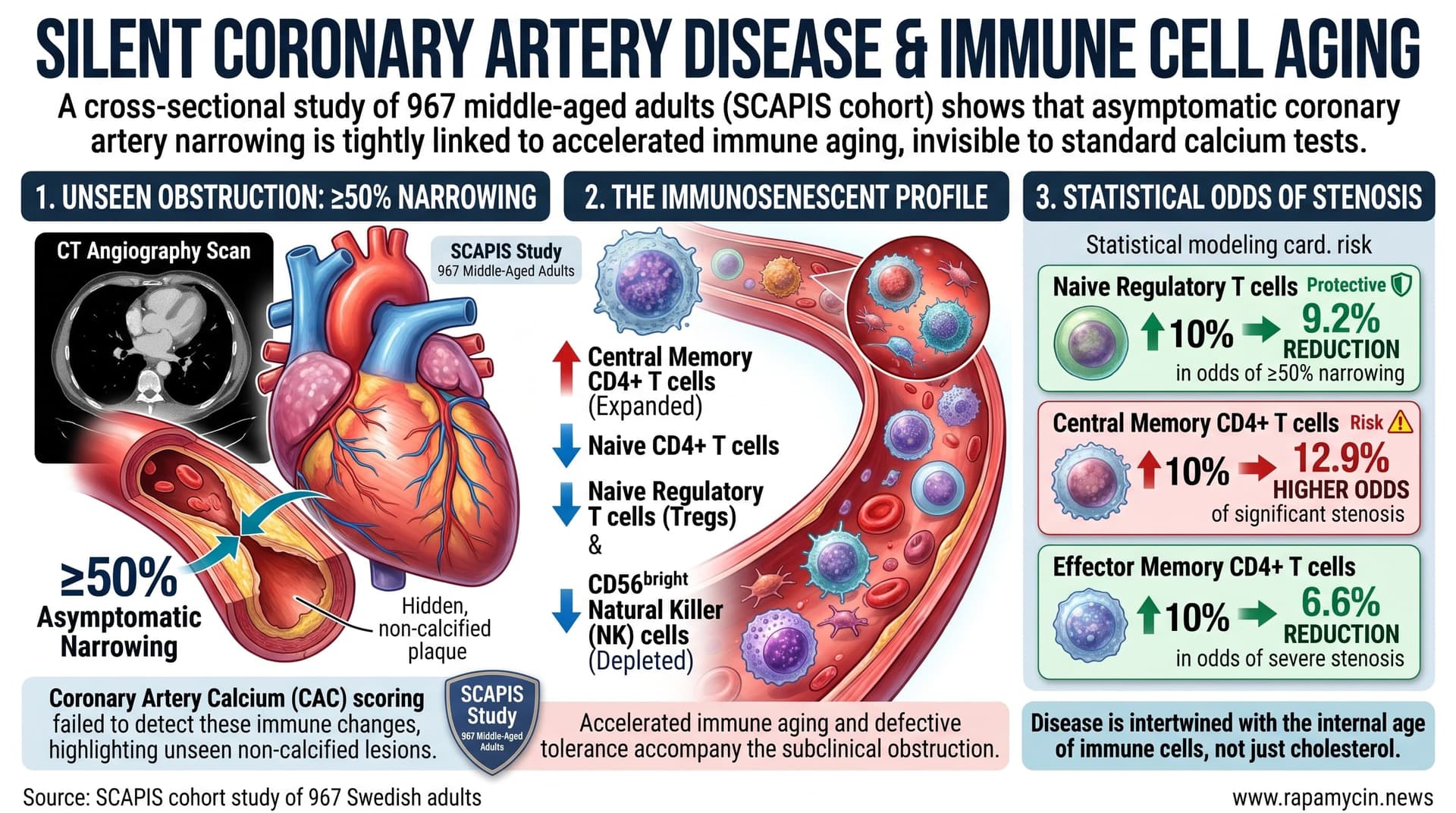
Coronary artery disease often progresses silently for years before causing symptoms. A cross-sectional clinical study of 967 middle-aged Swedish adults from the SCAPIS cohort investigated whether shifts in adaptive and innate immunity relate to hidden plaque buildup. Using multi-color flow cytometry on fresh whole blood and coronary computed tomography angiography, researchers identified an immunosenescent profile in individuals harboring 50 percent or greater asymptomatic coronary artery narrowing. These individuals demonstrated an expansion of central memory CD4 positive T cells alongside depleted levels of naive CD4 positive T cells, naive regulatory T cells, and CD56bright natural killer cells. Standard coronary artery calcium scoring failed to detect these immune alterations, emphasizing its inability to track early non-calcified lesions. These findings indicate that accelerated immune aging and defective regulatory tolerance accompany subclinical coronary obstruction, presenting cellular targets for longevity therapeutics.
Cardiovascular disease remains the leading cause of mortality worldwide, yet its earliest stages develop without symptoms inside the arterial wall. For decades, the dominant clinical paradigm has framed atherosclerosis primarily as a mechanical lipid clearance problem. The Swedish CArdioPulmonary bioImage Study (SCAPIS) challenges this narrow perspective by establishing that premature aging of the adaptive immune system closely shadows the silent, structural narrowing of coronary arteries.
The primary breakthrough rests on the timing and location of immune decay. Prior investigations into immune exhaustion typically studied patients who had already suffered myocardial infarctions or presented with unstable angina. By evaluating 967 middle-aged individuals between 50 and 64 years of age with no history of coronary events, the authors captured the immune system at the asymptomatic crossroad where prevention is still possible. Using fresh whole blood samples rather than frozen specimens, the investigators preserved delicate cell surface phenotypes that previous population surveys lost during freeze-thaw cycles.
The researchers mapped immune cell subsets against advanced coronary computed tomography angiography (CCTA), an imaging modality capable of visualizing both soft non-calcified plaques and true luminal obstruction. The data demonstrated that individuals with significant subclinical stenosis (50 percent or greater luminal narrowing) suffered from a pronounced disruption in their T cell balance. Their immune systems were depleted of naive CD4 positive T cells and enriched with central memory CD4 positive T cells. Naive T cells represent the immune reserve, equipped to handle novel antigens and maintain tolerance, while memory cells reflect prior antigen encounters and cellular wear. In these patients, the cellular equilibrium shifted toward exhaustion.
Equally telling was the depletion of naive regulatory T cells (Tregs) and CD56bright natural killer cells. Regulatory T cells suppress excessive immune activation and protect arterial tissue from auto-inflammatory damage. When naive Tregs disappear, the body loses its front-line defense against inflammatory damage in the vascular endothelium.
A critical revelation emerged when comparing CCTA with traditional coronary artery calcium (CAC) scoring. While calcium scans are widely utilized for cardiovascular risk stratification, CAC scores showed zero independent associations with immune cell aging phenotypes once age and sex were accounted for. Calcium scans only detect mineralized, hard plaque, missing vulnerable non-calcified plaques and early vascular inflammation. Relying solely on calcium scores may therefore foster false reassurance. The immune system signals vascular distress long before mineralized scar tissue consolidates.
This investigation links systemic immunosenescence directly to vascular degeneration. Strategies aimed at preserving the naive T cell pool, preventing thymic decline, and dampening chronic baseline inflammation could represent actionable pathways to keep coronary arteries resilient throughout the human lifespan.
Actionable Insights
This study reveals that silent coronary disease does not merely correlate with cholesterol numbers, but is tightly intertwined with the internal age of your immune cells. Statistical modeling demonstrated measurable changes in disease odds based on cell levels:
Each 10 percent increase in the proportion of naive regulatory T cells was associated with an approximate 9.2 percent reduction in the odds of having 50 percent or greater coronary narrowing.
Each 10 percent increase in central memory CD4 positive T cells was linked to a 12.9 percent higher odds of significant arterial stenosis.
Each 10 percent increase in effector memory CD4 positive T cells was associated with a 6.6 percent reduction in the odds of severe stenosis.
To translate these findings into health optimization, individuals should address the primary lifestyle and metabolic drivers that accelerate immune aging. Visceral adiposity, elevated fasting glucose, systemic interleukin-18, and cytomegalovirus infection were all associated with accelerated immune degradation. Maintaining optimal body composition, maintaining insulin sensitivity through resistance training, ensuring restorative sleep, and supporting immune health with sufficient micronutrients like zinc and vitamin D preserve naive T cell reserves. Clinicians and health-conscious adults must also recognize that a zero coronary calcium score does not rule out soft, inflamed coronary plaque. Comprehensive cardiovascular evaluations should consider direct anatomical visualization via coronary CTA where indicated.
Context and Source
- Open Access Paper: Aging-related immune phenotypes are associated with subclinical coronary atherosclerosis in a middle-aged population: a subcohort of the Swedish CArdioPulmonary bioImage Study
- Lead Institution: Department of Health, Medicine and Caring Sciences, Linköping University, and Department of Cardiology, Linköping University Hospital
- Country: Sweden
- Journal Name: Immunity & Ageing
- Journal Impact Score: The impact score of this journal is 6.8, evaluated against a typical high-end range of 0 to 60+ for top general science, therefore this is a High impact journal.