Stanford Scientist: Why Aging Accelerates at 44 and 60
Nonlinear Aging and Phenotypic Tracking
I. Executive Summary
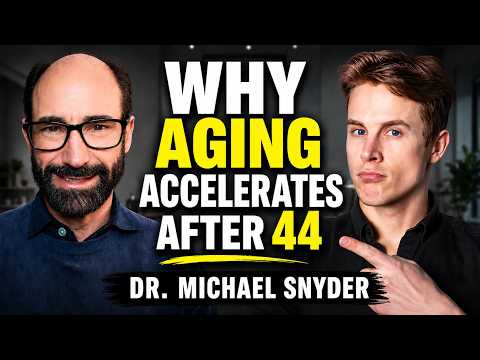
The provided transcript features a technical dialogue with Dr. Michael Snyder, Chair of Genetics at Stanford University, delineating the multi-omic architecture of human biological decline and personalized healthspan optimization. The central paradigm of the discussion is the validation of nonlinear molecular aging. Rather than progressing along a gradual, linear continuum, the human body undergoes two distinct, accelerated biological inflection points or “aging waves” occurring at the average ages of 44 and 60. Through deep, high-frequency, longitudinal profiling of transcripts, proteins, metabolites, lipids, and microbiome compositions over a 13-year period, the Snyder Lab demonstrated that roughly 81% of all profiled molecules exhibit dramatic, non-linear shifts at these specific chronological milestones. The mid-40s wave is heavily characterized by dysregulation in lipid, alcohol, and caffeine metabolism alongside structural muscle and skin alterations. Conversely, the early-60s wave triggers steep drop-offs in immune regulation, carbohydrate metabolism, and nephrotic/kidney function panels.
Beyond these universal aging waves, the transcript deconstructs the profound biological heterogeneity of aging via the “ageotype” framework, establishing that individuals deteriorate along distinct, predictable physiological vectors: metabolic, immune, hepatic, or nephrotic. This inter-individual variance is mirrored in early glucose dysregulation. Machine-learning algorithms analyzing continuous glucose monitoring (CGM) curve morphology during at-home oral glucose tolerance tests (OGTT) can now distinguish between distinct underlying metabolic subphenotypes, such as peripheral muscle insulin resistance versus pancreatic beta-cell insufficiency. Furthermore, the dialogue highlights a major paradigm shift in longevity genetics: recent mathematical modeling that isolates and removes historical extrinsic mortality (e.g., infections, accidents) reveals that the true heritability of intrinsic human lifespan is 50% to 55%, more than doubling traditional cross-sectional estimates.
To systematically counteract these biological drop-offs, the discussion bridges real-time tracking with advanced clinical interventions. Dr. Snyder proposes a tripartite theoretical blueprint for radical lifespan extension beyond the 120-year human barrier: autologous mitochondrial transplantation to replace organelles degraded by somatic mutations, targeted senolytic destruction of inflammatory senescent “zombie” cells, and continuous autologous pluripotent stem cell replenishment of failing organ niches. For immediate clinical execution, the protocol mandates continuous physiological monitoring using multi-sensor wearables and home-based dried-blood spot micro-sampling. These methods capture subtle longitudinal shifts away from an individual’s established personal baseline, allowing for automated, artificial intelligence-driven preventive course corrections months before the manifestation of clinical symptoms or irreversible organ damage.
II. Insight Bullets
-
Nonlinear Molecular Aging (The 44/60 Waves): Longitudinal multi-omic profiling confirms that human aging is non-linear, marked by two massive lurches or accelerated biological “waves” centered around the average ages of 44 and 60 [Shen et al., 2024].
-
Mid-40s Pathological Profile: The biological wave at age 44 is defined by rapid shifts in molecular pathways governing lipid regulation, alcohol clearance, and caffeine metabolism, matching clinical spikes in early cardiovascular presentation and musculoskeletal complaints [Shen et al., 2024].
-
Early-60s Pathological Profile: The biological wave at age 60 triggers a synchronized, systemic drop-off in carbohydrate metabolism, adaptive immune response mechanisms, and renal filtration pathways [Shen et al., 2024].
-
The Ageotype Framework: Human aging can be segmented into four distinct, predictable, and frequently overlapping biological pathways called ageotypes: metabolic, immune, hepatic, and nephrotic [Ahadi et al., 2020].
-
Intrinsic Lifespan Heritability Revision: When mathematical models isolate and strip away extrinsic causes of death (accidents, acute infections), the true heritability of the intrinsic biological human lifespan rises to 50% to 55%, doubling historical estimates [Shenhar et al., 2026].
-
Glucotype Subphenotyping via CGM: Prediabetic states exhibit distinct metabolic defects (e.g., muscle insulin resistance vs. pancreatic beta-cell dysfunction) that can be accurately mapped by machine-learning models assessing the morphology of a patient’s continuous glucose monitor curve [Snyder et al., 2025].
-
Sarcopenia and Disuse Inflexibility: Skeletal muscle mass drops at roughly 2% per decade, but acute periods of complete muscular disuse or injury accelerate this wasting within 48 hours; after age 40, the physiological capacity to regain this lost mass is significantly blunted.
-
GLP-1 Agonist Muscle Wasting Risks: Incretin mimetics (GLP-1 receptor agonists) like semaglutide or tirzepatide safely deplete visceral fat stores but pose a severe clinical risk of accelerating concurrent lean skeletal muscle wasting if unmitigated.
-
Fiber-Driven Epigenetic Signaling: Ingested dietary fiber undergoes microbial fermentation into short-chain fatty acids (SCFAs), which act as active ligands directly targeting gene expression pathways essential for maintaining gut mucosal barrier integrity.
-
The Physiological Shift Alert Gap: Multi-sensor consumer wearables can detect clear step-function anomalies (elevated resting heart rate, collapsed HRV, and altered gate/sleep architectures) up to four months prior to major cardiovascular failures; however, standard medical infrastructure lacks real-time infrastructure to act on these signals.
-
Retinal Scans as Multi-System Biopsies: Artificial intelligence algorithms processing non-invasive 3D retinal scans can effectively predict future risks for neurodegenerative disease (Alzheimer’s), bone mineral density loss (osteoporosis), and advanced ischemic cardiovascular disease.
-
Personal Baselines vs. Population Averages: Standard diagnostic reference ranges fail to identify early disease because they rely on population cross-sections; true predictive medicine requires tracking internal longitudinal deviations from an individual’s unique molecular baseline.
-
High-Frequency Metabolomic Micro-sampling: Capillary blood micro-sampling allows patients to remotely mail in dried blood spots every 90 days to track 650 unique metabolites, offering real-time readouts of oxidative stress, inflammation, and visceral organ load.
-
Absolute Lifespan Extension Key 1 (Mitochondrial Injections): Pushing human longevity past the historical 120-year barrier will require autologous mitochondrial transplantation to replace organelles degraded by somatic mitochondrial DNA mutations and electron transport chain leakages.
-
Absolute Lifespan Extension Keys 2 & 3 (Senolytics & Stem Cells): Secondary and tertiary absolute longevity vectors require the systematic clear-out of senescent “zombie” cells via senolytic compounds and the active replenishment of somatic tissues with autologous, reprogrammed pluripotent stem cells.
IV. Actionable Protocol (Prioritized)
High Confidence Tier (Protocols backed by Level A/B evidence)
-
At-Home Glucotype Identification and Targeted Nutrition: Deploy a continuous glucose monitor (CGM) for a minimum of 14 to 30 days annually to establish your personal food-spiking profile (“glucotype”). Utilize strategic macronutrient sequencing by consuming a fiber-rich salad or protein block immediately prior to simple carbohydrates (e.g., french fries or white rice) to utilize fiber-mediated gastric slowing and blunt postprandial glucose excursions [Snyder et al., 2025].
-
Wearable-Based Personal Baseline Monitoring: Utilize a multi-sensor wearable device to map strict individual baselines for resting heart rate (RHR) and heart rate variability (HRV). Program automated alerts to flag systemic shifts away from personal baselines (e.g., a sudden 50% drop in HRV or a sustained increase in RHR), which serve as early diagnostic signals for acute viral infections (including COVID-19) or psychological stress before symptoms manifest.
Experimental Tier (Protocols backed by Level C/D evidence with high safety margins)
-
Subtype-Specific Pharmacotherapy for Dysglycemia: If presenting with lean-phenotype type 2 diabetes or a confirmed pancreatic beta-cell defect (sluggish insulin secretion rather than peripheral insulin resistance), bypass standard first-line metformin protocols under medical supervision. Instead, implement targeted therapies like GLP-1 receptor agonists or insulin secretagogues that directly correct the underlying cellular defect [Snyder et al., 2025].
-
Resistance Training Mitigation for GLP-1 and Age-Induced Sarcopenia: If undergoing incretin mimetic therapy (tirzepatide/semaglutide) or entering the post-44/60 aging waves, mandate daily or near-daily progressive resistance exercises. This is required to counteract the rapid 48-hour molecular disuse atrophy signaling pathway and preserve lean skeletal muscle mass.
-
High-Frequency Multi-Omic Micro-sampling: Implement quarterly capillary blood micro-sampling (dried-blood spot tracking) to screen a panel of 650+ metabolites. Track longitudinal trend lines in oxidative stress, renal clearance markers, and inflammatory cytokines to identify sub-clinical transitions toward your specific ageotype (metabolic, immune, hepatic, or nephrotic).
Red Flag Zone (Claims debunked or lacking safety data)
-
Passive Aging Assumption [DEBUNKED]: Relying on the outdated model that human biological decline is a slow, linear process that can be managed by late-stage lifestyle interventions. Failure to implement aggressive heart, metabolic, and muscle protection frameworks prior to the critical molecular inflection bursts at ages 44 and 60 results in accelerated, unmitigated tissue degradation [Shen et al., 2024].
-
Unregulated Commercial Stem Cell Transplants [HIGH RISK]: Procuring systemic or localized stem cell injections from unverified, commercial offshore clinics claiming generic rejuvenation. Clinical data regarding safety margins, pure cell lineage, and oncogenic risks remain highly controversial and lack rigorous human validation.
-
Over-the-Counter Direct-to-Consumer Mitochondrial Supplements [SAFETY DATA ABSENT]: Consuming unverified supplements that claim to clean or replace intracellular mitochondria. True organelle rejuvenation requires advanced autologous mitochondrial transfer or highly targeted clearance pathways that cannot be replicated via standard oral over-the-counter formulations.