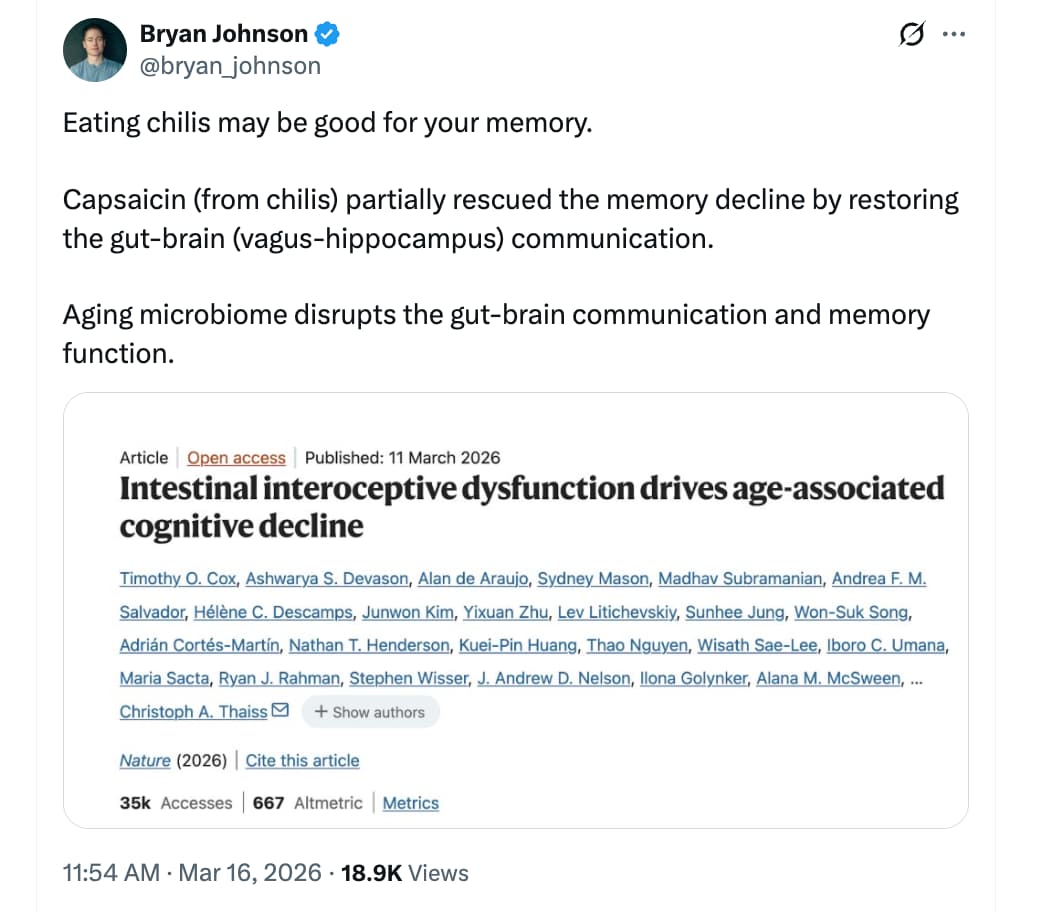
I’ve been digging through the latest data on spicy food consumption, particularly focusing on two large-scale longitudinal studies from China. As many of you know, we often discuss capsaicin for its potential metabolic benefits and AMPK activation, but these two recent papers present a bit of a “pick your poison” scenario for the longevity community.
On one hand, we have a massive prospective study from the China Kadoorie Biobank (CKB) looking at cancer risk, and on the other, an open cohort study tracking cognitive function over 15 years.
The Good News: Gastrointestinal Protection
The first study, Spicy food consumption and risk of gastrointestinal-tract cancers: findings from the China Kadoorie Biobank, followed over 512,000 adults. The results suggest that your burning palate might actually be shielding your gut.
“Spicy food consumption was inversely associated with oesophageal cancer risk, with adjusted HRs of 1.00, 0.88, 0.76, 0.84 and 0.81 for those who never/rarely consumed (reference) and consumed… 6–7 days/week, respectively (ptrend < 0.002).”
Key Takeaways:
- 19% lower risk of esophageal cancer for daily spice eaters.
- Weak inverse associations were also found for stomach and colorectal cancers.
- The benefit was most robust in those who didn’t smoke or drink alcohol, suggesting capsaicin might have independent protective effects on the GI lining.
The Bad News: Brain Fog and Memory Loss
However, the second study, High Chili Intake and Cognitive Function among 4582 Adults: An Open Cohort Study over 15 Years, offers a sobering counter-narrative. This study focused on adults over age 55 and found a dose-dependent link to cognitive decline.
“Compared with non-consumers, those whose cumulative average chili intake was above 50 g/day had the regression coefficients… for global cognitive function of −1.13 (−1.71 to −0.54). Those with chili consumption above 50 g/day had an odds ratio of 2.12 for self-reported poor memory.”
Key Takeaways:
- 50g+ of chili per day (about 3-4 tablespoons of dried chili) was linked to double the risk of self-reported memory decline.
- BMI Factor: Interestingly, the association was stronger in individuals with a low BMI. If you’re lean and mean, your brain might be more sensitive to high-dose capsaicin.
- The researchers suggest that while capsaicin helps with weight and blood pressure, the long-term “neuro-overstimulation” might be a net negative for the aging brain.
My Take & Discussion
We are looking at a classic biological trade-off. Capsaicin is a known TRPV1 agonist. In the gut, this might stimulate protective mucosal factors and reduce inflammation. In the brain, however, chronic high-level activation of these receptors might be neurotoxic or lead to “excitotoxicity-lite” over decades.
So, should we keep eating chili? Personally, I think the “dose makes the poison” rule applies here. 50 grams of chili a day is a lot—more than most casual spice fans consume. The GI benefits seem to kick in at much lower, more frequent doses (even 1-2 times a week showed benefit).
I am inclined to stop consuming chili peppers, as the trade-off between the benefits and risks is clearly disproportionate. Doing so also allows me to better appreciate the original taste of the ingredients.
What are your thoughts?
- Do you track your capsaicin intake as part of your longevity stack?
- Given the “lean person” risk factor in the cognitive study, should those of us on Rapamycin (who often have lower BMIs) be more cautious?
- Are there any other neuroprotective supplements you’d pair with spicy food to offset the potential cognitive risk?
- Are there other studies that advocate for or against the consumption of chili peppers?