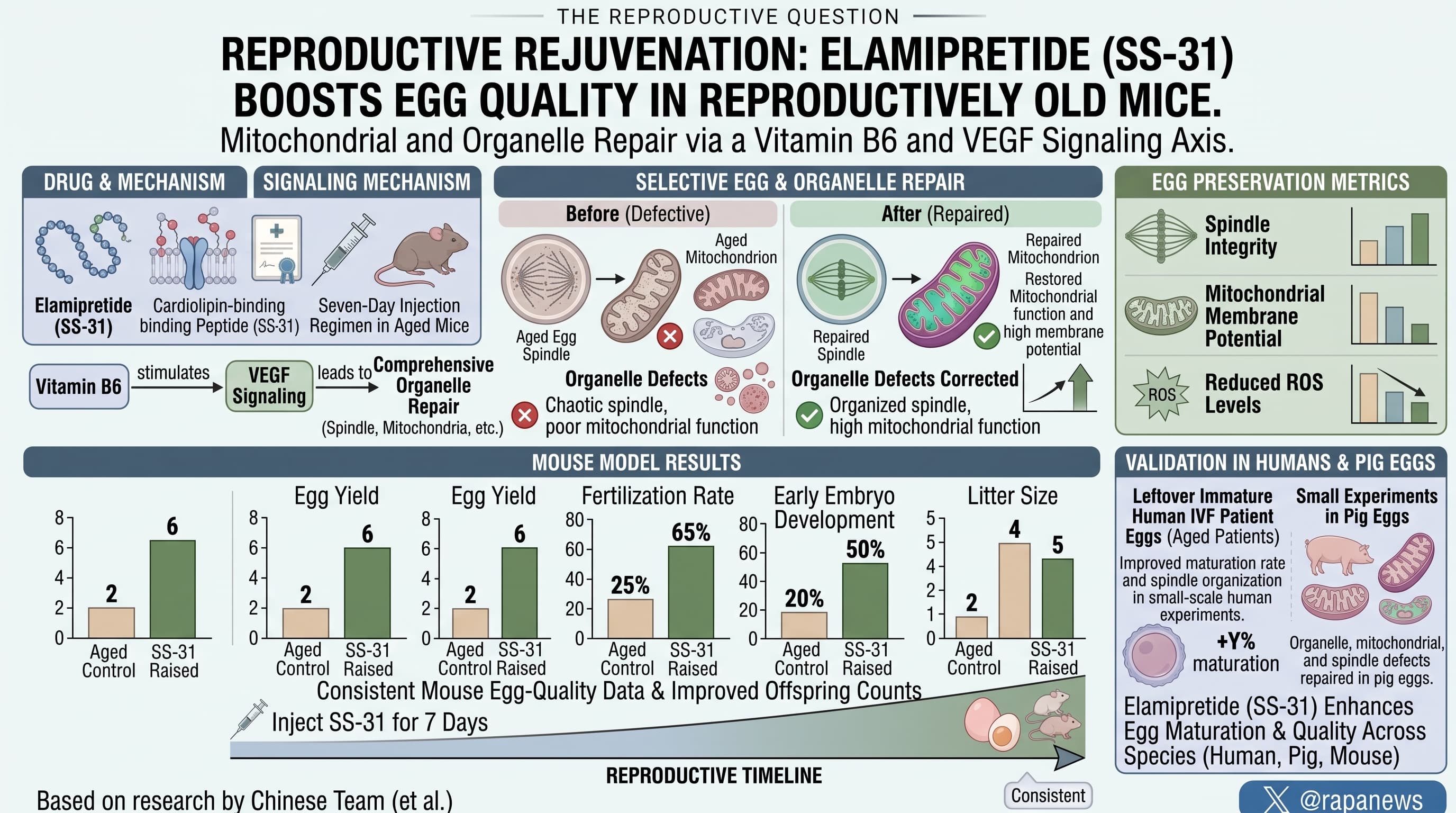
A Chinese team reports that seven days of injected elamipretide (SS-31), the cardiolipin-binding peptide approved in 2025 for Barth syndrome, raised egg yield, fertilization, early embryo development and litter size in reproductively old mice. It also repaired spindle, mitochondrial and organelle defects in their eggs. The authors attribute this to a vitamin B6 and VEGF signaling axis, and add small experiments in pig eggs and in leftover immature human eggs from IVF patients. The mouse egg-quality data are fairly consistent.
Female fertility fails long before the rest of the body does, and the egg cell is the weak link. Eggs carry more mitochondria than any other cell, and as they age those mitochondria drift out of position, leak reactive oxygen and stop supporting the machinery that separates chromosomes. A study in Aging Cell now tests whether a drug built for mitochondria can reverse that.
The drug is elamipretide, a four-amino-acid peptide that binds cardiolipin, a lipid of the inner mitochondrial membrane. Researchers at Nanjing Agricultural University injected it into the abdomen of female mice aged 8, 10 and 12 months, when mouse fertility has largely collapsed. They compared doses of 3, 5 and 10 mg/kg per day and courses of 3, 7 and 10 days.
One regimen stood out: 5 mg/kg for seven days. Ten-month-old mice on that schedule released roughly two and a half times as many eggs after hormone stimulation as untreated old mice. More of those eggs fertilized, and far more embryos reached the four-cell stage. Under the microscope, treated eggs had tidier spindles, better-aligned chromosomes, lower reactive oxygen and mitochondria back around the spindle.
The headline claim that fertility was restored needs qualifying. Young mice delivered about 14 pups per litter. Untreated old mice delivered roughly none to one. Treated old mice delivered about two to three. That is a real change from near-zero, but it recovers under a fifth of youthful output, and the benefit was gone within a month. In 12-month-old mice it barely registered.
The mechanism is the least settled part. Metabolite profiling of ovaries pointed to vitamin B6 metabolism, and adding vitamin B6 to the culture dish improved maturation of old eggs. Gene expression analysis pointed to VEGF signaling. Yet the paper’s own figures show VEGF pathway proteins elevated in old eggs and lowered by elamipretide, and a VEGF-suppressing drug mimicked the benefit. That is inhibition, although the abstract calls it activation. The link between vitamin B6 and VEGF is described by the authors themselves as speculation.
Then there is the human experiment. Immature eggs discarded from IVF cycles were matured in a dish with or without elamipretide. In women aged 35 and over, 79 percent of treated eggs matured within 48 hours against 60 percent of controls, and fertilization and cleavage rates were also higher. The paper calls this significant, but reports no statistical test. Recomputed from the published counts, none of the differences clears conventional thresholds, and in women under 35 the treated eggs fertilized less often.
A third experiment, in pig eggs damaged with hydrogen peroxide, showed protection at very high concentrations.
Taken together, the work makes a reasonable case that egg mitochondria remain a druggable target late in reproductive life in mice, using a compound that already has a regulatory approval. It does not show that the drug improves a woman’s chance of a baby. No blastocysts, chromosome counts, pregnancies or births were measured in human material, and the dish concentration used is far above what an injection is likely to deliver.
Actionable Insights
For readers weighing the evidence, these are the magnitudes:
- Mouse egg yield: about 9 eggs per old mouse untreated versus about 23 treated (young mice: about 34). That is roughly 2.5 times more eggs, or about 55 percent of the gap to young closed.
- Mouse four-cell embryo rate: about 54 percent untreated versus 77 percent treated, a gain of 23 percentage points.
- Mouse litter size: about 0.5 pups versus about 2.5, against 14 in young animals. The gain is real and small.
- Human eggs, age 35 and over: 13 cleaved embryos from 29 treated eggs (45 percent) versus 6 from 25 controls (24 percent). Taken at face value that is one extra embryo per five eggs, but the range compatible with the data runs from a slight harm to a fourfold benefit.
Practical points: the dose response was not linear (10 mg/kg did worse than 5), longer treatment did not help, and the effect faded in a month. Vitamin B6 improved egg maturation only in a dish, at an unstated dose, so this is not evidence for supplementation. Anyone pursuing fertility treatment should treat this as an early laboratory lead.
Context/Source
- Open Access Paper: Elamipretide Rejuvenates Oocyte Quality and Restores Female Fertility During Reproductive Aging
- Institutions: College of Animal Science and Technology, Nanjing Agricultural University; Center of Reproductive Medicine, Maternity and Child Health Care of Guangxi Zhuang Autonomous Region, Nanning; Affiliated Hospital of Youjiang Medical University for Nationalities, Baise.
- Country: China
- Journal: Aging Cell (Wiley, for the Anatomical Society)
- Impact evaluation: The impact score of this journal is approximately 7.7, evaluated against a typical high-end range of 0 to 60+ for top general science, therefore this is a High impact journal.