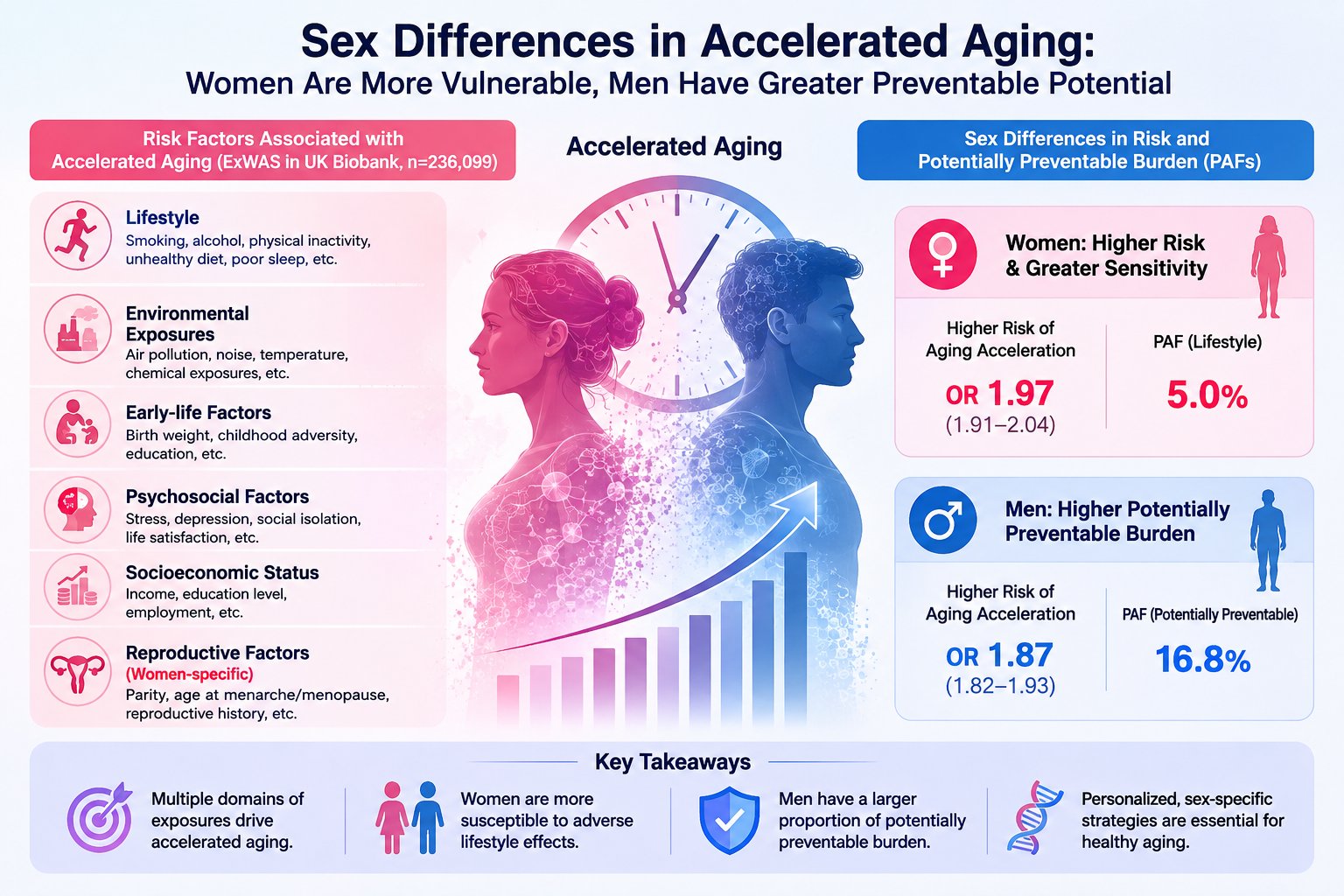
Researchers at Xuanwu Hospital, Capital Medical University screened 118 environmental, lifestyle, early-life, psychosocial and socioeconomic exposures against biological-age acceleration in 236,099 UK Biobank participants, then repeated the analysis separately in men and women. Lifestyle dominated every other domain by a wide margin. Women showed a slightly stronger response to the same adverse lifestyle exposures than men, but men carried a far larger preventable burden at the population level simply because more of them live badly (73% of men versus 56% of women in the intermediate or unfavourable lifestyle tertiles). Roughly a quarter of accelerated-aging cases in the whole cohort were attributable to the five modifiable domains combined. Reproductive variables including menopause, early menarche and stillbirth added independent, though modest, risk in women.
Aging is not a single process running at a single speed. Two people born the same year can be biologically a decade apart, and researchers now routinely quantify that gap using blood-based “clocks” that estimate biological age from ordinary lab values. The question this paper asks is deceptively simple: what actually drives the gap, and does it work the same way in men and women?
The team ran what is essentially a hypothesis-free sweep. Rather than picking a favourite exposure and testing it, they threw 118 candidate factors at the data at once, an approach borrowed from genomics called an exposure-wide association study. Everything went in: air pollution, greenspace, mobile-phone use, television hours, sleep, supplements, salt at the table, sunscreen habits, loneliness, income, employment, childhood adversity, and for women, menstrual and reproductive history.
The result is a clean hierarchy. Lifestyle beat everything. People in the worst lifestyle tertile had roughly two and a half times the odds of being classified as biologically accelerated compared with the best tertile. Socioeconomic status came second, psychosocial factors third, early-life factors fourth. Environmental exposures, the domain that gets the loudest press coverage, contributed almost nothing once everything else was accounted for.
The big idea, though, is the sex split. Women appeared more sensitive to the same bad habits: the odds ratio for an unfavourable lifestyle was 2.88 in women versus 2.37 in men, even though similar proportions were exposed. But when the authors asked a different question, how much accelerated aging could be erased if everyone moved to a favourable profile, the answer flipped. Men had 41.7% of cases theoretically preventable; women only 15.0%. The reason is not biology but arithmetic: more men are exposed in the first place.
There is a caveat the paper handles too gently. The two clocks contradict each other. On one measure women look 17 years older than men on average; on the other, men look slightly older. Since both measures were calculated by comparing everyone against the pooled average of the whole cohort, one sex is forced above the line and the other below it by construction. What the data show robustly is that lifestyle matters enormously and that men have more room to improve. What they do not show, yet, is that women’s biology ages faster.
Actionable Insights
The practical content here is unglamorous and consistent. Effect sizes below are standardised so they can be compared with each other. Cohen’s d of 0.2 is small, 0.5 moderate, 0.8 large.
Diet was the single strongest protective factor found. The best diet score versus the worst carried d = 0.76 in women and d = 0.60 in men, translating to a biological age roughly 3.0 years younger on the phenotypic clock and 7.7 years younger on the physiological clock. That is the largest modifiable signal in the entire 118-factor screen.
Television time was the strongest behavioural risk factor in women: three or more hours daily was associated with d = 0.42, about 1.7 years of added phenotypic age.
Habitually adding salt at the table carried d = 0.32 overall and d = 0.38 in men, an unusually large effect for such a small habit.
Routine sun and UV protection was protective at d = 0.25.
Overall, moving from the worst to the best lifestyle profile corresponds to d = 0.51, which in plain terms is roughly a 15 percentage-point absolute drop in the chance of being classified as an accelerated ager.
Caution: this is cross-sectional observational data. These are associations, not demonstrated causes.
Context and Source
- Open Access Paper: Sex differences in aging acceleration: higher susceptibility in women, greater preventability in men
- Authors: Ziye Ren, Shuiyue Quan, Fangyu Li, Longfei Jia
- Institution: Department of Neurology and Innovation Center for Neurological Disorders, Xuanwu Hospital, Capital Medical University; National Clinical Research Center for Geriatric Diseases, Beijing, China
- Country: China (data source: UK Biobank, United Kingdom)
- Journal: npj Aging (Nature Portfolio, published in partnership with the Japanese Society of Anti-Aging Medicine), published online 20 August 2026.
-
Funding: Brain Science and Brain-like Intelligence Technology National Science and Technology Major Project, National Natural Science Foundation of China, Beijing Hospitals Authority, Xuanwu Hospital. No competing interests declared.
Journal impact: The impact score of this journal is 13.0 (2025 Journal Impact Factor; 5-year JIF 12.2), evaluated against a typical high-end range of 0 to 60+ for top general science, therefore this is a High impact journal.