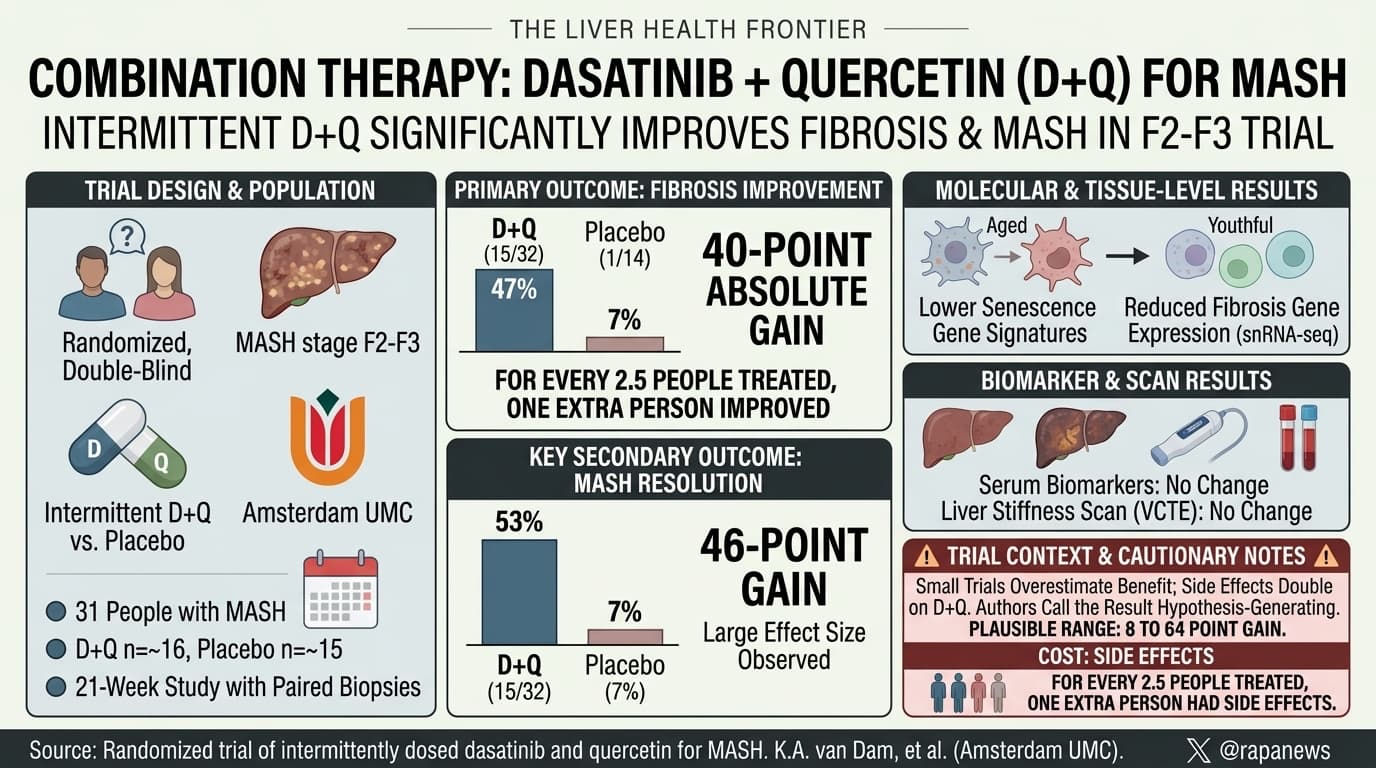
A 21-week, double-blind, placebo-controlled trial at Amsterdam UMC gave 31 people with fibrotic fatty liver disease (MASH, stage F2 to F3) intermittent dasatinib plus quercetin (D+Q) or placebo. On paired liver biopsies, 47% of the D+Q group improved by at least one fibrosis stage without worsening of MASH, against 7% on placebo. MASH resolved in 53% versus 7%. Single-nucleus RNA sequencing showed lower senescence and fibrosis gene signatures after treatment. Blood tests and liver stiffness scans did not move, side effects were about twice as common on D+Q, and the authors themselves call the result hypothesis-generating.
For a decade, senolytics have been long on mouse data and short on human proof. The idea is simple: aged, damaged cells that refuse to die pile up in tissues and secrete inflammatory and scar-promoting signals, so clearing them should relieve the tissue. Until now, no randomized human trial had shown that a senolytic changes the structure of a diseased organ under the microscope. This one does, in the liver, with large caveats.
Researchers recruited 31 adults with biopsy-confirmed MASH and moderate to advanced scarring. Seventeen received dasatinib, a leukemia drug, at 100 mg per day with 1,000 mg of quercetin, a plant flavonoid sold as a supplement. Fourteen received matching placebo. Dosing was sparse: three consecutive days a week for three weeks, then four weeks off, repeated three times. That is 27 dosing days across five months.
Three pathologists, blinded to both treatment and timepoint, scored biopsies taken before and after. Eight of 17 treated participants improved by at least one fibrosis stage without their steatohepatitis worsening. One of 14 placebo participants did. Nine of 17 on D+Q had resolution of MASH, against one on placebo. This happened without weight loss, which is the usual route to liver improvement in this disease.
The molecular data point the same way. Sequencing of individual liver cell nuclei showed that gene programmes associated with senescence and with collagen production fell after D+Q and did not fall after placebo. The proportion of hepatic stellate cells, the liver’s scar-producing cells, also dropped.
The reasons for caution are substantial. The whole primary result is eight responders against one. The relative risk of 6.59 carries a confidence interval running from 0.93 to 46.53, which technically includes no effect at all. In a worst-case analysis of the four missing biopsies, statistical significance disappears. Change one placebo patient from non-responder to responder and the headline finding is no longer significant.
The groups were also uneven at the start. The D+Q arm had twice the rate of type 2 diabetes and more people at the higher fibrosis stage, which leaves more room to improve.
None of the non-invasive measures agreed with the biopsies. Liver enzymes, stiffness scans, FIB-4, ELF and ProC3 showed no significant difference. Insulin resistance and continuous glucose data did not improve either, despite strong mouse evidence that they should.
Safety was acceptable but not clean. Adverse events hit 82% of the D+Q group versus 43% on placebo, mostly headache and gut complaints. Platelet counts fell by an adjusted 50 units relative to placebo. There were no cases of bone marrow suppression or heart rhythm changes.
The trial earns senolytics a larger liver study. It does not establish D+Q as a treatment, and 21 weeks says nothing about durability, cancer risk or long-term dasatinib exposure.
Actionable Insights
This trial does not justify self-treating with dasatinib, and that is the main take-home message.
The size of the claimed benefit: fibrosis improved in 47% of treated people versus 7% on placebo, an absolute gain of 40 percentage points. Put plainly, for every 2.5 people treated, one extra person improved. MASH resolution showed a 46-point gain. Those are very large effects, bigger than those reported for approved MASH drugs, which is itself a reason for suspicion. Small trials routinely overestimate, and the plausible range here runs from an 8-point to a 64-point gain.
The size of the cost: for every 2.5 people treated, one extra person had side effects.
Practical points:
- The benefit was shown only in people with biopsy-proven fibrotic MASH. It says nothing about healthy people taking D+Q for prevention.
- Quercetin alone was not tested. Nothing here supports quercetin supplements for liver health.
- Dasatinib is a prescription chemotherapy drug that lowers platelets, and it interacts with acid reducers and many common medications.
- Blood tests and liver scans did not detect the improvement. Anyone experimenting could not monitor whether it was working without a biopsy.
- If you have fatty liver disease, the proven options remain weight loss and approved drugs.
Context and Source
- Open Access Paper: Senolytics dasatinib and quercetin in metabolic dysfunction-associated steatohepatitis: a proof-of-principle randomized, controlled trial
- Institution: Amsterdam University Medical Center, with co-authors at UC San Diego and Cedars-Sinai
- Country: the Netherlands (single centre), with US collaborators
- Journal: Nature Metabolism, published online 1 October 2026
- Impact evaluation: Nature Metabolism’s Journal Impact Factor is 27.5 (2025), with a 5-year figure of 28.5. The impact score of this journal is 27.5, evaluated against a typical high-end range of 0 to 60+ for top general science, therefore this is a High impact journal.
Related Reading:
- Dasatinib and Quercetin as Senolytic May Cause Brain Damage
- Topical "Zombie Cell" Killer (Navitoclax) Primes Aged Skin for Rapid Healing, Bypassing Systemic Toxicity
- An Interesting New Clinical Study: VIAging Deceleration Trial Using Metformin, Dasatinib, Rapamycin and Nutritional Supplements
- Old Shoulders, New Tricks: "Hit-and-Run" Senolytics Restore Youthful Tendon Healing