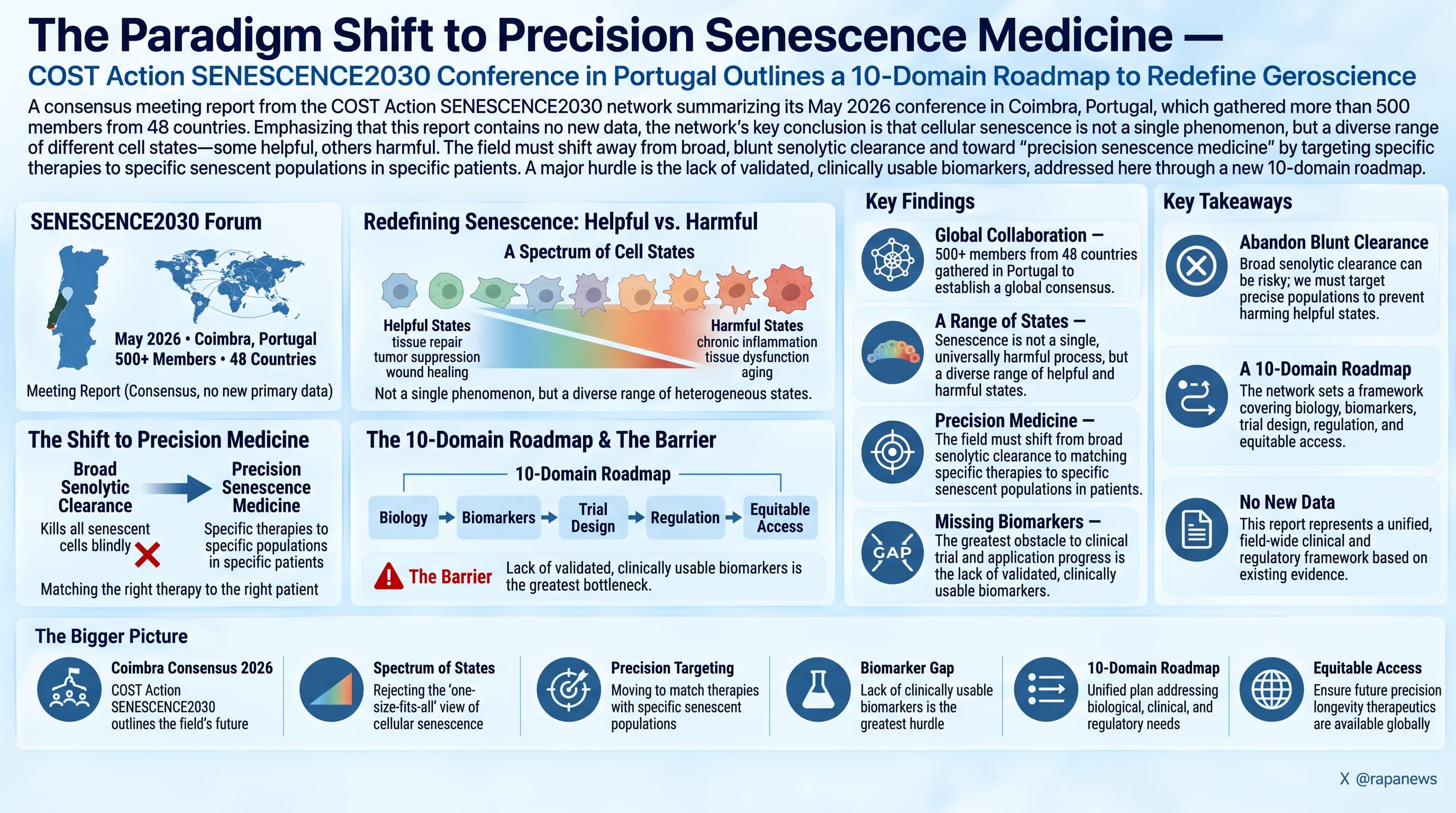
A meeting report from the COST Action SENESCENCE2030 network sums up the conclusions of its May 2026 conference in Coimbra, Portugal. The network has more than 500 members from 48 countries. Its main conclusion is that cellular senescence is a range of different cell states, some helpful and some harmful, and not a single phenomenon. The authors say the field has to move away from broad senolytic clearance and toward “precision senescence medicine,” which means matching specific therapies to specific senescent populations in specific patients. The largest obstacle they identify is the lack of validated, clinically usable biomarkers.
For more than a decade, the case for senolytic drugs has been simple. Old, damaged “zombie” cells build up in our tissues and leak inflammatory signals, and clearing them out slows aging. Mice treated this way live longer and healthier lives. The idea produced companies, clinical trials and a large supplement market.
A new consensus report from SENESCENCE2030, a European network of more than 500 scientists, quietly retires that story. After a two-day meeting in Coimbra in May 2026, the group concluded that senescence is not one thing. It is a family of related cell states that vary by tissue, trigger, age and time, and some of those states do useful work.
Senescent cells help heal wounds, shape embryos, regenerate tissue and stop damaged cells from becoming cancerous. In those roles they appear briefly and the immune system then removes them. Problems begin when they persist. The report argues that persistence, abundance and location decide whether a senescent cell helps or harms, and that its mere presence does not.
The group uses the term “senotypes” for these distinct states, while admitting there is no agreed way to define or classify them yet. The practical result is a call to move from broad elimination toward precision. That means choosing which senescent populations to target, in which patients, at what stage of disease, and with which drug. The authors compare this to oncology’s shift from blanket chemotherapy to molecularly targeted treatment.
The report names measurement as the biggest obstacle. No single marker reliably identifies senescent cells across tissues. The classic tags (p16, p21 and a stain for beta-galactosidase activity) also show up in healthy cells doing normal jobs. Participants proposed splitting biomarkers into four roles:
- Burden: how many senescent cells are present.
- Identity: which kind they are.
- Activity: what they are doing.
- Response: whether a treatment worked.
The group saw blood-based panels as the most promising route to something cheap and minimally invasive. These would combine proteins, metabolites and extracellular vesicles, possibly integrated with machine learning.
The report also widens the treatment options beyond senolytics. It includes senomorphics, which calm harmful secretions without killing the cell. It also lists immune-based clearance, metabolic and mitochondrial modulators, epigenetic drugs and vesicle-based therapies.
Readers should be clear about what this document is. It is a meeting report, not a study. It has no new data, no trial results and no effect sizes. Its “consensus” came from talks and roundtables, not from a formal structured voting process. Several biotech companies took part, and the corresponding author discloses financial ties to two companies focused on senescence. None of this makes the conclusions wrong, and most of them fit the wider literature. But it is a strategy paper. Its value is in showing where serious researchers think the field is heading.
The message is sobering for anyone taking senolytics on a schedule today. The people who know this biology best say they cannot yet measure who needs treatment, which cells to target, or whether it worked.
Actionable Insights
This is a consensus meeting report with no participants, interventions or outcomes measured.
The practical take-home messages are about how to interpret evidence, not about specific protocols.
- Clearing more senescent cells is not automatically better. Senescent cells support wound healing, tissue repair and tumor suppression. Aggressive senolytic cycling around surgery, injury or training blocks has a plausible downside that has not been ruled out.
- No consumer test currently measures your “senescent burden” reliably. Treat any commercial p16, beta-galactosidase or SASP panel marketed for self-tracking as exploratory.
- Persistence is the problem, not presence. Interventions that support immune clearance and limit chronic inflammation fit the model at least as well as drugs that kill cells. Examples are exercise, metabolic health and avoiding chronic infection.
- The field now treats senomorphics, which dampen harmful secretions, as legitimate options alongside senolytics. This puts mTOR-pathway (e.g. rapamycin) and metabolic interventions in the same conversation.
- Wait for trials that use biomarker-based patient selection before drawing firm conclusions about any senotherapeutic in humans.
Context and Source
- Full title: A consensus roadmap from the SENESCENCE2030 network towards precision senescence medicine
- Paywalled Meeting Summary: SENESCENCE2030 Meeting Report, published online 3 September 2026.
-
Institution:
- Corresponding author Marco Demaria is at the European Research Institute for the Biology of Ageing (ERIBA), University of Groningen and University Medical Center Groningen.
- The authors span 33 affiliations, mostly in Italy, the UK, Spain and Austria.
- Country: the Netherlands (corresponding author); multinational, mainly European, consortium
- Journal: Nature Aging (Nature Portfolio)
- Impact evaluation: The impact score of this journal is 25.0, evaluated against a typical high-end range of 0–60+ for top general science, therefore this is a High impact journal.