Dihydronicotinamide Riboside (NRH): Complete Evidence Review
Bottom Line Up Front
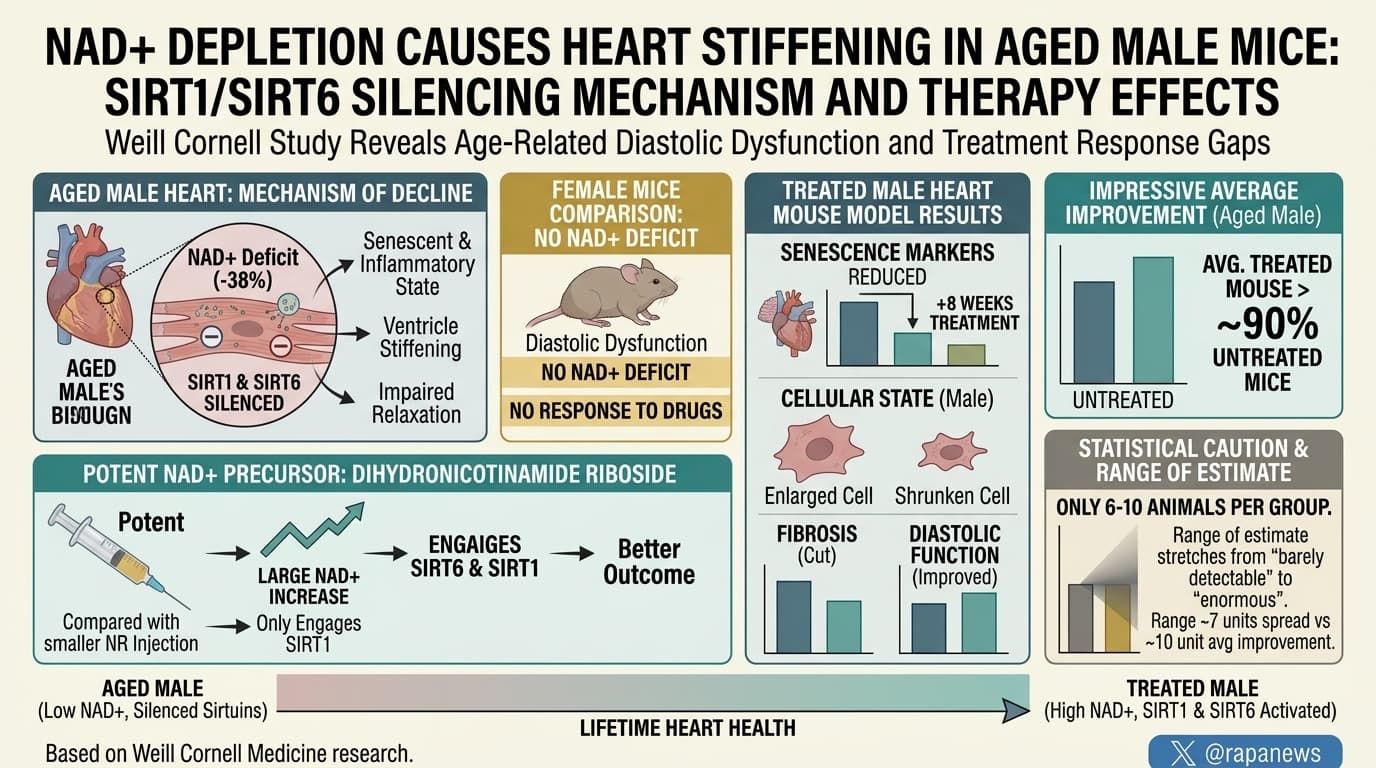
NRH is the most potent NAD+ precursor yet characterized, raising tissue NAD+ several-fold where nicotinamide riboside manages 1.5-fold. It is also the only NAD+ precursor with a documented, reproducible toxicity ceiling in mice, and the gap between the effective dose and the toxic dose is roughly three to four fold. There are zero human data of any kind: no pharmacokinetics, no safety study, no efficacy trial, no registered clinical trial, and no FDA new dietary ingredient notification. The entire evidence base is seven years old, comprises roughly a dozen primary papers, and rests on two laboratories plus a handful of collaborators.
Pharmacokinetics
This is the least developed part of the evidence base, resting essentially on two studies.
Absorption and circulating profile
Single 250 mg/kg intraperitoneal dose in young male C57BL/6J mice: blood levels of NRH peaked at 5 minutes with a Cmax of 65.7 micromolar, disappeared by 60 minutes, and showed a half-life of 8.2 minutes. Pre-treatment with ABT702, an adenosine kinase inhibitor, prolonged NRH serum presence with a Cmax of 111.6 micromolar. ScienceDirect
An independent report using the same dose found peak circulating concentrations at 15 minutes, declining steeply to near-undetectable by 4 hours. [Confidence: High that the compound clears within an hour, Medium on the precise half-life given single-study status]
An 8.2 minute half-life is extremely short. For comparison, most oral supplements aim for hours. The implication is that NRH does not produce a sustained plasma exposure; it produces a spike.
Oral bioavailability and biodistribution
This is the strongest PK dataset available, using a dual-labeled tracer.
Two hours after an oral dose of 250 mg/kg of isotopically labelled M+7 NRH (labelled on both the nicotinamide moiety with 18O and the ribose with 13C5), NRH was distributed in all tissues and body fluids analysed, including plasma, urine, liver, lung, pancreas, kidney, heart, muscle and brain. High relative values of NRH were found in urine, plasma and kidney; brain was the tissue with the poorest distribution, as expected due to the blood-brain barrier. Nature
Crucially, labelling showed two parallel routes. NRH led to labelling of liver NAD+ both through direct label incorporation (M+7) and via nicotinamide (M+2). So even orally, a portion of NRH is degraded to nicotinamide and recycled conventionally, exactly like NR. Intact delivery is real but partial. Nature
The comparison to NR is the point of the experiment. The detection of NRH in plasma and tissues contrasts with other NAD+ boosters such as NR and NMN, which can hardly be detected after oral administration, and Liu et al. failed to detect isotopically labelled NR in circulation up to 135 minutes after oral administration. NatureNature
NRH is orally bioavailable and not degraded in plasma, which distinguishes it from NR, whose circulating levels are quickly curtailed by degradation to nicotinamide. ScienceDirect
What has never been measured: an actual bioavailability fraction. No study reports F, no study has done matched intravenous versus oral dosing, and no AUC comparison exists. “Orally bioavailable” in this literature means “detectable after oral dosing,” not a quantified percentage. [Confidence: High that F has not been determined]
Elimination
High relative values of NRH were found in urine, indicating substantial renal excretion of intact compound. No formal mass balance, clearance, or volume of distribution has been published. No metabolite profiling of excreted species exists beyond the pyridone chemistry described above. Nature
PK summary table
| Parameter |
Value |
Species, route |
Status |
| Cmax |
65.7 uM |
mouse, 250 mg/kg IP |
single study |
| Tmax |
5 to 15 min |
mouse, IP |
two reports |
| Half-life |
8.2 min |
mouse, IP |
single study |
| Detectable duration |
under 60 min |
mouse, IP |
consistent |
| Oral absorption intact |
yes, all tissues at 2 h |
mouse, 250 mg/kg gavage |
single study, tracer |
| Oral bioavailability (F) |
never measured |
- |
absent |
| Plasma stability |
stable, unlike NR |
mouse |
replicated |
| BBB penetration |
yes, lowest of all tissues |
mouse |
single study |
| Primary excretion |
urinary, intact |
mouse |
single study |
| Clearance, Vd, AUC |
never reported |
- |
absent |
| Human PK |
none |
- |
absent |
6. Pharmacodynamics
The PD profile contains the field’s most important and least discussed finding: acute and chronic dosing produce opposite effects on NAD+ redox state, and chronic dosing does not raise steady-state NAD+ at all.
Disease Model Evidence
Every entry below is rodent or cell culture. No human data exist for any indication.
Cisplatin acute kidney injury. NRH prevents cisplatin-induced acute kidney injury in mice, with measurement of kidney NAD+ metabolites and poly-ADP-ribosylation and PARP1 levels, consistent with cisplatin-triggered PARP activity depleting NAD+ and NRH restoring it. [Confidence: Medium, single study] Amsterdam UMCResearchGate
Diet-induced obesity, prevention. Mice supplemented with NRH at 100 mg/(kg*day) in drinking water showed robust protection against diet-induced body weight gain, attributable to decreased fat depot weight, along with protection against high-fat-diet-induced increases in fasting glycemia and insulinemia, better glucose clearance, and prevention of increases in circulating ALT, creatinine and LDL-cholesterol. Across liver, brown adipose, and both white adipose depots, NRH reduced the number of high-fat-diet-induced differentially expressed genes by 90% or more. [Confidence: Medium to High, well powered, open access, independent of the discovering lab] NatureNature
Toxicity and the Therapeutic Window
This is where NRH separates from every other NAD+ precursor, and it deserves the most attention.
Cell culture signals, 2020 onward
Hepatocellular carcinoma HepG3 cells show dose-dependent cytotoxicity when supplemented with 100 to 1000 micromolar NRH. At 100 micromolar, a significant increase in ROS was observed concurrent with changes in the NAD(P)H and GSH/GSSG pools. NRH altered mitochondrial membrane potential, increased mitochondrial superoxide formation, and induced mitochondrial DNA damage in those cells, and also caused metabolic dysregulation, altering mitochondrial respiration. The mechanism was PUMA and BAX-mediated apoptosis. HEK293T cells were unaffected at 100 micromolar while HepG3 showed significant loss of viability, establishing that the toxicity is cell-type specific rather than universal. Dihydronicotinamide riboside promotes cell-specific cytotoxicity by tipping the balance between metabolic regulation and oxidative stress | PLOS One +2
The definitive in vivo dose-response, 2026
The Nature Communications study ran 16 weeks of drinking-water dosing plus a two-week dose-ranging arm. The results:
At 100 mg/kg/day for 16 weeks: no alterations in basic blood biochemistry markers, including markers of liver damage (ALT, AST, alkaline phosphatase), bone, kidney (creatinine), or muscle (creatine kinase). Triglyceride and cholesterol levels were also comparable. Body weight, composition, food and water intake, activity, treadmill performance, energy expenditure and glucose tolerance were all unchanged. Nature
At 400 mg/kg/day for 16 weeks: male mice showed higher daily spontaneous activity during the light phase, driven by spikes of activity occurring every 3 to 4 hours, which were not observed at 100 mg/(kg*day). These measures were carried out in two independent batches of mice, all showing this abnormal behavioural pattern. The altered behaviour in males was also observed in the treadmill test, revealing lower performance that did not necessarily stem from fatigue per se, but from a failure to properly engage into the running test. High NRH doses led to increased circulating ALT and creatinine levels both in males and females, which may be reflective of hepatic and renal damage, as well as decreased levels of alkaline phosphatase. Nature
Mechanism of the toxicity: immunofluorescence analyses revealed a significant increase in the number of gamma-H2AX positive nuclei, but only in male mice treated with 400 mg/(kg*day), and poly-ADP-ribosylation levels were notably higher in liver homogenates from those mice. Nature
Dose-ranging at two weeks (0, 100, 200, 300, 400): a dose-dependent decrease in circulating alkaline phosphatase was already evident, reaching significance at 300 mg/(kgday). Transcriptomic analyses revealed significant gene expression changes across all tested doses, including at 100 mg/(kgday), a dose that showed no effect in the chronic supplementation study. Circadian rhythms emerged as the most significantly altered category at the toxic dose, with other enriched terms including cell cycle regulation, radiation response and glucose homeostasis. Nature
Causal attribution in cells: In AML12 hepatocytes, DNA damage occurred only at the higher dose of 0.5 mM, and 24-hour exposure to NRH 0.5 mM impaired both respiration and glycolytic rates, suggesting treated cells suffered a metabolic breakdown. These effects were reversed by inhibiting adenosine kinase with 5-iodotubercidin, indicating that toxicity arises from excessive NAD(H) synthesis rather than NRH itself. Nature
The authors’ own verdict: signs of toxicity and altered behaviour were detected when mice were dosed with NRH concentrations above 300 mg/(kgday). This suggests that the tolerance window of NRH is more limited than that of other NAD+ precursors, such as the closely related NR, where no adverse effects are observed at doses below 1 g/(kgday). Nature
Therapeutic window, expressed in human-equivalent terms
Using standard body surface area allometric scaling (mouse Km 3, human Km 37, conversion factor 0.081), for a 70 kg adult:
| Mouse dose |
Finding in mice |
Human equivalent |
| 100 mg/kg/day |
clean at 16 weeks |
about 570 mg/day |
| 200 mg/kg/day |
transcriptomic change only |
about 1.13 g/day |
| 300 mg/kg/day |
ALP falls significantly |
about 1.70 g/day |
| 400 mg/kg/day |
ALT and creatinine up, liver DNA damage, behavioural disruption |
about 2.27 g/day |
| 1000 mg/kg single |
tolerated acutely |
about 5.7 g single dose |
This is an allometric estimate, not a pharmacokinetic bridge, and route differences are not captured. But the shape of the result is what matters: the margin between the clean dose and the first biochemical toxicity signal is about three-fold. People routinely take 1 to 2 g/day of NR, a dose range that in the NRH scaling falls between the first toxicity signal and frank hepatic and renal injury. [Confidence: Medium on the absolute numbers, High on the conclusion that the window is narrow]
Clinical Data
There are none.
- No registered interventional trial of NRH or dihydronicotinamide riboside on ClinicalTrials.gov. Every NAD-precursor trial returned in searching is nicotinamide riboside, nicotinamide mononucleotide, or nicotinamide.
- No GRAS notification, no New Dietary Ingredient notification, no FDA correspondence for dihydronicotinamide riboside.
- No human pharmacokinetic study, no single ascending dose study, no repeat-dose tolerability study.
- No genotoxicity battery, no carcinogenicity study, no reproductive toxicology, no second-species repeat-dose toxicology.
A labelling warning worth flagging for your audience. An FDA New Dietary Ingredient notification exists for something abbreviated “NRHM,” but NRHM is nicotinamide riboside combined with L-malic acid, where L-malic acid is affirmed as GRAS as a direct food substance. That is nicotinamide riboside hydrogen malate, an entirely different compound from dihydronicotinamide riboside. Anything marketed with “NRH” or “NR-H” on the label is far more likely to be the malate salt of ordinary NR than the reduced dihydro form. [Confidence: High on the identity of NRHM, Medium on the prevalence of the labelling confusion in the market] Regulations
Practical Assessment
NRH is a genuinely interesting compound with a genuine biochemical advantage: it survives plasma, it reaches tissues intact after oral dosing including across the blood-brain barrier, and it uses a pathway that does not depend on NRK1 or on microbiome-mediated deamidation. Those are real answers to real limitations of NR and NMN. [Confidence: High]
It also has a documented narrow therapeutic index, a mechanistically coherent explanation for that narrowness (reductive stress from NADH overproduction), liver DNA damage at four times the clean dose, and a chronic-dosing profile that does not actually elevate steady-state NAD+ in the tissues measured. [Confidence: High]
For anyone weighing this as a personal intervention, the relevant facts are that no human has been dosed with it in a study, the compound isomerizes into cytotoxic species, the effective-to-toxic margin in the only long-term animal study is about three-fold, and the toxicity operates through DNA damage in the liver rather than through anything self-limiting like nausea.