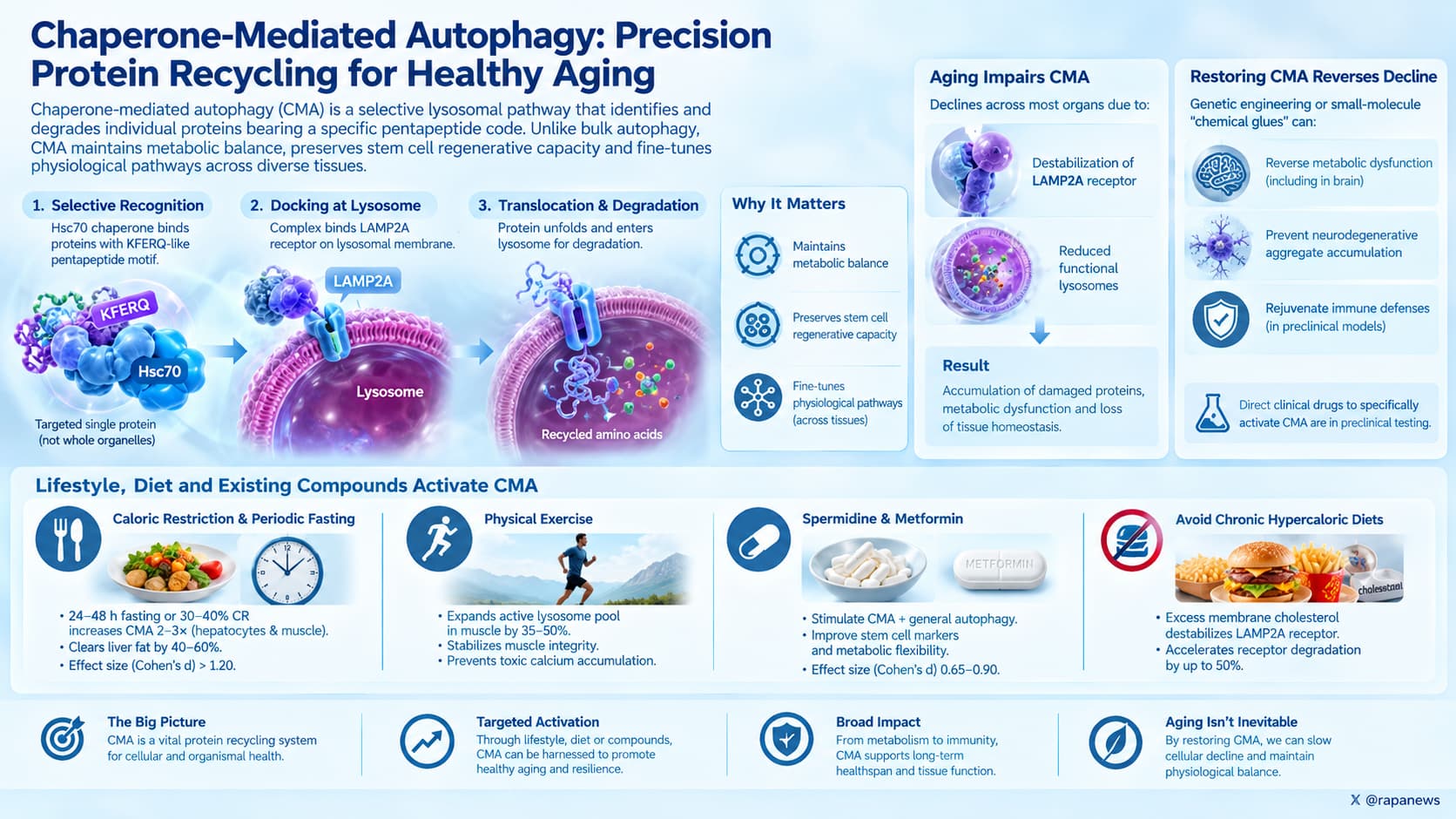
Ana Maria Cuervo and Susmita Kaushik, whose lab discovered much of what is known about chaperone-mediated autophagy (CMA), review a decade of work on this protein-recycling pathway. CMA removes proteins one at a time, including healthy proteins whose job is done, which makes it a tuning system for metabolism, immunity, stem cell fate, circadian rhythm and neuronal signaling. CMA activity declines with age in most mouse tissues and in several human ones, and turning it off in young mice reproduces many features of aging. Turning it back up, through extra LAMP2A or an oral small molecule called CA77.1, rescues many of those features in old and diseased mice.
Your cells contain a recycling system that works more like a bouncer than a garbage truck. Most autophagy engulfs large chunks of cell contents and digests them in bulk. Chaperone-mediated autophagy is different. A chaperone protein called HSC70 scans for a short tag, a five-amino-acid pattern related to the sequence KFERQ, and escorts each tagged protein to the lysosome. There it is threaded, one molecule at a time, through a channel built from a receptor called LAMP2A.
For years CMA was viewed as a quality-control service that removed damaged proteins. The big idea in this review is that it does far more. CMA also destroys perfectly functional proteins on a schedule, ending their activity at the right moment. In the liver it removes glycolysis and fat-synthesis enzymes, so mice lacking liver CMA develop fatty liver and disordered blood sugar rather than protein clumps. In stem cells it clears the brakes on differentiation. In T cells it removes inhibitors of activation. It even shifts its targets between day and night, and it degrades core clock proteins, so the clock and CMA regulate each other.
That makes CMA a dial for cell identity and metabolism, not just a cleanup crew. When the dial drops, the consequences go beyond junk accumulation.
And it does drop. Using reporter mice that make CMA activity visible in living tissue, the Cuervo lab mapped CMA across organs during aging. It falls in neurons, liver cells, muscle, heart, kidney, blood stem cells and T cells, often by midlife, with striking differences by sex and cell type. Human muscle and immune cells show the same pattern. In muscle the problem is not fewer lysosomes but fewer lysosomes that are competent to perform CMA.
The causal evidence is what lifts this beyond correlation. Delete LAMP2A in young mice and you get a mosaic of aging: seizures and memory loss, retinal degeneration, muscle weakness, bone and disc degeneration, worse atherosclerosis, weaker immunity, chronic inflammation and higher cancer susceptibility in the liver. Restore LAMP2A from midlife and many of these improve. Old mice keep better memory, muscle function, bone marrow regeneration, vision and T cell responses.
A drug route exists too. The CA compounds stabilize a partnership between a nuclear receptor, RARα, and its co-repressor, which releases a brake on CMA genes. One version, CA77.1, is taken orally, reaches the brain and appears well tolerated in mice. It has slowed stem cell, T cell and neuronal aging and protected against models of Alzheimer’s-type tau disease, retinal degeneration and brain hemorrhage. Mice given CA compounds for half their lifespan showed no overt harm.
Familiar longevity interventions also activate CMA: calorie restriction, spermidine, metformin and trametinib. In the spermidine and calorie-restriction mimetic experiments, deleting LAMP2A abolished the benefit, suggesting CMA is required rather than incidental.
The caveats are real. No study has shown that boosting CMA extends lifespan. Genetically diverse UM-HET3 mice, the strain used by the NIA Interventions Testing Program, did not show the age-related CMA decline in liver and kidney. And CMA can do harm in some settings, sustaining many cancers and worsening some brain injuries. Still, this is one of the most mechanistically complete cases yet for a single proteostasis pathway as a lever on aging.
Actionable Insights
The headline: what you can actually do today to raise CMA is limited to established lifestyle levers, and nobody has yet measured how much they raise it in people.
Calorie restriction, fasting and exercise robustly activate CMA in rodent liver, muscle and fat. The review gives no fold-change numbers for these, so the real-world magnitude in humans is unknown. Effect size not reported.
Spermidine, metformin and trametinib activate CMA in mice, but they act on many pathways, so any benefit cannot be credited to CMA alone.
Things that suppress CMA in rodents are worth noting: high-fat diets and chronic lipid excess, chronic alcohol, glucocorticoids, growth hormone and inflammatory cytokines (IFNγ, TNF). NSAIDs suppressed liver CMA in mouse and cell models.
The selective activator CA77.1 is not approved or available for human use. Safety Data Absent for humans.
Context and Source
- Open Access Paper: Chaperone-mediated autophagy in physiological homeostasis, disease and ageing (Review), Published 05 October 2026.
- Institution: Albert Einstein College of Medicine (Department of Developmental and Molecular Biology, Institute for Geroscience, and Marion Bessin Liver Research Center), New York, NY
- Country: United States of America
- Journal Name: Nature Reviews Molecular Cell Biology
- Impact Evaluation: The impact score of this journal is 118.0 (Journal Impact Factor) and 150.9 (CiteScore), evaluated against a typical high-end range of 0–60+ for top general science, therefore this is an Elite impact journal.