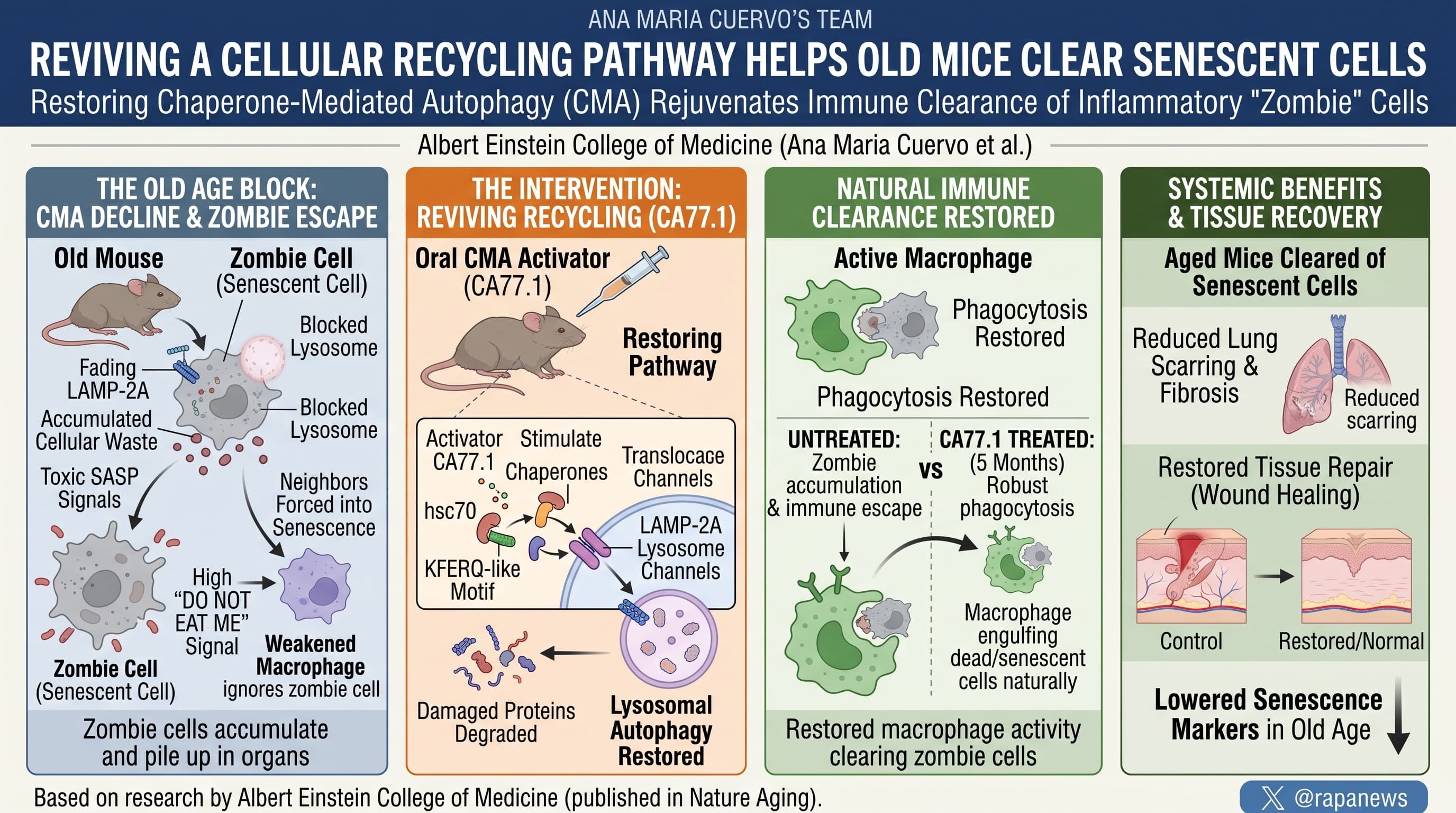
A team led by Ana Maria Cuervo at Albert Einstein College of Medicine reports that the age-related decline of chaperone-mediated autophagy (CMA), a selective protein recycling route inside lysosomes, helps senescent cells escape removal. Cells lacking CMA still become senescent, but they release an altered mix of signals that pushes neighbours toward senescence and weakens macrophages. Macrophages lacking CMA keep a “do not eat me” receptor on their surface and engulf fewer dead and senescent cells. Mice with CMA deleted in myeloid cells carried more senescence markers in old age and healed wounds more slowly. An oral CMA activator, CA77.1, given for five months to old mice lowered several senescence markers and, in a separate experiment, reduced bleomycin-induced lung scarring in young males when started early.
Senescent cells, the worn-out cells that stop dividing but refuse to die, are normally cleared by the immune system. In old age they accumulate, and nobody is quite sure why the clean-up fails. A study in Nature Aging points to a specific culprit: the slow loss of a cellular recycling pathway called chaperone-mediated autophagy.
CMA is a selective disposal route. A chaperone protein picks out individual proteins carrying a particular tag and delivers them to a receptor, LAMP2A, on the lysosome, the cell’s recycling compartment. The pathway weakens with age in most tissues.
The researchers found two consequences of that decline. First, young fibroblasts ramp up CMA when they are pushed into senescence, but fibroblasts from 23-month-old mice do not. Without that boost, the cells fail to remodel their protein content properly, and the cocktail of molecules they secrete changes. Young cells engineered to lack CMA reproduced close to half of the protein changes seen in old cells. Their secretions drove healthy neighbouring cells toward senescence and were toxic to macrophages.
Second, macrophages themselves depend on CMA. Without it, they fail to pull a receptor called SIRP-alpha off their surface. That receptor reads the “do not eat me” signal displayed by other cells, so macrophages that keep too much of it become reluctant eaters. In a dish, macrophages lacking the CMA receptor engulfed dying cells at a small fraction of the normal rate.
The team then tested this in animals. Mice whose macrophages lacked CMA showed more senescence markers in fat, liver and lung at 23 months, most clearly in males, and their skin wounds closed more slowly.
Finally, the researchers gave 18-month-old mice an experimental CMA-activating compound, CA77.1, by mouth for five months. Treated animals ended up with fewer cells positive for a standard senescence stain, with the clearest effect in the lung. In young male mice given bleomycin, a drug that scars the lungs, starting the compound two days after injury roughly halved scarring. Starting at seven days helped much less.
The work offers a coherent explanation that ties together two hallmarks of ageing, failing autophagy and accumulating senescent cells, and it comes from the laboratory that has defined this pathway. That is also a reason for care. The compound is patented by two of the authors, and the study did not show that its benefits in living mice depend on CMA. The main senescence stain measures a lysosomal enzyme, in a study that manipulates lysosomes. Nobody measured whether treated mice were stronger, healthier or longer lived. And the lung experiment was preventive treatment of an acute injury in young animals, which has a poor record of predicting success against human pulmonary fibrosis.
Actionable Insights
Nothing here can be applied by people today. CA77.1 is an experimental compound with no human safety or efficacy data.
What the numbers show in mice:
- Senescence stain in old mice. The share of stain-positive cells in fat rose from about 8 to 10 percent in young mice to about 18 to 20 percent in old mice. With CA77.1 it was about 10 percent in males and about 17 percent in females. So the effect ranged from a near-complete reversal to almost none, depending on sex and tissue.
- Lung. The stain signal in old lungs was roughly 3 to 6 times the young level and fell by about half or more with treatment. This was the most consistent result.
- Lung scarring after bleomycin. Early treatment cut scarring by about 55 percent. Late treatment cut it by about 24 percent.
- Losing macrophage CMA. Roughly doubled the senescence stain in male fat and lung, and left wounds visibly larger at day 15.
The practical message is conceptual: clearance of senescent cells may depend on keeping macrophages functional, not only on killing senescent cells directly. Whether any human intervention raises CMA is unproven. Rodent studies link fasting to higher CMA and high-fat diets to lower CMA, but this paper did not test either.
Context and Source
- Open Access Paper: Decline of chaperone-mediated autophagy in aging impairs macrophage clearance of senescent cells
- Institution: Albert Einstein College of Medicine (lead), with Ohio State University, Université Paris Cité and Gustave Roussy, and the University of Pittsburgh
- Country: United States, with collaborators in France
- Journal: Nature Aging, published online 5 October 2026
- Competing interests: CA77.1 is covered by a US patent held by two authors, including the senior author. The senior author also holds equity in Life Biosciences and consults for Generian Pharmaceuticals. Another author holds equity in Generian. The authors state these activities are unrelated to this work.
- Impact evaluation: The impact score of this journal is 25.0 (Journal Impact Factor, 2025 citation data, released June 2026), evaluated against a typical high-end range of 0 to 60+ for top general science, therefore this is a High impact journal.