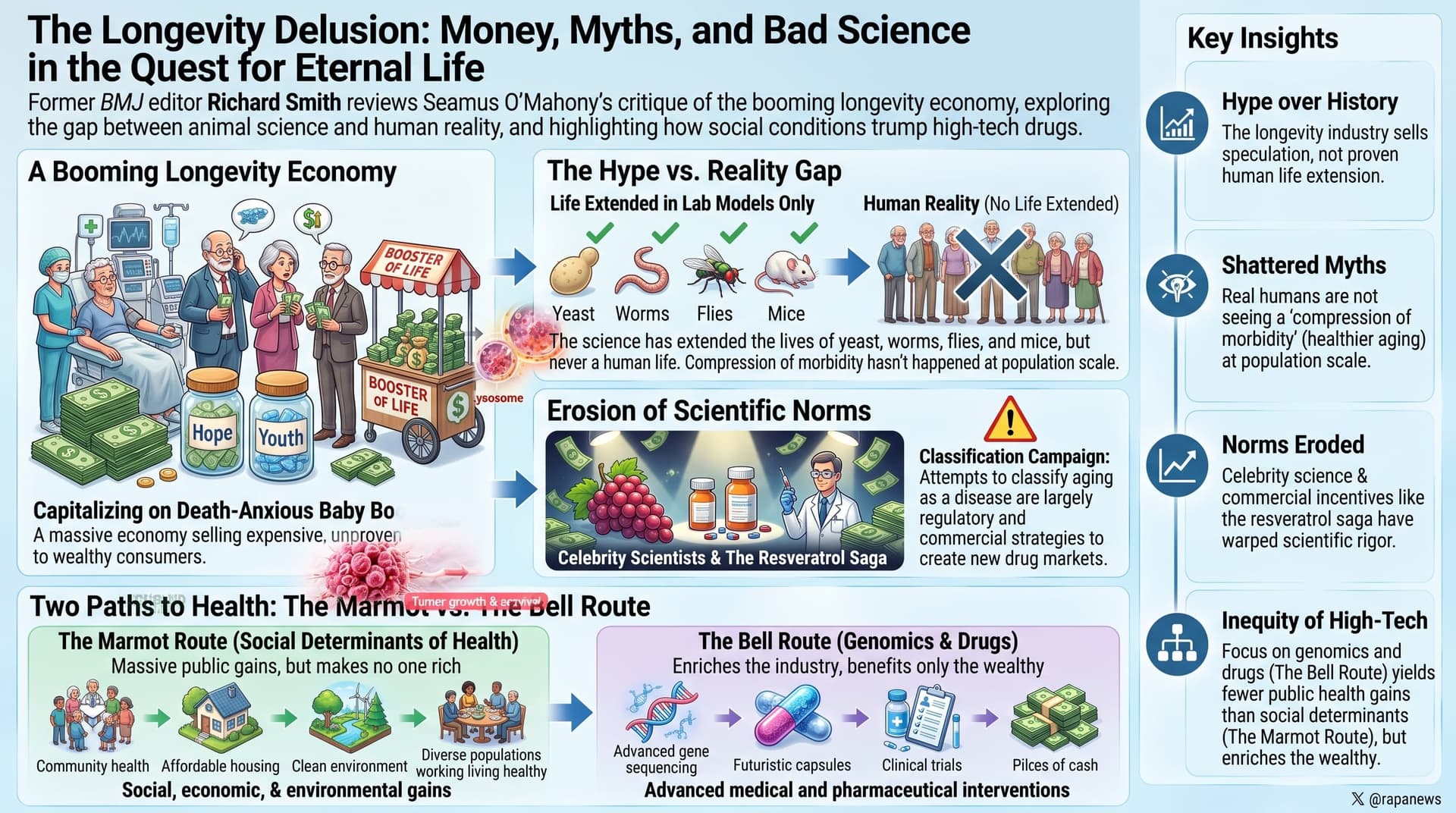
Former BMJ editor Richard Smith reviews The Longevity Delusion: Money, Myths and Bad Science, a new book by retired Irish gastroenterologist Seamus O’Mahony. Smith largely agrees with the book’s argument. A booming longevity economy sells hope to wealthy, death-anxious baby boomers. The science has extended the lives of yeast, worms, flies and mice, but it has never extended a human life. The “compression of morbidity” has not happened at population scale. Celebrity scientists and the resveratrol saga show what happens when commercial incentives erode scientific norms. Social determinants of health, the Marmot route, would deliver far bigger gains than genomics and drugs, the Bell route, but would mostly benefit the poor and make no one rich. The book also warns that the campaign to classify aging as a disease is partly a regulatory and commercial strategy. This is an unreviewed opinion piece about a book.
Every gold rush has its prospectors, its outfitters and its snake-oil sellers. According to Seamus O’Mahony, a retired Irish gastroenterologist, the modern hunt for longer life has all three and very little gold. Writing in The BMJ, former editor Richard Smith reviews O’Mahony’s new book, The Longevity Delusion, and largely endorses its verdict: the business of beating aging has outrun the science of it by decades.
The commercial picture is the easy part. A wealthy and politically influential generation of baby boomers fears frailty and dementia and will pay for anything that promises more years, or better ones. Supplement makers, private clinics, wellness resorts, venture investors and a crowd of online influencers have arrived to meet that demand.
The science is where the book does its real work. Biogerontology has extended the lives of yeast, worms, flies and mice using caloric restriction, genetic tweaks and drugs such as rapamycin. It has never added a measurable year to a human life. O’Mahony makes the scale problem vivid: a nematode has under a thousand cells, while a person has tens of trillions. The field also still lacks an agreed, evidence-backed theory of why we age.
The sharpest section targets the “compression of morbidity,” the 1980 proposal by Stanford rheumatologist James Fries that healthy living could squeeze the illness at the end of life into a shorter window. Governments loved the idea because it implied a cheaper old age. The data have not cooperated. Life expectancy has risen, but years spent in poor health have risen faster. A 2024 analysis of 183 countries put the average gap between total lifespan and healthy lifespan at 9.6 years, with the United States worst at 12.4. Fries himself died with dementia at 83, four years after a disabling stroke.
The book’s cast includes Aubrey de Grey, the theorist behind the SENS damage-repair program, and Harvard’s David Sinclair. Sirtris, the resveratrol company Sinclair co-founded, sold to GlaxoSmithKline for 720 million dollars in 2008 and was shut down by 2013 after its lead compound faltered. Smith uses the episode to illustrate a wider decay in scientific norms, where self-promotion, commercial interest and headline-chasing labs crowd out slower, more careful work.
O’Mahony’s alternative is unglamorous. Michael Marmot’s decades of research show that income, education, housing and community shape lifespan more than any molecule. The catch, as Smith notes, is that fixing those would mostly help the poor, and there is no business model in that.
The book also warns that efforts to have aging classified as a disease are as much about unlocking regulatory pathways and investment as about patient care.
The piece has weaknesses. It is an unreviewed opinion article about a book, not a study. Some claims go further than the evidence: metformin did not extend lifespan in the most rigorous mouse tests, and the resveratrol record is mixed rather than uniformly null. Compression of morbidity also has support at the individual level, even if whole populations have not followed.
The Counter-Argument: The Case for Geroscience: Why “Delusion” Is the Wrong Diagnosis
O’Mahony and Smith are right that the longevity market is crowded with hype. But their argument repeatedly treats the failures of salesmen as failures of the science, and that conflation does not survive a closer look.
First, “never extended human lifespan” is a statement about trials, not biology. No geroprotector has been tested against a human lifespan endpoint, because such a trial would take decades and has never been funded. Statins and blood pressure drugs were never approved on lifespan endpoints either. Absence of evidence produced by absence of trials is not evidence of failure.
Second, the animal data are not trivial. Rapamycin extended median lifespan by roughly a quarter in genetically diverse mice, replicated across three independent sites, and worked in marmosets (very close genetically to humans), and in mice even when started late in life. The mTOR pathway it targets is conserved from yeast to humans. The roundworm cell-count comparison is rhetoric: mice have billions of cells and still respond.
Third, the resveratrol collapse is evidence that the field works. Rigorous programs tested resveratrol and metformin in mice, found no lifespan benefit, and published the nulls. A delusion does not falsify its own flagship molecules.
Fourth, compression of morbidity has been declared dead too early. Population health gaps are measured largely by years lived with diagnosed disease. Earlier diagnosis and longer survival with treated conditions inflate that number even when people stay functional. At the individual level, Fries’s own cohort found that habitual runners had far lower mortality than controls and developed disability later. That Fries himself died with dementia is a single case and says nothing about the hypothesis.
Fifth, the Marmot versus Bell framing is a false choice. Poverty, stress and poor housing appear to act partly by accelerating biological aging. Understanding those mechanisms complements social policy. And the disease-by-disease model the book implicitly defends has diminishing returns, because eliminating any single major killer adds only a few years to population life expectancy. Slowing aging itself is the only strategy that targets heart disease, cancer, dementia and frailty at once.
Sixth, calling aging a treatable condition is not a commercial plot. High blood pressure and bone loss were once dismissed as normal aging too. A regulatory category is what allows rigorous trials with composite endpoints to exist at all.
Finally, the claim that geroscience serves only the rich has it backward. Rapamycin, metformin and acarbose are off-patent generics costing a few dollars a month. If any proves effective, it would be among the most equitable interventions in medicine.
References
- Smith R. The Longevity Delusion: Money, Myths, and Bad Science. BMJ 2026;395:e101072. bmj.com
- Miller RA, et al. Rapamycin-mediated lifespan increase in mice is dose and sex dependent. Aging Cell 2014;13:468-477. PMC
- Strong R, et al. Longer lifespan in male mice treated with a weakly estrogenic agonist, an antioxidant, an alpha-glucosidase inhibitor or a Nrf2-inducer. Aging Cell 2016. PMC
- Hector KL, Lagisz M, Nakagawa S. The effect of resveratrol on longevity across species: a meta-analysis. Biol Lett 2012. The Scientist summary
- Garmany A, Terzic A. Global Healthspan-Lifespan Gaps Among 183 WHO Member States. JAMA Netw Open 2024. PubMed
- Chakravarty EF, Fries JF, et al. Runners cohort mortality and disability. Arch Intern Med 2008. Medical News Today summary
- Li Y, et al. Impact of Healthy Lifestyle Factors on Life Expectancies in the US Population. Circulation 2018. EUR repository
- Olshansky SJ, Carnes BA, Cassel C. In search of Methuselah: estimating the upper limits to human longevity. Science 1990. (Single-disease elimination estimates; not re-verified this session.)