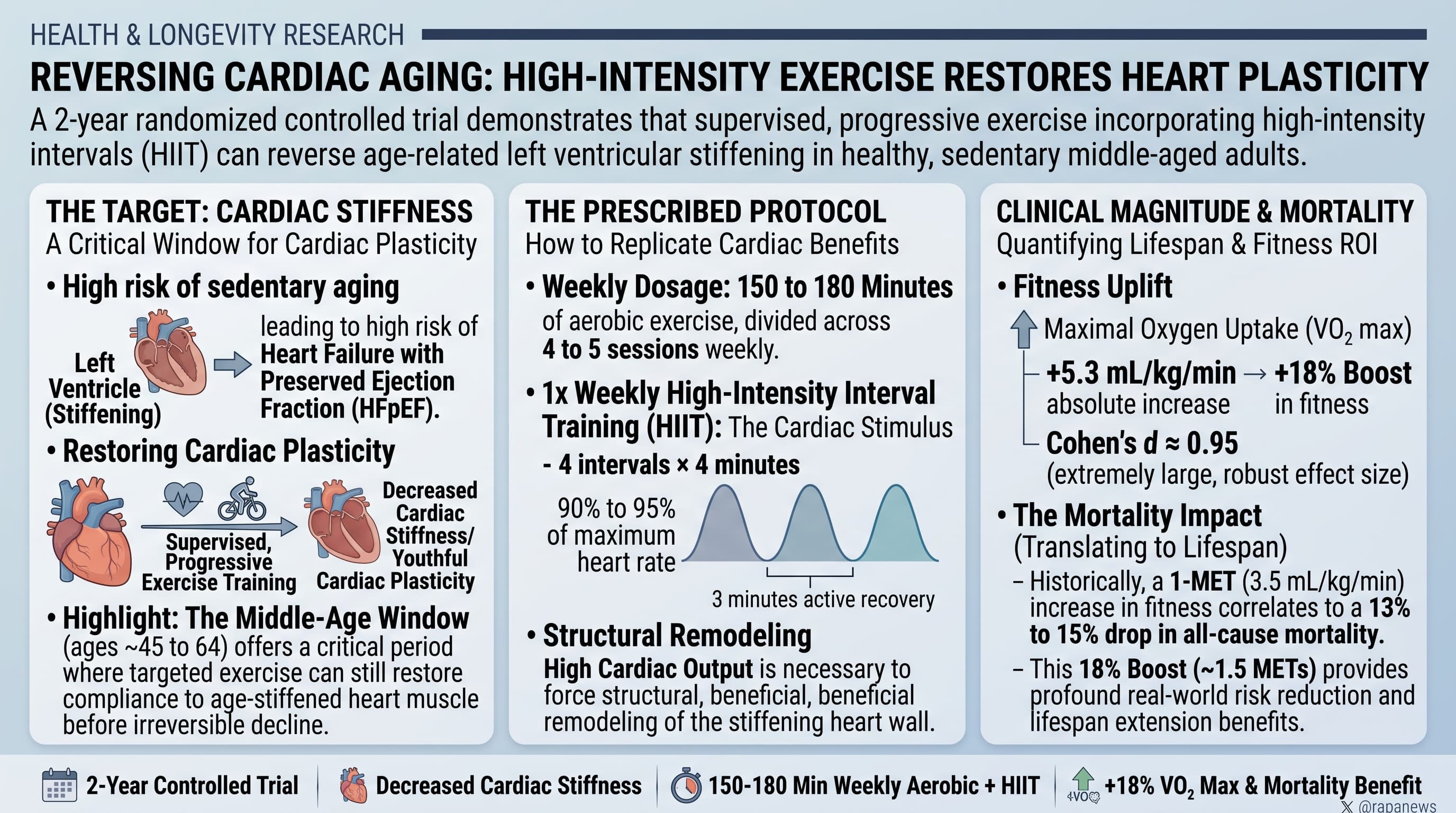
A two-year randomized controlled trial demonstrated that supervised, progressive exercise training incorporating high-intensity intervals can reverse age-related left ventricular stiffening in healthy, sedentary middle-aged adults. The intervention significantly increased maximal oxygen uptake and decreased cardiac stiffness, highlighting a critical window of cardiac plasticity during middle age where targeted exercise can forestall the development of heart failure with preserved ejection fraction.
Sedentary aging leads to severe cardiovascular deterioration. One of the most dangerous physiological manifestations is increased left ventricular stiffness. This stiffness mirrors the cardiac profile of patients suffering from heart failure with preserved ejection fraction. While older adults who have exercised their whole lives maintain compliant, youthful hearts, initiating an exercise regimen after age 65 fails to reverse established ventricular stiffness. This presents a clinical gap regarding when and how to intervene.
This study recruited sedentary but healthy middle-aged adults between the ages of 45 and 64 to determine if cardiac plasticity remains during this transitional life stage. Researchers randomized participants into two groups: a two-year exercise training group and an active control group performing yoga and balance training. The exercise protocol was rigorous and periodized. It escalated to four to five days of training per week, including at least one high-intensity interval session consisting of four minutes at 95 percent peak heart rate followed by three minutes of recovery, repeated four times.
Two years of progressive exercise fundamentally remodeled the middle-aged heart. The exercise group demonstrated a rightward and downward shift in their left ventricular end-diastolic pressure-volume curves. This indicates a more compliant, elastic heart chamber capable of accommodating more blood volume without unsafe spikes in filling pressure. Conversely, the control group experienced no improvements in cardiac compliance or aerobic capacity, cementing the fact that low-intensity balance work is insufficient to reverse cardiac aging. The critical takeaway is that middle age represents a biological transition window for cardiovascular rescue. Intervening with an optimized, intensive exercise prescription before the physiological deficits of older age accumulate can restore cardiac youthfulness and mitigate the risk of late-life heart failure.
Actionable Insights
For individuals aiming to optimize longevity, maintaining a compliant left ventricle is vital. To replicate the cardiovascular benefits observed in this trial, individuals must engage in 150 to 180 minutes of aerobic exercise weekly, divided across four to five sessions. This routine must include at least one weekly session of high-intensity interval training. The prescribed protocol of four intervals of four minutes at 90 to 95 percent of maximum heart rate, separated by three minutes of active recovery, provides the necessary cardiac output stimulus to force structural remodeling of the heart.
The practical magnitude of this intervention is substantial. Participants increased their maximal oxygen uptake by an absolute 5.3 mL/kg/min, or 18 percent, yielding a robust standardized effect size calculated at a Cohen’s d of approximately 0.95. Given that a 1-MET (3.5 mL/kg/min) increase in fitness historically corresponds to roughly a 13 to 15 percent drop in all-cause mortality, this 18 percent boost offers profound real-world lifespan extension benefits. Furthermore, the left ventricular stiffness constant dropped from 0.072 to 0.051, representing a medium-to-large clinical improvement with a Cohen’s d of approximately 0.65. Reversing ventricular stiffness at this scale offers direct mechanical protection against age-related heart failure.
Context/Source
- Open Access Paper: Reversing the Cardiac Effects of Sedentary Aging in Middle Age-A Randomized Controlled Trial. 2018.
- Institution: Institute for Exercise and Environmental Medicine, Texas Health Presbyterian Hospital and University of Texas Southwestern Medical Center.
- Country: United States.
- Journal Name: Circulation.
- Impact Evaluation: The impact score of this journal is 41.3, evaluated against a typical high-end range of 0–45+ for top cardiovascular medicine, therefore this is a Elite impact journal.