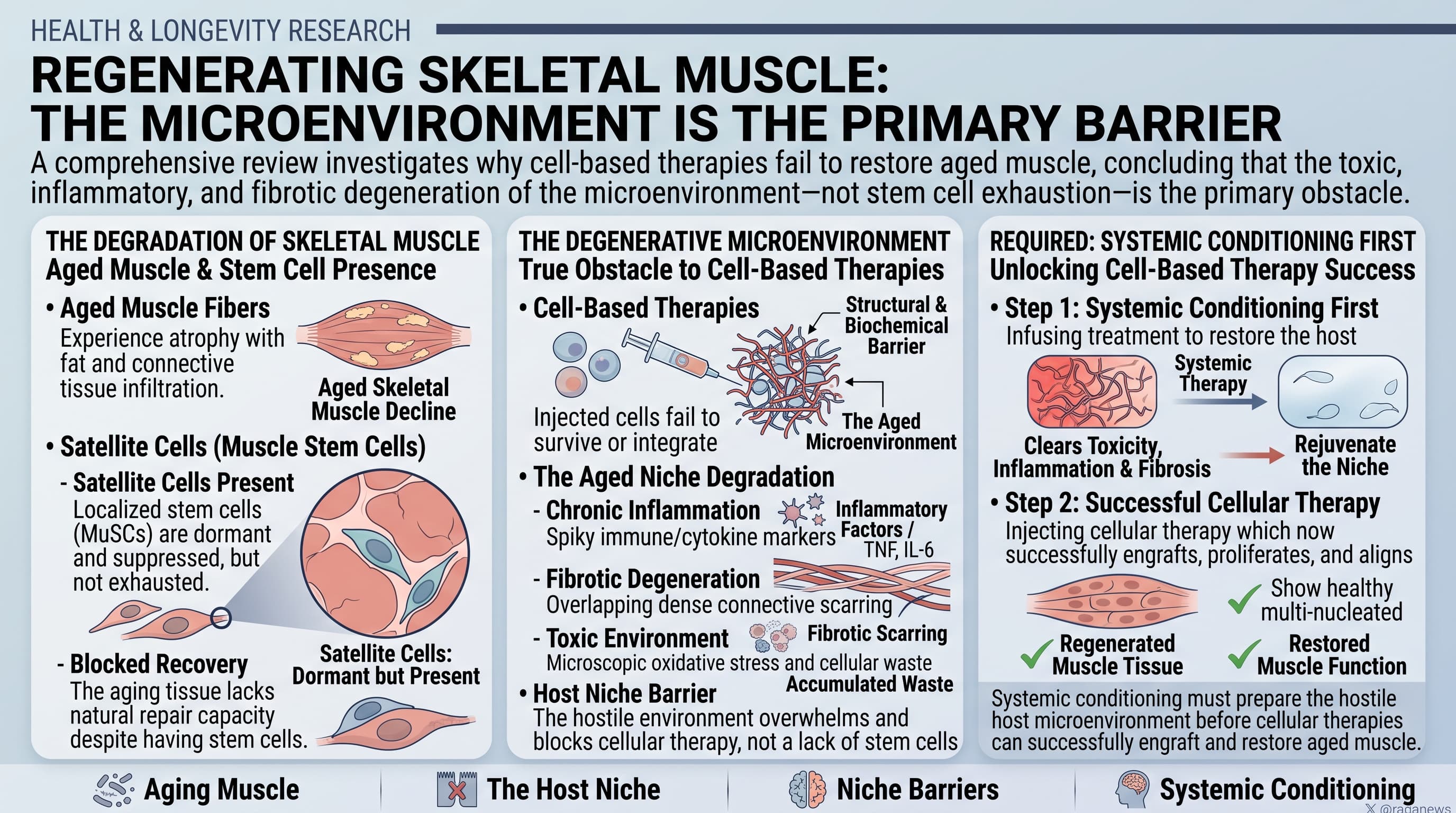
This comprehensive review investigates the breakdown of skeletal muscle regeneration in aging and the structural barriers facing cell-based therapies. It concludes that the primary obstacle to restoring muscle tissue is not the exhaustion of localized stem cells themselves, but rather the toxic, inflammatory, and fibrotic degeneration of their surrounding microenvironment, requiring systemic conditioning before cellular therapies can succeed.
Skeletal muscle makes up roughly 40 percent of adult body mass and serves as a central hub for metabolic homeostasis, glucose regulation, and physical function. As organisms age, this tissue undergoes a catastrophic failure in regenerative capacity, clinically manifesting as sarcopenia. Historically, the longevity field viewed this functional decline as an isolated exhaustion of muscle satellite cells. The current review upends that model. It establishes that primary sarcopenia represents a systemic breakdown of the entire tissue microenvironment rather than just the intrinsic decay of localized stem cells.
This distinction dictates the future of cell therapy. Injecting healthy satellite cells into aged muscle yields remarkably poor engraftment. The aged skeletal muscle niche is actively hostile to regeneration. It is characterized by chronic inflammation driven by the senescence-associated secretory phenotype, significant biomechanical stiffening of the extracellular matrix, and profound vascular decay. Macrophages within this environment fail to execute the critical transition from a pro-inflammatory state to a tissue-reparative state. This immunological failure traps the muscle in a persistent fibrotic loop.
Because the microenvironment suppresses even youthful cells, researchers are pivoting to autologous cell therapies combined with systemic niche conditioning. Induced pluripotent stem cells and direct lineage reprogramming allow scientists to generate scalable patient-specific myogenic progenitors that reset the cellular epigenetic clock. Pluripotency protocols successfully bypass the historic expansion bottlenecks that rapidly degrade the stemness of primary cells. Yet evidence suggests these advanced cells only survive the aged environment rather than actively repairing the surrounding host tissue. True regeneration requires conditioning the host matrix prior to cellular intervention.
Exercise remains the most validated method for niche conditioning. Mechanical loading physically expands the satellite cell pool and reprograms the inflammatory landscape of the aged stem cell niche. Additionally, resolving systemic immune dysfunction is identified as a critical prerequisite. The review highlights how hematopoietic aging, specifically clonal hematopoiesis of indeterminate potential, drives chronic systemic inflammation that actively impairs localized muscle repair. Mutant immune clones flood the systemic circulation with inflammatory cytokines, reinforcing the local fibrotic blockade.
Muscle aging is not a localized structural failure but an integrated systemic collapse. The scientific community must deploy combinatorial strategies that pair advanced autologous stem cell grafts with microenvironmental remodeling to successfully restore contractile function in aging populations.
Their proposed answer has two halves. First, prepare the recipient: exercise, immune resetting, or biomaterial scaffolds that shelter the graft. Second, replace scarce primary cells with muscle progenitors grown from a patient’s own reprogrammed cells, which can be expanded without losing potency. One such product, MyoPAXon, has entered a first-in-human trial, though it was developed for muscular dystrophy and not for sarcopenia.
The authors add a caution. In every aged-animal study so far, the benefit comes from the graft itself. Nobody has checked whether the recipient’s own stem cells recover. The new cells appear to survive in old muscle without repairing it.
Insights
Nothing in this paper supports seeking cell therapy for age-related muscle loss today. There is no approved cell product for sarcopenia, and the review confirms that resistance exercise and nutrition remain the standard of care. Some key points to note:
- Exercise physically alters the stem cell niche by restoring cell cycle regulators like Cyclin D1 and expanding the type II fiber satellite cell pool.
- The magnitude of age-related decline is massive, with sarcopenia prevalence surging from between 5 and 13 percent in populations over 60, up to 50 percent in populations over 80.
- Routine exercise physically intercepts this trajectory by maintaining mechanotransduction signals, mitigating an absolute risk increase of approximately 37 to 45 percent.
- Aged muscle tissue experiences elevated CD38 NADase activity, resulting in severe intracellular NAD+ depletion.
- Interventions that replenish NAD+ or restore basal autophagy directly rescue satellite cell senescence, transforming cells from an irreversible pre-senescent state back into functional stem cells.
- Aged individuals with sarcopenia exhibit an approximate 20 percent reduction in capillary-to-fiber ratio compared to healthy peers.
- Preserving cardiovascular integrity is structurally required for muscle maintenance because capillary endothelial cells provide critical angiocrine signals that sustain muscle stem cell dormancy.
Exercise is the only intervention discussed that a reader can use now. The review cites a human study in which twelve weeks of progressive resistance training expanded the stem cell pool on type II (fast) fibers, the subpopulation most depleted by aging. It gives no numbers for that gain, so the size of the benefit cannot be stated from this paper.
The figures it does report are sobering. In the best human satellite cell trials, donor cells produced working fibers in 3.5 to 21.2 percent of fibers, and only beside the injection track. Bone marrow transplant contributed donor nuclei to 0.5 to 0.9 percent of fibers. Sarcopenic older adults have about 20 percent fewer capillaries per fiber than non-sarcopenic peers, which is one more reason to maintain aerobic and resistance training.
MSC infusions improved physical performance in small frailty trials, but the review reports no magnitudes and the effect is transient. Clinics selling “stem cells for muscle” are running well ahead of this evidence.
Context and Source
- Paywalled Paper: Ageing of the skeletal muscle as a barrier to cell therapy: Cell sources, microenvironmental failure and autologous alternatives
- Institution: Department of Biomedical Engineering, Dongguk University
- Country: South Korea
- Journal: Ageing Research Reviews, online 22 August 2026
- Impact evaluation: The impact score of this journal is 12.4, evaluated against a typical high-end range of 0 to 60+ for top general science, therefore this is a High impact journal