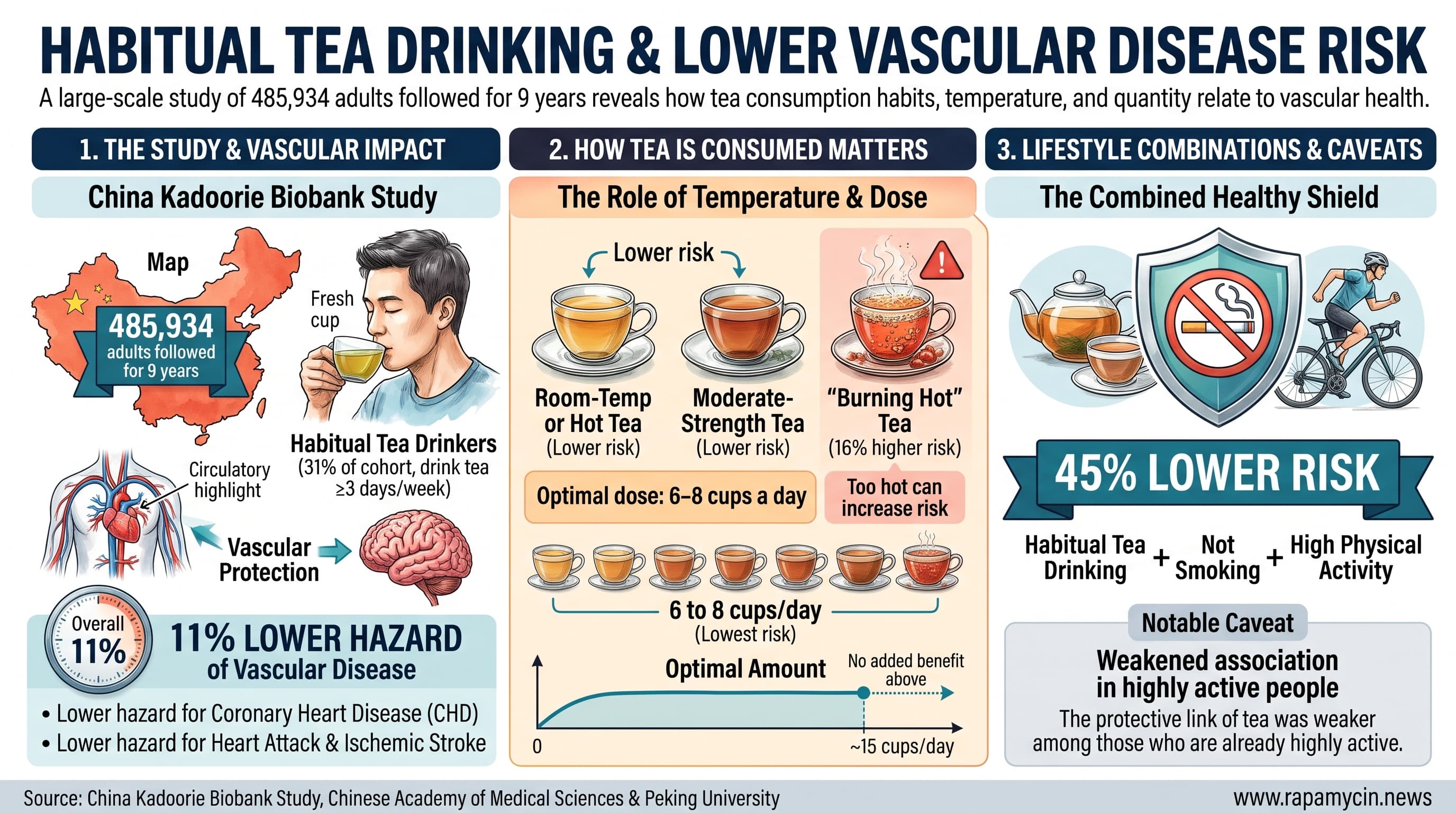
Researchers from the Chinese Academy of Medical Sciences, Peking University and collaborators analyzed 485,934 adults from the China Kadoorie Biobank, followed for an average of 9 years. About 31% drank tea at least three days a week. These habitual tea drinkers had an 11% lower hazard of vascular disease overall than non-habitual drinkers, with lower hazards for coronary heart disease, heart attack and ischemic stroke. The associations depended on how tea was consumed. Moderate-strength tea and room-temperature or hot tea were linked to lower risk, while “burning hot” tea was linked to 16% higher risk. Among weekly drinkers, the lowest risk occurred at roughly 6 to 8 cups a day, with no added benefit above about 15. Habitual tea drinking, not smoking and high physical activity together were associated with 45% lower risk. Tea’s association was weaker among people who were already very active.
Tea is the world’s most widely consumed beverage after water, and its polyphenols have long been suspected of protecting blood vessels. The China Kadoorie Biobank, one of the largest health studies ever run, offers an unusual chance to test that link in a population where tea drinking is deeply embedded in daily life.
This analysis followed nearly half a million adults from ten regions of China, recruited between 2004 and 2008. Participants described their tea habits in detail: how often they drank, how many cups, which type, how strong and how hot. During about nine years of follow-up, nearly 15,000 developed some form of vascular disease, including heart attacks, strokes, lung-related heart disease and peripheral artery problems.
After adjustment for age, sex, education, income proxies, smoking, alcohol, physical activity, body weight and a long list of existing conditions, habitual tea drinkers had 11% lower risk of vascular disease overall. The pattern held for heart disease, heart attack and ischemic stroke, the most common type of stroke. It did not hold for hemorrhagic stroke or pulmonary heart disease.
How people drank tea mattered. Moderate-strength tea was linked to the lowest risk. Room-temperature and hot tea were linked to about 17 to 18% lower risk, while tea described as “burning hot” was linked to 16% higher risk. That fits earlier evidence connecting very hot drinks to esophageal injury and cancer. Black tea showed stronger associations than green tea, unexpected because most earlier studies favor green tea.
Among regular drinkers, risk fell steadily to a low point of about 6 to 8 cups a day and then crept back up, losing its apparent advantage above roughly 15 cups. The authors caution against reading this as a recommendation, since cup size was never standardized.
When tea was combined with other habits, the lowest risk appeared in people who drank tea, did not smoke and were physically active, about 45% lower than in inactive, non-tea-drinking smokers. Tea’s association looked strongest in people with obesity, and it faded among the most active participants. That suggests tea and exercise may affect overlapping pathways.
There are reasons for skepticism. Tea drinkers in this cohort were very different from non-drinkers: nearly two-thirds were men, about half were current smokers (vs one in five non-drinkers), and more drank alcohol. Statistical adjustment can reduce but not erase such differences. Some results are hard to believe: black tea drinkers had roughly 60% lower risk of coronary heart disease, and tea drinkers overall had about 52% lower risk of “other cerebrovascular disease.” Effects of that size from a beverage point to regional differences, chance or unmeasured confounding rather than biology. The study also could not account for coffee drinking or diet.
Even so, the core finding fits a large body of evidence. Moderate tea drinking, especially when not scalding hot, appears compatible with better vascular health. It is best viewed as one part of a healthy lifestyle, with smoking avoidance and exercise carrying far stronger causal evidence.
Actionable Insights
- Habitual tea drinking was associated with about 11% lower vascular disease risk (HR 0.888).
- In absolute terms, about 3.1% of participants developed vascular disease over 9 years (about 3.4 per 1,000 per year).
- An 11% relative reduction corresponds to roughly 0.35 percentage points over 9 years: about 1 fewer case per 290 tea drinkers (computed, assuming causality).
- Avoid scalding hot tea. “Burning hot” tea carried 16% higher vascular risk and is classified by IARC as a probable esophageal carcinogen (above 65°C). Let tea cool for a few minutes.
- Moderate strength and moderate amounts looked best. The lowest risk appeared around 6 to 8 cups a day, with no apparent benefit beyond about 15 cups. Cup size was not standardized, so treat this as approximate.
- Tea does not offset smoking. Tea-drinking smokers still had higher risk than tea-drinking non-smokers.
- If you’re already very active, tea may add little. Its association was not significant in the high-activity group.
- For green tea extract supplements: the cardiovascular associations here come from brewed tea, not extracts. High-dose EGCG supplements (roughly 800 mg/day or more) have been linked to liver injury.
Context and Source
-
Paywalled Paper: Habitual tea consumption is associated with lower cardiovascular disease risk
-
Institutions:
- School of Health Policy and Management and School of Population Medicine, Chinese Academy of Medical Sciences and Peking Union Medical College
- Peking University Health Science Center
- University of Hong Kong; Sun Yat-sen University
- China Kadoorie Biobank Collaborative Group (with Oxford)
- Country: China
- Journal: Journal of Internal Medicine (Wiley)
- Impact evaluation: The impact score of this journal is approximately 9, evaluated against a typical high-end range of 0 to 60+ for top general science and medicine, therefore this is a High impact journal.