Beyond Plain Water: How Everyday Kitchen Staples Slash Produce Pesticides by Half
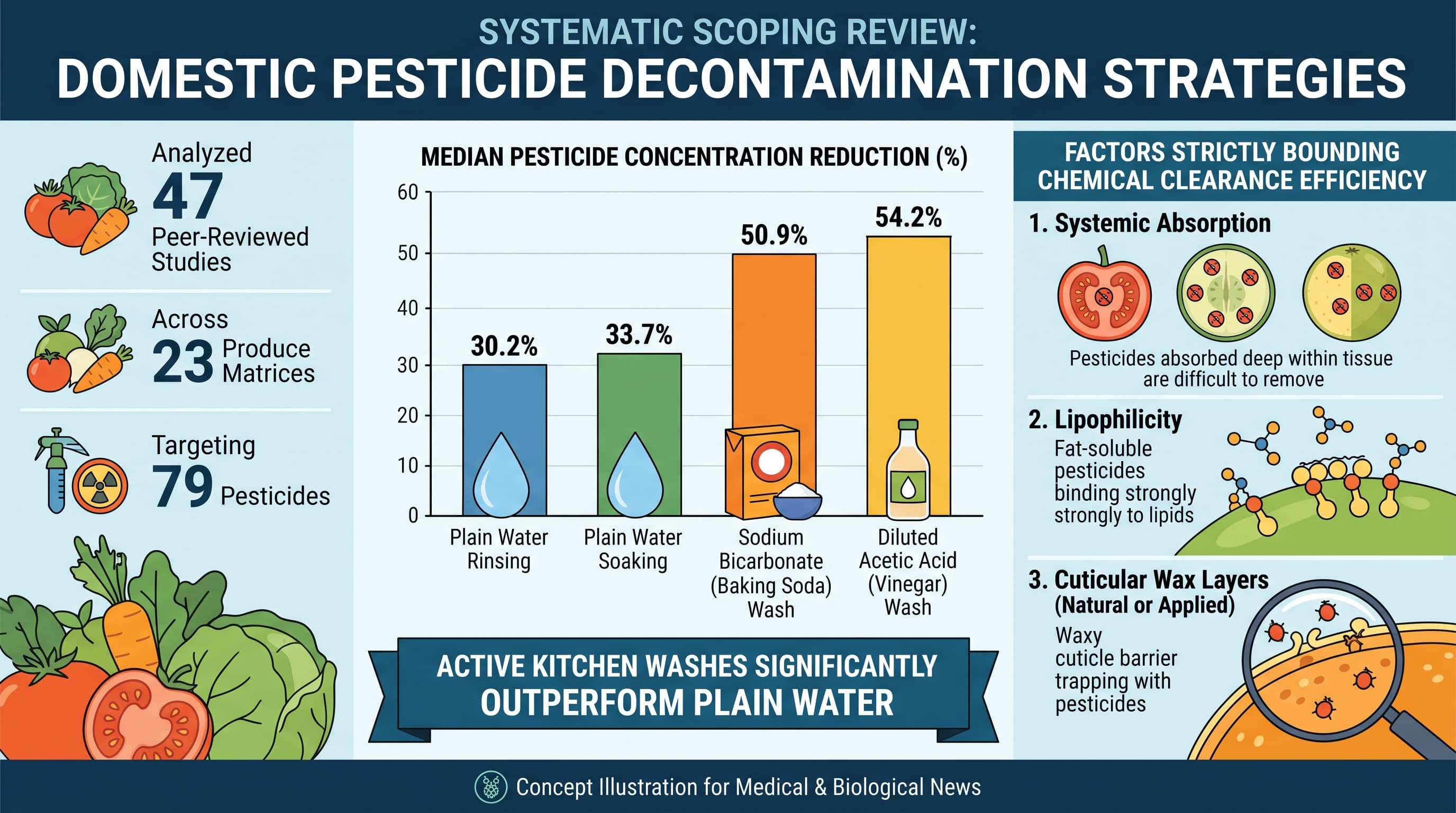
A systematic scoping review analyzing 47 peer-reviewed studies across 23 produce matrices and 79 pesticides evaluated common domestic decontamination strategies. The analysis demonstrated that while plain water rinsing and soaking achieve modest median reductions of 30.2% and 33.7% respectively, active kitchen washes using sodium bicarbonate (baking soda) or diluted acetic acid (vinegar) significantly outperform plain water, achieving median pesticide concentration reductions of 50.9% and 54.2%. Chemical clearance efficiency is strictly bounded by pesticide systemic absorption, lipophilicity, and the presence of natural or applied cuticular wax layers.
Diets rich in fruits and vegetables remain fundamental to cardiovascular and metabolic longevity, yet commercial produce serves as the primary route of civilian exposure to synthetic agrochemicals. Regulatory surveillance, such as the USDA Pesticide Data Program, rinses produce under cold running water for 15 to 20 seconds before testing, an approach that assumes standard home prep will clear significant surface burden. However, comprehensive quantitative synthesis reveals this baseline assumption is overly optimistic.
Analyzing 1,100 extracted data points across global literature, researchers evaluated four consumer practices: cold water rinsing, plain water soaking, soaking in sodium bicarbonate solutions, and soaking in acetic acid or vinegar. Running water rinses, lasting an average of 41 seconds, achieved an overall median pesticide reduction of just 30.2%. Static water soaking for an average of 11 minutes performed marginally better at 33.7%.
The primary barrier to clearance is chemical behavior at the surface boundary. Hydrophobic compounds, characterized by high octanol-water partition coefficients, migrate rapidly into plant cuticles or artificial wax coatings. Highly lipophilic compounds such as lambda-cyhalothrin resist displacement by plain water, remaining embedded in external tissues. Similarly, systemic compounds like azoxystrobin and acetamiprid translocate beneath the epidermis into the vascular system, rendering internal residues physically inaccessible to standard washing.
Introducing active alkaline or acidic solutions substantially alters this dynamic. Baking soda solutions achieved a median reduction of 50.9%, whereas vinegar solutions demonstrated a median removal of 54.2%. These agents enhance the degradation and dislodgement of complex agrochemicals, outperforming plain water rinsing by an absolute margin of 20 to 24 percentage points. Nevertheless, complete elimination of chemical residues was rare across all modalities. While active kitchen soaks significantly lower cumulative xenobiotic intake, structural produce characteristics and pesticide mobility place hard physical limits on how much toxic burden can be eliminated at the sink.
Actionable Insights
Do not rely on quick running water rinses to clean non-organic produce. A 15 to 40 second cold water rinse leaves roughly 70% of detectable pesticide mass on conventional produce.
Soaking produce in a mild alkaline or acidic solution provides a substantial, measurable improvement in residue clearance. Adding either dissolved sodium bicarbonate or diluted distilled vinegar to a produce soak improves pesticide removal from a baseline of roughly 30% to over 50%. In practical terms, this intervention eliminates an additional 20% to 24% of the starting pesticide residue, cutting consumer dietary exposure roughly in half compared to eating produce straight from the store.
Soak firm produce for 10 to 15 minutes before consumption. For smooth, hard-surfaced produce such as apples, tomatoes, and peppers, an alkaline soak accelerates surface breakdown of non-systemic chemicals. However, recognize the biological limits: porous, high-surface-area items like strawberries and leafy greens absorb chemicals internally, where washing solutions cannot reach. For these thin-skinned items, prioritize organic purchasing to prevent internal agrochemical deposition entirely.
Context/Source
- Full Title: Reducing pesticide residues on produce: a scoping review of household produce washing methods
- Institution: Environmental Working Group, Washington, DC, United States
- Country: United States
- Journal Name: Frontiers in Environmental Health
- Impact Evaluation: The impact score of this journal is 2.0 (CiteScore), evaluated against a typical high-end range of 0 to 60+ for top general science, therefore this is a Low impact journal.