The Cellular Blueprint of Centenarians: Rare Genetic Mutations Unify the Body’s Ultimate Survival Pathways
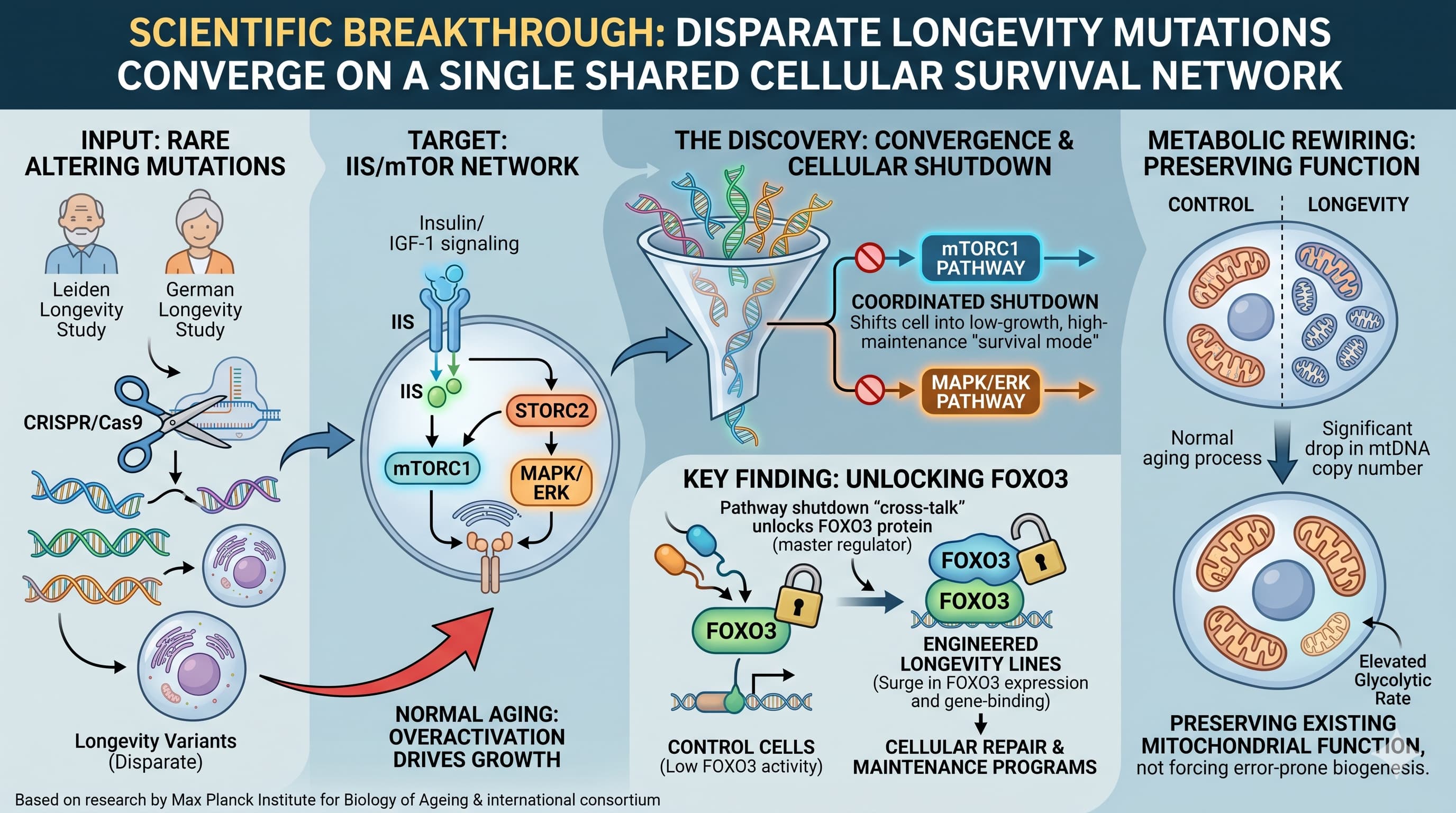
How do some individuals live past 100 while maintaining remarkable health and resilience to age-related diseases? While lifestyle and environment play obvious roles , the hidden engine of extreme human longevity is increasingly traced to rare, inherited genetic mutations. Now, a groundbreaking study by researchers at the Max Planck Institute for Biology of Ageing and an international consortium has revealed that these disparate genetic variants actually converge on a single, shared cellular survival network.
Rather than relying on abstract computer models, the team took rare protein-altering mutations discovered in exceptionally long-lived individuals from the Leiden Longevity Study and the German Longevity Study and engineered them directly into mammalian cell models using CRISPR/Cas9. They targeted the insulin/IGF-1 signaling and mechanistic target of rapamycin (IIS/mTOR) network—a well-known pathway that acts as the cell’s main nutrient sensor and growth engine.
The results uncovered a profound cellular consensus. Despite originating from different genes and individuals, every single longevity variant triggered a coordinated shutdown of both the mTORC1 and MAPK/ERK signaling pathways. These two pathways typically drive cellular growth, protein synthesis, and proliferation, but their overactivation over time accelerates aging. By dampening these engines, the mutations effectively shifted cells into a low-growth, high-maintenance survival mode.
Crucially, this pathway cross-talk acted as a molecular switch to unlock the master longevity regulator, FOXO3. Across all engineered cell lines, Foxo3 expression and gene-binding activity surged. This find bridges a critical knowledge gap, directly showing how suppressing growth networks liberates FOXO3 to activate downstream cellular repair and maintenance programs.
The mutations also drove a fascinating metabolic rewiring. All lines demonstrated an elevated glycolytic rate paired with a significant drop in mitochondrial DNA copy number. This metabolic profile mimics the cellular state found in long-lived animal models, reinforcing the theory that longevity is governed by preserving existing mitochondrial function rather than forcing the biogenesis of new, error-prone powerhouses.
While the cells split into two distinct groups regarding their growth rates and individual stress tolerances—with some cells growing slower but resisting DNA damage, and others multiplying faster—their shared underlying metabolic and signaling characteristics suggest a universal blueprint. Extreme human longevity may not require a flawless genetic hand, but rather a strategic set of rare variations that lock the body’s cells into a highly coordinated, resilient attractor state.
The functional characterization of rare genetic variants found in exceptionally long-lived individuals reveals a striking molecular convergence with the mechanism of action (MoA) of rapamycin. Rapamycin is a well-characterized pharmacological inhibitor of the mechanistic target of rapamycin complex 1 (mTORC1). The mutations analyzed in this study—spanning key nodes in the insulin/IGF-1 signaling (IIS) and mTOR infrastructure (such as DEPTOR , IRS1 , and PHLPP1 ) that replicate the precise downstream biochemical and metabolic footprint achieved by rapamycin therapy.
Actionable Insights
The discoveries in this study validate specific, targetable pathways for biohackers and longevity clinicians looking to replicate the genetic advantages of centenarians:
-
Inhibit Anabolic Growth Pathways (mTOR and MAPK/ERK): Because centenarian mutations naturally down-regulate mTORC1 and MAPK/ERK signaling, utilizing geroprotectors like rapamycin, or practicing intermittent caloric restriction, can mimic this molecular brake, shifting tissues from a state of hyper-proliferation to cell preservation.
-
Maximize FOXO3 Transcriptional Activity: The study confirms that activating FOXO3 is an absolute prerequisite for longevity. Clinicians can support FOXO3 activity through targeted interventions like cold shock therapy, heat shock protocols (saunas), or consuming nutraceuticals like resveratrol, astaxanthin, and green tea catechins, which help uncouple FOXO3 from negative growth regulators.
-
Optimize Mitochondrial Preservation over Proliferation: The drop in mitochondrial DNA levels in long-lived cell lines suggests that anti-aging interventions should focus on mitochondrial quality control rather than biogenesis. Implementing regular zone 2 endurance exercise, supporting cellular NAD+ levels, and prioritizing deep sleep help maintain mitochondrial respiration efficiency, shielding tissues from toxic reactive oxygen species and metabolic exhaustion.
Context & Impact Evaluation
- paper: Rare genetic variants in the IIS/mTOR signalling pathway identified in exceptionally long-lived individuals show shared in vitro effects associated with lifespan across species
- Institutions: Max Planck Institute for Biology of Ageing (Cologne, Germany); Cologne Excellence Cluster on Aging and Aging-Associated Diseases (CECAD), University of Cologne (Cologne, Germany); Section of Molecular Epidemiology, Department of Biomedical Data Sciences, Leiden University Medical Center (Leiden, The Netherlands); Institute of Clinical Molecular Biology, Kiel University (Kiel, Germany).
- Country: Germany and The Netherlands.
- Journal Name: bioRxiv (Preprint server).
- Impact Evaluation: The impact score of this journal is 0 (un-peer-reviewed preprint server)