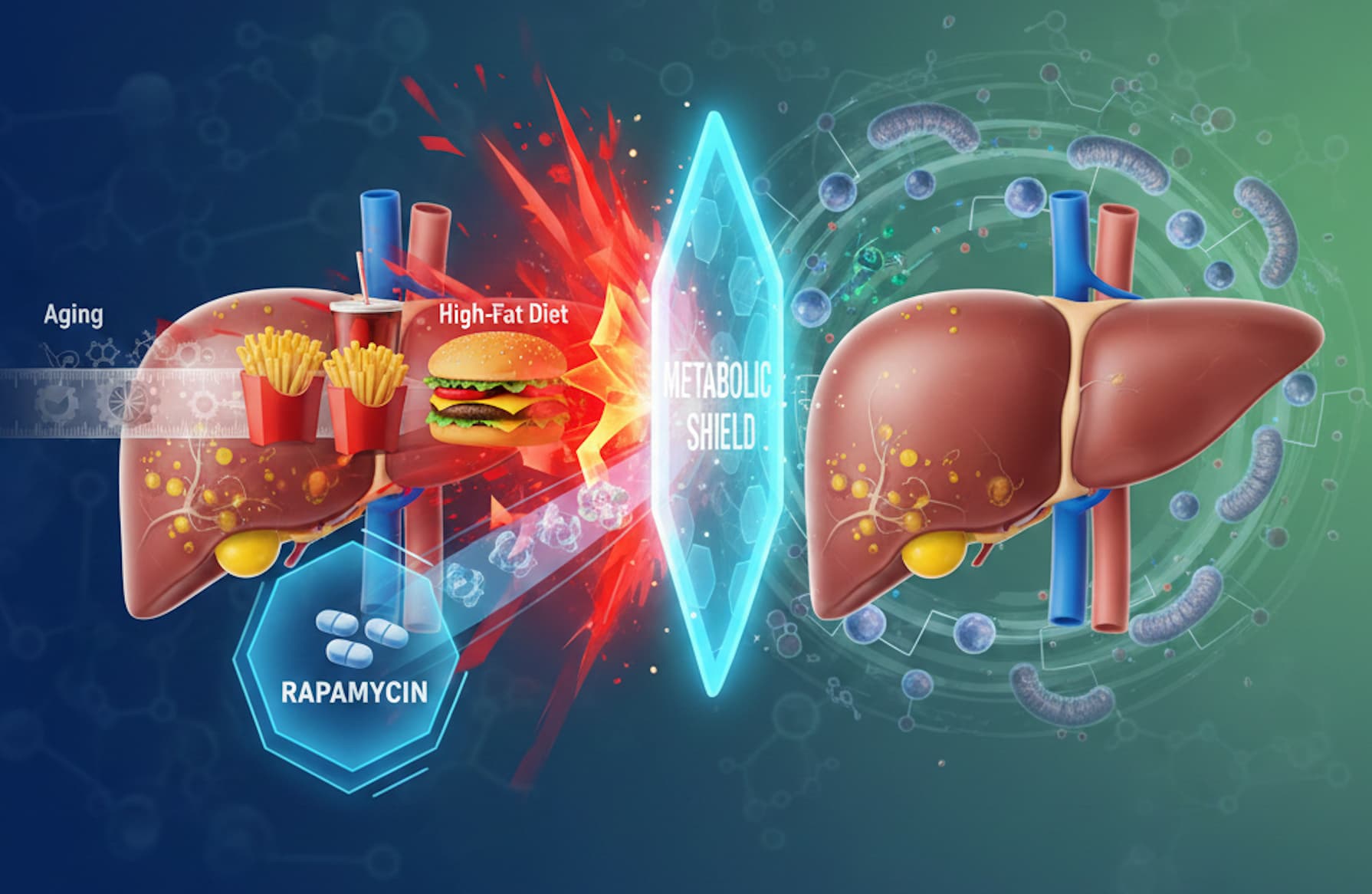
In a compelling demonstration of pharmacological resilience, researchers have uncovered that the widely studied longevity drug, rapamycin, acts as a potent “metabolic shield,” effectively reversing the liver damage caused by the collision of aging and a high-fat diet (HFD). Published in Aging Cell, this study bridges a critical gap in longevity science: the interaction between biological age and environmental metabolic stress.
While obesity and poor diet are known drivers of Metabolic dysfunction-Associated Steatotic Liver Disease (MASLD), this research reveals that aging acts as a “force multiplier,” dramatically exacerbating the inflammatory and transcriptional dysregulation caused by a high-fat diet. The study utilized young (5-month) and old (22-month) male C57BL/6 mice, subjecting them to dietary stress. The results were stark: older livers didn’t just get fatter; they became hyper-inflamed, showing severe steatohepatitis (MASH) and a dangerous upregulation of tumorigenic pathways.
The “Big Idea” here is the rescue effect. When mice were treated with rapamycin starting at 4 months of age, the drug didn’t just blunt the damage—it effectively reversed the majority of the HFD-driven transcriptional chaos. Rapamycin treatment normalized liver morphology, crushed pro-inflammatory signaling (specifically the Stat1 and NF-κB pathways), and restored metabolic gene networks that usually collapse with age. Crucially, it also reset the “Tumorigenic Index,” a genomic score predicting liver cancer risk, back to baseline levels.
This study suggests that rapamycin’s value isn’t merely in extending maximum lifespan under ideal conditions, but in fortifying the organism against the inevitable metabolic insults of modern life—making it a vital candidate for preventing the progression of age-related liver disease and cancer.
Institution: Sanford Burnham Prebys Medical Discovery Institute, USA
Journal:Aging Cell, 2026 Feb 7 Impact Evaluation: The impact score of Aging Cell is approximately 7.2 - 7.8 (based on historical JIF trends for this title). This is a High impact journal within the specialized field of geroscience and biogerontology.
Intervention: Microencapsulated Rapamycin (eRapa) at 42 ppm in feed.
Duration: Treatment began at 4 months of age (prevention model) and continued until sacrifice at 21 months.
Dietary Challenge: 9-week High-Fat Diet (HFD, 60% fat) vs. Normal Diet (ND, 10% fat) initiated at 18 months.
Lifespan Analysis & Control Validity
Control Assessment: The mice were sacrificed at 21 months (approx. 630 days). Standard C57BL/6 median lifespan is typically 800–900 days (26–30 months). Therefore, these animals were essentially “middle-aged” to “early old,” and the study cannot make claims regarding maximum lifespan extension from this specific dataset. The authors rely on previous literature (e.g., Harrison et al., 2009) to assert pro-longevity effects.
Mechanistic Deep Dive
The study provides a granular look at how rapamycin remodels the aged liver transcriptome under stress:
Inflammation Suppression (The Stat1 Axis): Aging + HFD triggers a massive immune response in the liver, characterized by the infiltration of CD8+ T cells and dendritic cells. Rapamycin potently downregulated the Stat1 , Irf3 , and Rela (NF-κB) regulons. This confirms rapamycin’s role as an immunomodulator, preventing the “inflammaging” that drives fibrosis and cancer.
Metabolic Rescue (BCAA & Lipid Metabolism):
BCAA: HFD and aging normally suppress Branched-Chain Amino Acid (BCAA) degradation. Rapamycin reversed this, likely by inhibiting the mTORC1-SREBP1 axis, which in turn lowers BCKDK (the inhibitor of degradation), thereby reactivating BCAA catabolism. This is critical because elevated circulating BCAAs are a hallmark of insulin resistance.
Lipid Handling: Rapamycin restored fatty acid metabolic processes and reduced the expression of genes associated with ER stress and the Unfolded Protein Response (UPR), which are typically overwhelmed by high lipid loads.
Cancer Prevention (Tumorigenic Index): The study utilized a transcriptomic “Tumorigenic Index” (TI) to predict Hepatocellular Carcinoma (HCC) risk. HFD significantly elevated this risk in aged mice. Rapamycin treatment completely normalized the TI scores to levels seen in lean controls. [Confidence: High]
Novelty
The “Double Hit” Model: Most studies look at aging or HFD. This study confirms that aging sensitizes the liver to dietary toxicity. A diet that is manageable for a young mouse becomes toxic and pro-tumorigenic in an old one.
Transcriptional Reversal: It demonstrates that rapamycin doesn’t just slow the decline; it actively reverses established transcriptional signatures of metabolic stress, effectively “de-aging” the gene expression profile of the liver even in the presence of a toxic diet.
Critical Limitations
Sexual Dimorphism Gap: The study utilized only male mice. Given the known sexual dimorphism in rapamycin response (females often show different sensitivity or side effects regarding glucose handling), this is a significant blind spot. [Confidence: High]
Weight Loss Confounder: Rapamycin-treated mice lost significant weight compared to HFD controls (41.3g vs 57.8g). It is biologically difficult to decouple the direct molecular effects of mTOR inhibition from the secondary benefits of leanness. While the authors argue on-target molecular effects (pS6 reduction), the weight loss is likely a major driver of the improved phenotype.
Macronutrient Confusion: The control diet and HFD differed not just in fat, but in the carbohydrate:fat ratio (7.0 vs 0.33). This introduces a variable where effects could be driven by carbohydrate restriction rather than just fat addition.
Missing Functional Data: The study relied on liver homogenate albumin as a proxy for function, admitting that serum albumin (the gold standard) was not collected. This limits our ability to confirm true physiological liver function preservation beyond histological and genomic markers.
Verification Status:Translational Gap / Contradiction. While robust in mouse models Havas et al. (2026), human clinical data reveals a paradox. In humans, the high doses of rapamycin (sirolimus) used in transplant patients (not the low doses typically used by longevity biohackers) frequently causes hyperlipidemia (elevated triglycerides and cholesterol) and hyperglycemia, a condition often termed “sirolimus-induced dyslipidemia” Morrisett et al. (2002); Kasiske et al. (2008).
Clinical Reality: Meta-analyses of human trials indicate that while mTOR inhibitors reduce HCC recurrence in transplant patients, they do not consistently improve native metabolic liver disease and may worsen insulin resistance Bhat et al. (2023).
Claim: Aging acts as a “force multiplier” for HFD-induced liver inflammation (specifically via Stat1 and NF-κB pathways).
Evidence Level:Level D (Pre-clinical/Mouse).
Verification Status:Verified (Mechanistic Consensus). Multiple studies confirm that aged livers exhibit a heightened inflammatory response to metabolic stress compared to young livers, often driven by macrophage polarization (M1) and inflammasome activation, even if total fat accumulation is similar Fontana et al. (2013); Bertolotti et al. (2014).
Claim: Rapamycin treatment reduces the “Tumorigenic Index” and prevents Hepatocellular Carcinoma (HCC) progression.
Evidence Level:Level D (Pre-clinical) & Level B/C (Human Transplant Data).
Verification Status:Supported with Caveats. In mice, rapamycin reliably inhibits chemically and diet-induced hepatocarcinogenesis Chiba et al. (2022). In humans, systematic reviews confirm that sirolimus-based immunosuppression significantly reduces HCC recurrence after liver transplantation compared to calcineurin inhibitors Grigg et al. (2019). However, its efficacy as a primary preventive agent in non-transplant NASH patients remains unproven in RCTs.
Claim: Rapamycin restores Branched-Chain Amino Acid (BCAA) catabolism in the fatty liver.
Evidence Level:Level D (Pre-clinical/Mechanistic).
Verification Status:Verified. Loss of BCAA catabolism is a known driver of mTORC1 hyperactivity and tumorigenesis in liver cancer Ericksen et al. (2019). Restoring this pathway (via BCAA restriction or mTOR inhibition) is a validated mechanistic target for improving metabolic health in rodent models Cummings et al. (2018).
Claim: Rapamycin drives significant weight loss and liver mass reduction in high-fat diet contexts.
Evidence Level:Level D (Pre-clinical).
Verification Status:Variable/Dose-Dependent. Rapamycin-induced weight loss is a consistent finding in high-dose mouse studies, often attributed to reduced adiposity or “wasting” effects Leontieva et al. (2014). However, in humans, significant weight loss is not a standard side effect of therapeutic dosing; conversely, peripheral edema (fluid retention) is common Stallone et al. (2009).