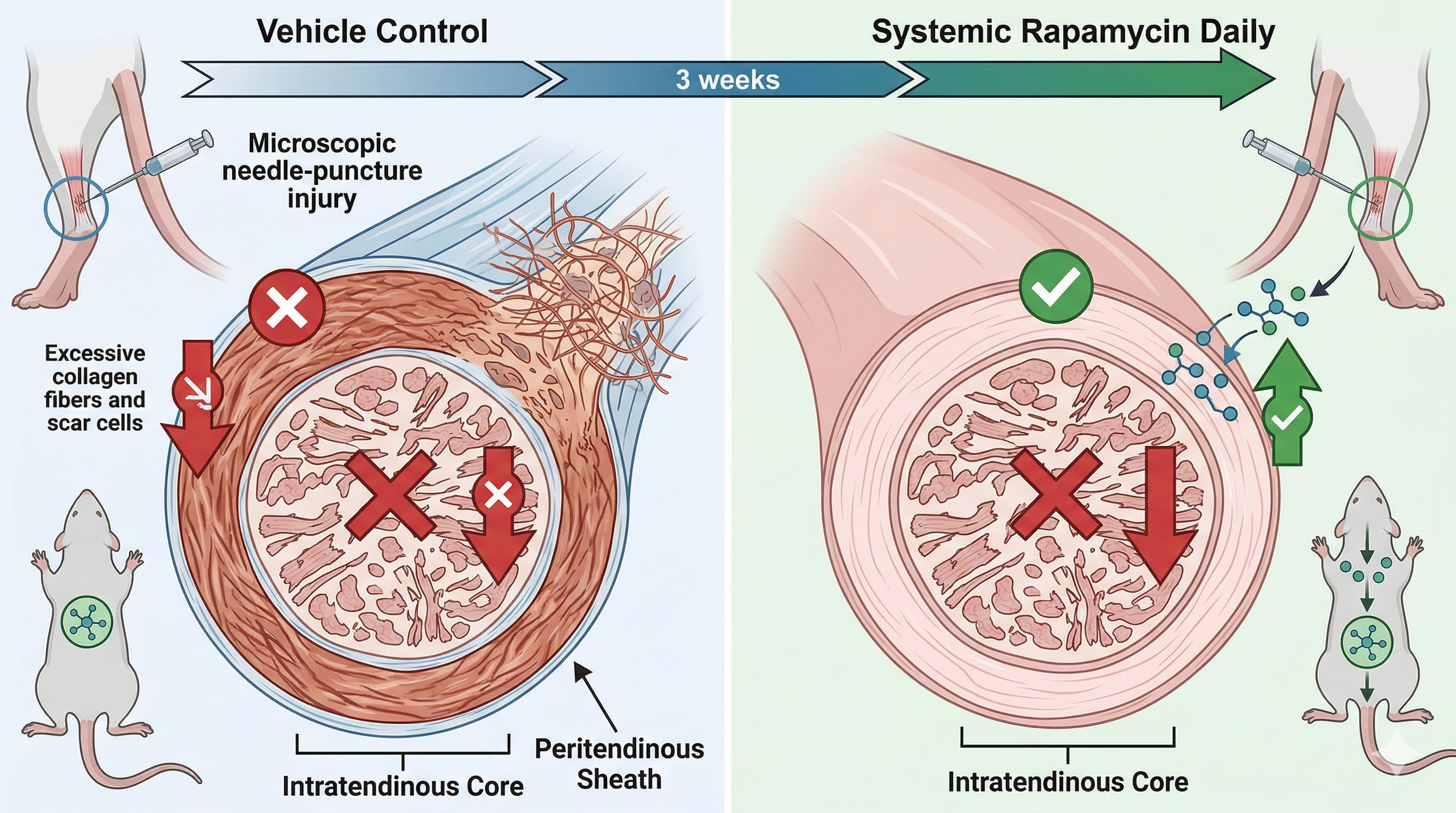
Tendon injuries are notoriously difficult to resolve, frequently resulting in disorganized, fibrotic scar tissue that permanently compromises biomechanical function and increases reinjury risk. In longevity and biohacking circles, the mTOR inhibitor rapamycin is frequently lauded for its potent pro-autophagy and anti-fibrotic properties, making it a theoretically attractive candidate to improve connective tissue repair. However, recent data provides a reality check regarding its utility in acute trauma scenarios.
Researchers investigated whether systemic, daily administration of rapamycin could enhance Achilles tendon healing in a rodent needle-puncture injury model. The findings reveal a stark spatial divergence in the drug’s efficacy. Over a three-week observation period, rapamycin successfully attenuated peritendinous fibrosis—the scarring on the outer sheath of the tendon. However, it completely failed to improve the regenerative healing within the intratendinous core.
At the cellular level, immunohistochemistry demonstrated that rapamycin diminished the migration of CD146+ cells to the lesion site during the critical first week of healing. Because CD146+ cells are implicated in the intrinsic reparative and angiogenic processes of the tendon vascular niche, their suppression indicates that acute mTOR inhibition likely stalls the essential proliferative phase of deep tissue regeneration. Furthermore, while the study identified alterations in circulating extracellular vesicle microRNAs (such as the downregulation of miR-128-3p), suggesting a robust systemic response to the drug, this systemic signaling did not translate into localized architectural improvements in the tendon core.
For clinicians and longevity enthusiasts, the takeaway is highly practical: the timing and context of mTOR inhibition are non-negotiable variables. Administering a strong mTOR inhibitor immediately following acute mechanical trauma appears counterproductive for core tissue regeneration. While rapamycin may prevent peripheral adhesions by inhibiting excessive fibroblast activity, it concurrently deprives the damaged tendon core of the anabolic and proliferative signals strictly required to rebuild the extracellular matrix. Ultimately, this study strongly suggests that acute, continuous rapamycin dosing is not a viable therapeutic protocol for early-stage tendon rupture or traumatic injury.
Source:
- Open Access Paper: Rapamycin reduces peritendinous fibrosis but has a limited effect on intratendinous healing in a rodent Achilles tendon injury model
- Institution: Royal Veterinary College.
- Country: United Kingdom.
- Journal: Scientific Reports. Date Published: 2026 Mar 26
- Impact Evaluation: The impact score of this journal is 3.8, evaluated against a typical high-end range of 0–60+ for top general science, therefore this is a Medium impact journal.