Calcium score test is not invasive - it’s a short 10 min scan procedure. There’s of course a radiation concern, but if a scanner is CT-C3000 the radiation is minimal. Insurance doesn’t cover it, but it’s not that expensive ($150). I plan to do a carotid arteries ultrasound. My previous one 5 years ago was clean.
3 Likes
Where is this discussion going? Are people disputing that lower LDL is not better at reducing all-cause mortality?
There is NO compelling evidence to dispute this.
Doctors who study lipidology and its effects think that lower is better.
“There are about 700 board-certified lipidologists in the US and Canada, but only about 50 “dedicated” lipidologists, who work exclusively with cholesterol and atherosclerosis.”
Leading Lipidologists Endorsing Lower LDL Targets
Dr. Michael Miller - Professor of Cardiovascular Medicine at the University of Maryland School of Medicine
Dr. Christie Ballantyne - Professor and Chief of Cardiology at Baylor College of Medicine
Dr. Seth Martin - Director of Advanced Lipid Disorders Center at Johns Hopkins Hospital
Dr. Pamela Morris - Director of Preventive Cardiology at New York-Presbyterian Hospital
For me, the preponderance of the evidence indicates that lower is better.
The evidence for the lowest possible LDL being best is just not there.
As far as ASCVD-Risk is concerned, blood pressure seems to be a more important factor according to this calculator. (Which actually kind of sucks because it won’t accept my age or LDL levels)
Of the variables the calculator uses is BP. Fairly small changes in BP produce a bigger change in the outcome than LDL levels.
https://tools.acc.org/ASCVD-Risk-Estimator-Plus/#!/calculate/estimate
4 Likes
Hi Anuser,
-
You’ve just requoted the full quote that I quoted earlier in the thread. The reason I cut it in half was merely because my post was already very long and so i only included the directly relevant part. The second half of the quote merely eliminates one legitimate reason why they might have made the change halfway through the study. I repeat: I’ve never made any claims as to why they did this. If you don’t believe me, go back and read what I’ve posted. The fact that you are resorting to “tinfoil” conspiracy allegations, suggests that it’s actually you who is being intellectually dishonest.
-
The divergence is a point of numerical fact. It is also a point of fact that they terminated the study early before any statistical significance could be determined. That’s not to say statistical significance would have emerged over time - it’s simply saying that we won’t ever know because the trial was terminated early.
-
Again you’re using a straw man argument. I never said that I “believe in” anything. I am merely saying that their negative findings are partly why I am not “convinced” by this Fourier study. Where you’ve made another factual error is that the independent commitee was also blinded. It seems silly making things up just to fit your narrative of “Rogue doctors”. They had access to the narrative in the CSR and the original team failed to respond to all communications from the reviewing team - another yellow flag.
I suspect you’re “convinced” by the Fourier study because you want to believe it. But I am simply putting for forward factual reasons why I’m not personally “convinced” by it. The fact that you find this so hard to accept is probably worth mulling on. My motivation is that I’m keen that anyone reading this board isn’t given a once-sided argument to lower their ldl-c to extremely low levels (c.30 mg/dl) without understanding some of the fact and questions surrounding this trial.
3 Likes
While lower LDL-C/apoB is always better (until 20-38mg/dL is reached), not every medication that lowers LDL-C necessarily provides a benefit when it comes to all-cause mortality. The atorva-/rosuvastatin+ezetimibe combination has proven itself in clinical trials so far while PCSK9i (at least in the study above) showed a (statistically not significant) trend towards higher all-cause mortality.
2 Likes
Hi Neo,
Thank you, yes I am aware of the evidence, but I haven’t gone into it sufficiently throughly to overcome my ‘first do no harm’ bias. Are there any particular studies you’ve found to be strong? I’d love to have a look.
This is misleading when out of context, because “adverse signals” for or against, is related to only a few specific diseases which they studied there.
To quantify the safety of PCSK9 inhibitors, with specific focus on the incidence of influenza, hypertension, type 2 diabetes, and cancer, compared to placebo or active treatment(s) for primary and secondary prevention.
I didn’t read their report, but thanks for pointing that out.
@L_H I kind of appreciate the discussion if I learn something from it, and if this study is concerning to you, then there is simply Praluent which is a PCSK9 inhibitor too but where a detection of a decrease in all cause mortality was shown.
Praluent detected a decrease in ACM.
https://www.nejm.org/doi/full/10.1056/nejmoa1801174
1 Like
Yes I think it’s the safety data that puts me off acting now. Both on PCSK9i and targetting an extremely low apoB.
Having said that - the risk reward profile for each person is different. I’m lucky to have below 70 mg/dl apoB naturally (without any pharma help). And I’m hopeful that I should be able to get close to 50 with just microdosing rosuvastatin and ezetimibe (2.5 mg of each eod). My intention is to trial this for 6 months and test every three months.
2 Likes
That looks interesting thank you. Just shows you can look through the “noise” of all cause mortality if you keep going for long enough!
I note that the treatment group in that study had relatively high ldl-c compared to the levels we’ve been discussing though. Ldl-c at 66 mg/dl by the end of the period (40 at the beginning). So apoB higher than that. The placebo group was at 90 to 103 mg/dl over the period.
So I don’t think it adds to the argument to go extremely low.
Seriously? We had that huge debate about Fourier and the report criticising it - and you never read the report criticising it??? What were you basing your reasoning on?
Children and newborns have very low LDL, does that convince you that it’s safe?
I probably have looked at it, but I didn’t read it in detail.
There are those who suggest that it wasn’t blinded:
To TCTMD, Nissen said the Cleveland Clinic’s academic research organization, known as C5Research, which he heads up, has a professional, experienced team of adjudicators, just like the TIMI group, with all clinical outcomes analyzed according to rigorous standards. An unblinded post hoc analysis introduces its own significant bias, he said.
And in the report, there is a “validation committee” that wasn’t blinded:
The Validation Committee also confirmed that all potential cases for readjudication had been evaluated, and that readjudications achieved by consensus of the Readjudication Committee were consistent with the information in the CSR narratives.
So I was wrong that I was wrong, and it wasn’t blinded after all.
No. Sadly I’m neither.
2 Likes
Appeal to nature fallacy. Safety data should be derived from rpcs only.
2 Likes
What did you mean here? Randomized control trial? RCTs?
1 Like
Randomized, placebo-controlled (rpc) trials.
1 Like
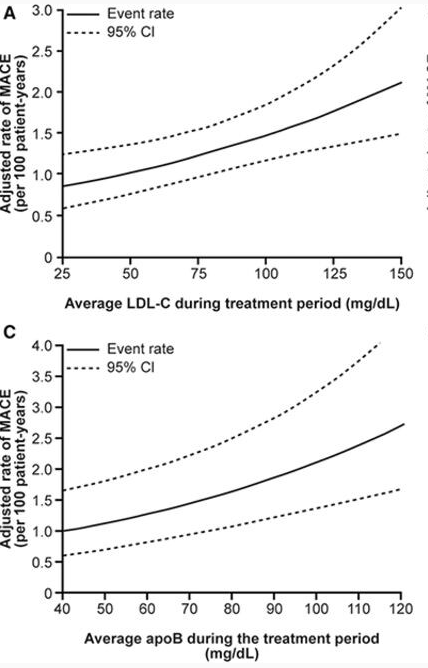
2 Likes
Newborns don’t have the microbial burden the oldsters have. They don’t need the LDL’s to clean up the mess. We do.
2 Likes
Too bad the data is from lowering LDL in 60 year olds then.
Proof?
What we actually need is magic pixie dust. That’s what keeps our immune system working. There’s gotta be a Chinese in vitro study about this.
1 Like
It says it reduced heart attack, stroke and fatal heart disease by one third. I didn’t read the actual study. The article doesn’t mention ACM or any other cause of mortality. They said it was about making sure it was safe to lower LDL, did they check ACM?
And as shown in the study I posted earlier, it is braindead to have ACM as the goal post as it requires a 25 x larger study than necessary.
Having low LDL-C levels with the accepted norms is good
The is no proof that having lower than this provides any additional benefits.
You should have pointed to the paper itself, not some communications major’s interpretation of the paper.
The study itself shows diminishing returns as LDL levels get lower. The is nothing in the paper that shows any benefits for LDL levels outside of the lower norm as measured by labs.
“LDL-C of ≈70 mg/dL, a further 20% reduction in LDL-C translates into a 6% to 7% lower risk of MACE. However, the question remains as to whether the additional percentage reduction in LDL-C (of 50% to 60%) and even lower on-treatment LDL-C level (<50 mg/dL) that can be achieved by adding a PCSK9 inhibitor to a statin will be associated with a lower risk of MACE.”
https://www.ahajournals.org/doi/10.1161/CIRCULATIONAHA.116.024604
1 Like