FWIW
Located the following;
Swanson Ultra
Retail Cost under $6.00 per 60 capsules
Cost $2.79 per 60 capsules bottle on 11/26/2023
Mineral Citrate Complex - Calcium, Magnesium, Zinc, Potassium
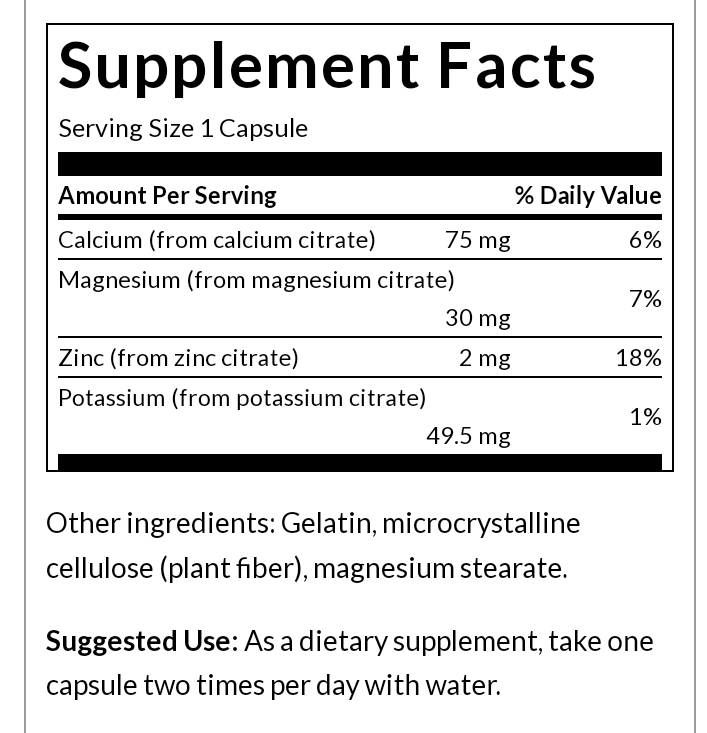
On a practical basis it is better to ask questions on the protocol thread. However, those masses are the cation masses. I would guess that there is perhaps 400mg of citrate in each capsule.
“However, the exact mechanisms of action of citrates have never been accurately described and results obtained so far often failed to demonstrate a significant advantage”
Is this true?
They are part of the AKG cycle but besides that there’s no real evidence it does anything for longevity.
My work on citrates started in 2022. I think it works for me. Only a few people have tried it, mainly friends and family. It seems worth a try, but people have to be careful and i dont promise anything.
I dont think anyone else is studying it the way i am.
It seems that the drug interaction between ezetimibe snd gemfibrozil is minor. The most important interaction seems to be an increased risk of developing gall stones if supplementing for a long time. I plan to take both and not do gemfibrozil permanently.
There is a tendency for gemfibrozil to increase plasma concentration of ezetimibe:
Objective: Ezetimibe is a novel lipid-lowering drug that prevents intestinal absorption of dietary and biliary cholesterol leading to significant reduction in total-C, LDL-C, Apo B, and TG and increases in HDL-C in patients with hypercholesterolemia. Gemfibrozil, a fibric acid derivative, is an effective lipid-modulating agent that increases serum high-density lipoprotein cholesterol and decreases serum TG. The objective of this study was to evaluate the potential for a pharmacokinetic (PK) interaction between ezetimibe and gemfibrozil.
Methods: This was a randomized, open-label, 3-way crossover, multiple-dose study in 12 healthy adult male volunteers. All subjects received the following 3 treatments orally for 7 days: ezetimibe 10 mg once daily, gemfibrozil 600 mg every 12 hours, and ezetimibe 10 mg once daily plus gemfibrozil 600 mg every 12 hours. A washout period of > or = 7 days separated the 3 treatments. In each treatment, blood samples were collected on day 7 to assess the steady-state PK of ezetimibe and gemfibrozil. The oral bioavailability of ezetimibe coadministered with gemfibrozil relative to each drug administered alone was evaluated with an analysis-of-variance model.
Results: Ezetimibe was rapidly absorbed and extensively conjugated to its glucuronide metabolite. Ezetimibe did not alter the bioavailability (based on AUC) of gemfibrozil. The mean AUC0-12 of gemfibrozil was 74.7 and 74.1 microg h/ml with and without ezetimibe coadministration, respectively (log-transformed geometric mean ratio (GMR) = 99.2; 90% confidence interval (CI) = 92 - 107%). Conversely, gemfibrozil significantly (p < 0.05) increased the plasma concentrations of ezetimibe and total ezetimibe (i.e. ezetimibe plus ezetimibe-glucuronide). Exposure to ezetimibe and total ezetimibe was increased approximately 1.4-fold and 1.7-fold, respectively (CI = 109 - 173% for ezetimibe and 142 - 190% for total ezetimibe), however, this increase was not considered to be clinically relevant. Ezetimibe and gemfibrozil administered alone or concomitantly for 7 days was well tolerated.
Conclusions: The coadministration of ezetimibe and gemfibrozil in patients is unlikely to cause a clinically significant drug interaction. The coadministration of these agents is a promising approach for patients with mixed dyslipidemia. Additional clinical studies are warranted.
May I asked what the benefit part of the rationale is for a temporary dosing is?
The uncertainty, and the mixed opinions whether there is an interaction concerns me, as that is not typical for other drugs I take or want to take, hence I will avoid it as it doesn’t seem to increase apoA1 which I was looking for, for Alzheimer’s.
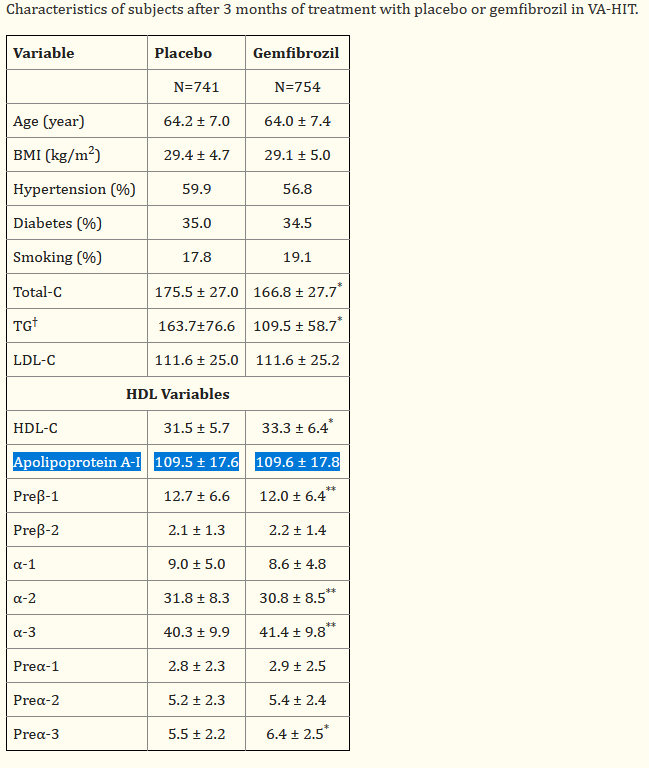
Bezafibrate? Post must be at least 20 characters
I have not looked at apoA1 increasing drugs or supplement (or even food) space. So I don’t know what to compare it with. Do you know? I wonder if I could get a chemical synthesis of a CETP inhibitor… 
There is one therapy, called lipoprotein apheresis, that involves removing Lp(a) from the blood using IVs.
Discussed a bit more here
And here
This is quite interesting though. A 5 year old S Korean study showing a positive result.
‘For the blood lipid profile, the policosanol 10 mg and 20 mg groups showed significant reductions in total cholesterol (TC) of around 8% (p = 0.029) and 13% (p = 0.0004), respectively, at week 24 compared with week 0. Serum HDL-C level significantly increased up to 16% and 12% in the policosanol 10 mg (p = 0.002) and 20 mg (p = 0.035) group, respectively. The study results suggest that long-term policosanol consumption simultaneously reduces peripheral BP as well as aortic BP accompanied by elevation of HDL-C and % HDL-C in TC in a dose-dependent manner.’
I don’t expect any Lp(a) drug to provide benefits by itself.
That is not convincing to me still since it is only one study.
If other studies fail then it suggest it is not a good supplement.
Not convincing but interesting. The german study i note was for a shorter period than the positive studies
(korean and cuban)
I also found another 2023 study in Japan with a positive result.
“In conclusion, 12 weeks of Cuban policosanolconsumption in Japanese subjects showed significant improvement in blood pressure, lipid profiles, hepatic functions, and HbA1c with enhancement of HDL functionalities”
The other (negative) 2006 study by Dulin et al was only 8 weeks. Same for the 2008 Italian study
Maybe there’s a time issue? Speculatively… Gut microbiome modulation effects often take longer.
Finally… This 2019 systematic review and met analysis of RCTs found a positive result for improvements in blood pressure from policosanol.
This is getting more convincing the longer i look. I’ve got some beeswax/honeycomb honey somewhere - i might just try a n= 1 study.
2.5g of wax = circa 22mg policosanol