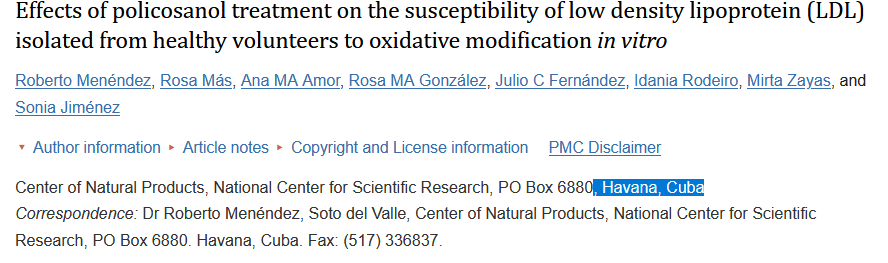
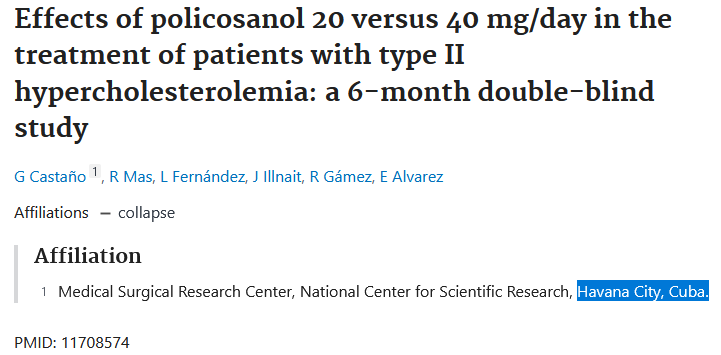
20 mg seems to be a good dose of Policosanol for LDL-C lowering. Have you quantified the drop with Ezetimibe, Policosanol, and Pantethine combo for yourself yet?
https://www.sciencedirect.com/topics/medicine-and-dentistry/policosanol
20 mg seems to be a good dose of Policosanol for LDL-C lowering. Have you quantified the drop with Ezetimibe, Policosanol, and Pantethine combo for yourself yet?
https://www.sciencedirect.com/topics/medicine-and-dentistry/policosanol
Reverse causality is the most likely culprit. People with cancer or other diseases have low levels of cholesterol, triglycerides etc. because their organs are shutting down. Manually lowering your triglycerides via statins, exercise and weight loss has no or even an protective effect against Alzheimer’s disease.
Bempedoyl-CoA is not in the prostate.
So you think that because something was discovered in a communist country it’s automatically bad? Your negativity continues to astound me.
I don’t know if policosanol works or not, but it is widely available and is a cheap supplement. It is certainly worth a try for someone having trouble with conventional medicines.
How about some results from the American Heart Journal? Are they communist lackeys?
“The efficacy and tolerability of policosanol have been documented in >3000 patients in >60 clinical trials”
“Policosanol: Clinical pharmacology and therapeutic significance of a new lipid-lowering agent”
https://www.sciencedirect.com/science/article/abs/pii/S0002870302585008
I question the premise ‘that it was discovered’ in the first place.
I’m not going to argue about this anymore, if you want to trust research from a literal communist country you do so, but I know @DeStrider does not trust research from certain countries.
And the paper in the American Heart Journal is just citing the same Cuban communist studies.
I haven’t taken policosonol. It’s hard to quantify the effect of Pantethine and Ezitimibe vs metformin because of the dosages involved and the fact that my diet changes from time to time.
600 mg of Pantethine in the morning and 10 mg of Ezitimibe in the evening on days that I don’t take metformin is keeping my lipids in the normal range.
What makes you certain that this is the case?
I know, it’s just a big Cuban conspiracy to sell us policosanol. It will make them a lot of money.
I am not defending communism, but I don’t think everything is a conspiracy.
“Despite being an island largely cut off from much of the world due to a decades-long embargo, Cuba has managed to build a robust health system that has been credited with some major medical advancements in recent years.”
"3 of Cuba’s Major Medical Achievements
The country was the first to eliminate HIV transmission from mother to child."
“Further, bempedoyl-CoA is not found in the plasma of individuals treated with bempedoic acid and likely does not escape the hepatocyte, suggesting that its activity is limited to the liver.”
It is not even going to be active in the kidney it seems.
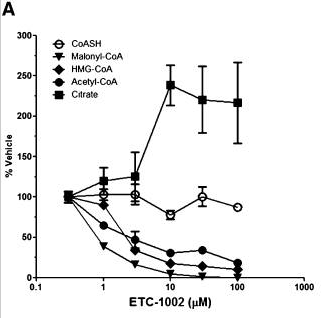
@John_Hemming increase in citrate levels in liver tissue as acetyl-CoA levels decrease as expected:
How would you compare a decrease in acetyl-CoA with possible HDAC6 inhibition?
I have simply pointed out that a version of the Long-chain acyl-CoA synthetases is expressed in the liver. The question as to what gets through the cell membrane is a separate one.
If Bempedoic gets through the cell membrane and is converted to an acyl-CoA, but is not found in plasma then that implies that Bempedoyl-CoA does not get through the cell membrane.
Hence it is likely to be where the enzyme is active. Which happens to be in the prostate and the kidney.
This fits with the experimental evidence.
Bempedoic Acid is C19H36O5 which fits with the definition of a long chain fatty acid. In the end the experimental evidence points to it being metabolised to ba-CoA by either ACSL or ACSVL1.
Its an interesting discussion, but I think to argue that only ACSVL1 can metabolise it requires some more solid evidence and although it is long for a long chain fatty acid it still has a chain under 20 carbons.
I would think probably it is metabolised more easily by ACSVL1, but can still be metabolised by one or more ACSL enzymes.
Why does it happen to be the prostate if it is not found in plasma? How does it get to the prostate?
I am assuming Bempedoic Acid gets into the cells from the plasma. It is then metabolised to some extent into bempedoyl-CoA where there is an enzyme expressed that can do this. Then it remains in that cell until it is metabolised into something else.
Hence it gets into the prostate cells as BA and is metabolised by ACS.L3 or ACSL4 into bempedoyl-CoA. It may be that this occurs to a lesser extent than in the liver, but given that BA results in some people getting enlarged prostates which would be expected from an aberrant splicing which would be expected from inhibition of ACLY the hypothesis is consistent with the known facts.
And what are you basing this on, that it is metabolised by ACS.L3 or ACSL4?
If you’re basing this on this, couldn’t the risk of an enlarged prostate be of some people’s reaction to an alteration in cholesterol metabolism in the liver?
I think it’s a bit far fetched to conclude that is because on an undocumented ACS.L3 or ACSL4 metabolism.
Sorry my typo. ACSL3 and ACSL4 add CoA to a long chain fatty acid (defined as 11-20 carbons) hence it is documented that they can convert Bempedoic Acid to Bempedoyl-CoA. They just need the Bempedoic acid and some ATP.
I think looking at a few more papers there is an argument that the expression of ACSVL1 in the liver is quite a lot more than ACSL3 or ACSL4 so there is potentially a higher concentration of Bempedoyl-CoA in the liver. That, however, is not the issue.
I think it is far more reasonable to assume that ACSL3 and ACLS4 doing their (documented) thing causes the creation of bempedoyl-CoA and that inhibits the creation of cytosolic acetyl-CoA resulting in aberrant splicing than its a reaction to a change in the liver cholesterol metabolism. One route has everything documented and in local order, the other is a remote unclear hypothesis.
I don’t think ACSL3 and ACSL4 is used because silencing Slc27a2 to decrease Slc27a2 protein levels by 80% reduces Bempedoyl-CoA by 85%, and also the cholesterol synthesis barely moved. What do you think of this?
To establish that ACSVL1 was the specific ACS isoform that catalyses the CoA activation of ETC-1002 we used small-interfering ribonucleic acid (siRNA)-mediated gene silencing in McArdle cells. ACSVL1 (Slc27a2) siRNA treatment reduced protein levels by more than 80%, which was associated with an 85% reduction in ETC-1002-CoA formation (Fig. 2c). Importantly, ACSVL1 gene silencing blocked ETC-1002 but not atorvastatin-dependent inhibition of de novo cholesterol synthesis, thus establishing the high specificity of ACSVL1 for the CoA activation of ETC-1002 (Fig. 2d).
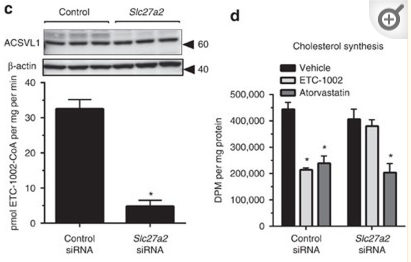
That fits with the idea that ACSVL1 is expressed to a greater extent than ACSL3 and ACSL4. What we don’t know is the extent to which ACSL3 and 4 are expressed in liver cells. They were using McArdle cells-RH7777.
In contrast to observations in liver microsomes, where ACSVL1 was highly expressed, the absence of ACSVL1 in human skeletal muscle corresponded to a lack of ETC-1002-CoA synthetase activity (Fig. 2f); however, CoA activation of palmitate was still observed in human skeletal microsomes indicating the activity of other ACS isoforms was present (Fig. 2f).
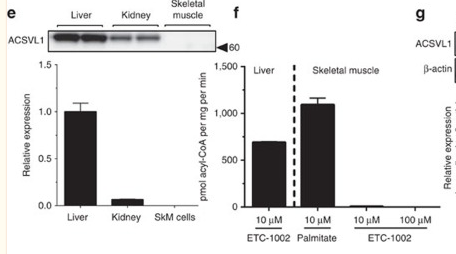
Despite other ACS isoforms in human skeletal muscle, as shown by the CoA activation of palmitate, there was no CoA activation of bempedoic acid. That should prove that ACSVL1 is required.