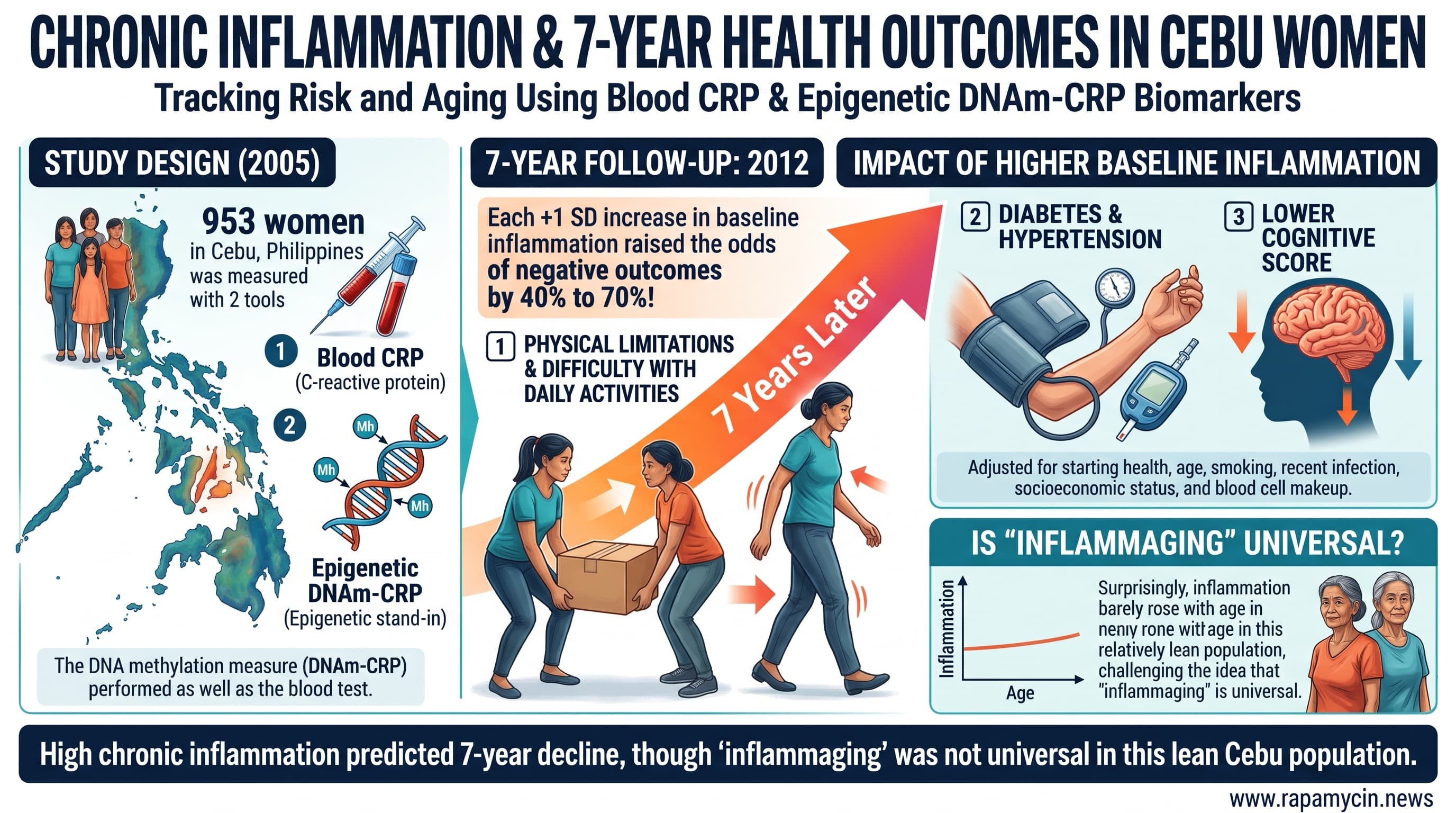
Researchers followed 953 women in Cebu, Philippines, and measured chronic inflammation in 2005 with two tools: blood C-reactive protein (CRP) and an epigenetic stand-in calculated from DNA methylation (DNAm-CRP). Seven years later, women with higher baseline inflammation were more likely to develop new physical limitations, trouble with daily activities, diabetes and hypertension. They were also more likely to score low on a cognitive screen. These results held after accounting for starting health, age, smoking, recent infection symptoms, socioeconomic status and blood cell makeup. Each one standard deviation increase in inflammation raised the odds of these outcomes by roughly 40 to 70 percent. Surprisingly, inflammation barely rose with age in this relatively lean population, which challenges the idea that inflammaging is universal. The DNA methylation measure performed as well as the blood test.
Inflammaging is one of the most repeated ideas in longevity science. The story goes that as we age, a slow-burning immune activation creeps upward, damages tissues and drives the diseases of old age. Nearly all the evidence for that story comes from wealthy countries, where obesity is common and baseline inflammation runs high. A new study from the Philippines asks whether the story holds in a very different setting, and the answer is yes and no.
The research team, led by anthropologist Thomas McDade at Northwestern University, drew on the Cebu Longitudinal Health and Nutrition Survey. This cohort has tracked thousands of Filipino women since they were pregnant in 1983. In 2005, when the women were 35 to 69 years old, nurses collected fasting blood samples in their homes. Seven years later, the team measured the same women again across physical function, chronic disease and cognition.
Inflammation was measured two ways. The first was standard high-sensitivity CRP, a liver protein that rises with inflammation. CRP has a known weakness: a cold or a stomach bug can spike it for days, which is a real problem where infections are common. The second was DNAm-CRP, a score built from methylation patterns at 1,468 sites across white blood cell DNA. Methylation changes more slowly, so in principle it records longer-term inflammatory exposure rather than last week’s sniffle.
The first surprise was that inflammation barely tracked age. Plasma CRP rose only slightly with age, and DNAm-CRP actually dipped a little. In this population, the steady age-linked climb at the center of the inflammaging concept was largely missing. These women also had much lower CRP than Americans of the same age.
Yet inflammation still predicted who aged worse. Women with higher DNAm-CRP in 2005 had 1.7 times the odds of having diabetes in 2012 for every standard deviation increase, even after the researchers accounted for whether they already had diabetes in 2005. Higher inflammation also predicted new physical limitations, trouble with daily tasks such as bathing or dressing, and hypertension. Plasma CRP added a link to lower scores on the Mini-Mental State Examination.
To put the total effect in perspective, the team counted how many of 11 health problems each woman had by 2012. Women at the low extreme of DNAm-CRP averaged 2.4 problems. Women at the high extreme averaged 3.7. That spread was about the same as the spread produced by fasting blood glucose, a standard marker of metabolic risk.
The DNA-based score held up well. It was unaffected by adjusting for white blood cell makeup or recent infection symptoms, and it worked equally well in leaner and heavier women. Plasma CRP, by contrast, lost its predictive power among women with larger waists.
The catch is that the effects were modest, and they showed up only after age 50. Among women under 50, neither measure predicted much. The study is also observational, so it cannot show that lowering inflammation would change anyone’s trajectory.
The big idea is that chronic inflammation can predict aging outcomes even in a population where it does not rise with age. That suggests the danger lies in your individual inflammatory set point rather than in an inevitable age-related climb. If that holds up, inflammation is something to measure and manage, not something to accept as part of getting older.
Actionable Insights
This study did not test any treatment, so every practical message here is inferred, not proven.
First, know your number. High-sensitivity CRP is an inexpensive, widely available blood test. In this study, a baseline CRP above 3 mg/L predicted higher risk of physical limitations, diabetes and hypertension over seven years. Test when you are healthy, because a reading above 10 mg/L usually reflects an acute infection and should be repeated.
Second, being lean is not full protection. These women were relatively slim by Western standards, yet inflammation still predicted their health trajectories.
Third, the payoff window appears to open after 50, when the associations became clear and grew stronger past 60.
How big is the effect? Moving one standard deviation up the inflammation scale was linked to roughly 40 to 70 percent higher odds of the outcomes measured. For diabetes, that roughly means going from a 14 percent risk to about 22 percent. Comparing the least and most inflamed women, the gap was about one extra health problem (2.4 versus 3.7) over seven years. In statistical terms, these are small effects, about the size of the risk carried by fasting blood sugar. Any lifestyle or drug approach to lowering CRP draws on other research: Safety Data Absent from this paper.
Context and Source
- Paywalled Paper: Chronic inflammation and multiple dimensions of aging among women in the Philippines
- Institution: Northwestern University (lead, Department of Anthropology and Institute for Policy Research), with University of North Carolina at Chapel Hill, Columbia University, University of San Carlos Office of Population Studies Foundation (Cebu), University of British Columbia and Harvard University
- Country: United States (lead institution); cohort based in the Philippines; epigenetic work in Canada
- Journal: The Journals of Gerontology, Series A: Biological Sciences and Medical Sciences
- Impact evaluation: This is a Medium impact journal. Within its own field it ranks 4th of 49 gerontology journals, so it is a respected specialist venue.