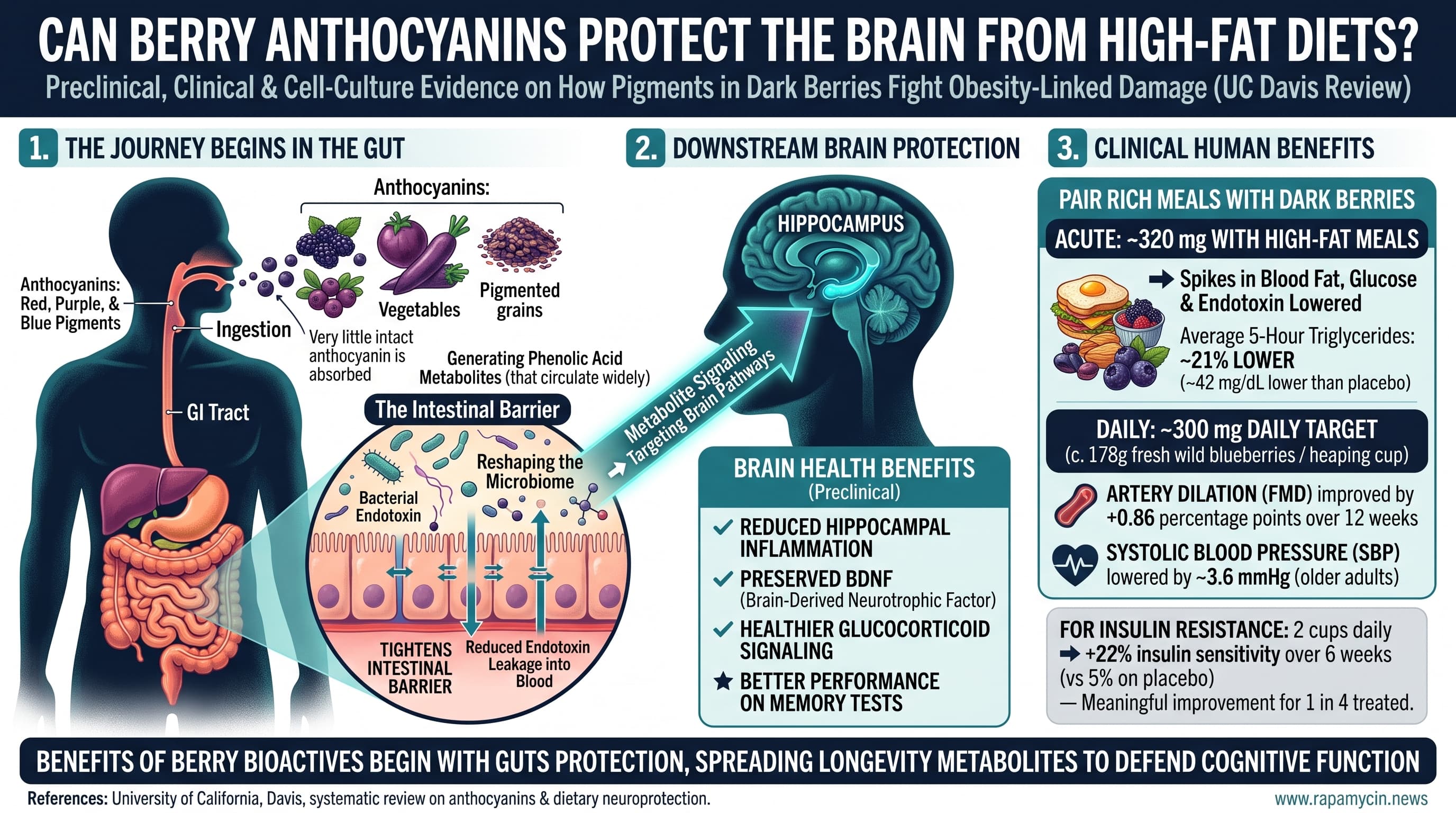
This review from the University of California, Davis, gathers preclinical, clinical and cell-culture evidence on whether anthocyanins, the red, purple and blue pigments in berries, purple vegetables and pigmented grains, can protect the brain from the damage linked to obesity and high-fat Western diets. The authors argue that the benefits begin in the gut. Very little intact anthocyanin is absorbed, so the compounds act mainly by tightening the intestinal barrier, reducing leakage of bacterial endotoxin into the blood, reshaping the microbiome, and generating phenolic acid metabolites that circulate widely. Further downstream, rodent studies show reduced hippocampal inflammation, preserved BDNF, healthier glucocorticoid signaling and better performance on memory tests. Human data are thinner. Single-meal trials show smaller post-meal spikes in blood fat, glucose and endotoxin, but direct evidence that anthocyanins protect cognition in people with obesity remains inconclusive.
Your brain may care what color your dinner is. That is the idea behind a new review from nutrition scientists at the University of California, Davis, who have pulled together more than a decade of research on anthocyanins, the pigments that make blueberries blue, blackcurrants inky and purple sweet potatoes purple. Their question is narrow but important: can these compounds blunt the harm that obesity and a fat-heavy Western diet inflict on the brain?
The harm itself is well documented. Obesity raises the risk of cognitive decline and dementia, and in rodents a high-fat diet reliably inflames the hippocampus, the brain’s memory hub. One leading explanation starts in the gut. Fatty diets loosen the seals between intestinal cells and change the microbial population, allowing fragments of bacterial cell wall called lipopolysaccharide, or LPS, to slip into the bloodstream. Even a single greasy meal can do this, because LPS hitches a ride on the fat particles absorbed after eating. Circulating LPS stirs up inflammation that can weaken the blood brain barrier and activate the brain’s immune cells.
The twist is absorption. Anthocyanins are poorly absorbed, and usually well under 5 percent of what you eat turns up in urine. For years that looked like a fatal flaw. The UC Davis team argues it is the point. Because most of the pigment stays in the gut, that is where it reaches concentrations high enough to matter. In mouse studies, anthocyanin extracts kept the intestinal barrier intact, reduced LPS leakage, shifted the microbiome toward species such as Akkermansia, and lowered inflammatory markers in the hippocampus. Gut microbes also break anthocyanins down into small phenolic acids, such as vanillic acid, which circulate at far higher levels than the parent compounds and appear to carry some of the benefit.
The review traces several downstream effects. Treated animals kept higher levels of BDNF, a protein that supports learning and neuron survival. Their stress hormone signaling looked healthier. Blood vessels produced more nitric oxide, which may improve blood flow to the brain. In fat tissue, anthocyanins switched on mitochondria-building programs and nudged white fat toward the more metabolically active “beige” type.
In people, the most striking data come from meal challenge studies. When 25 healthy young adults ate a roughly 1,000-calorie high-fat meal with a drink containing about 320 mg of anthocyanins, their post-meal rise in blood fats, glucose and LPS was smaller than with placebo, and BDNF released from blood cells increased. Separately, older adults who ate wild blueberry powder daily for 12 weeks showed better blood vessel function, lower systolic blood pressure and modest gains on some memory tasks.
There are gaps in the research review. Most of the brain evidence comes from short-term studies in young male rodents. Many studies used whole-food extracts loaded with other polyphenols, so the anthocyanins cannot be singled out. And whether anthocyanins protect cognition specifically in people with obesity is, by the authors’ own account, unresolved.
Still, the practical message carries little risk. Eating more deeply colored fruits and vegetables, especially alongside rich meals, is a cheap experiment with a plausible mechanism behind it.
Actionable Insights
Pair rich meals with dark berries. In a crossover trial, about 320 mg of anthocyanins taken with a high-fat meal lowered average blood triglycerides over five hours by roughly 21 percent (about 42 mg/dL lower than placebo).
Aim for about 300 mg of anthocyanins daily, roughly 178 g of fresh wild blueberries (a heaping cup). In older adults this improved artery dilation (FMD) by 0.86 percentage points and lowered 24-hour systolic blood pressure by about 3.6 mmHg over 12 weeks. Pooled data suggest that size of blood pressure drop corresponds to a population-level cardiovascular risk reduction in the single digits of percent.
If you are insulin resistant, blueberry bioactives (about two cups of berries daily) improved insulin sensitivity by 22 percent versus 5 percent on placebo over six weeks. About one extra person in every four treated reached a meaningful improvement.
Expect small lipid changes, not drug-like ones: LDL drops of around 7 mg/dL in pooled trials.
Do not expect a noticeable memory boost. Meta-analyses conflict. If the effect is real, it is small: the average person eating anthocyanins would score better than about 58 to 68 percent of non-eaters on cognitive tests.
Context and Source
- Paywalled Paper: Anthocyanins and brain health in the context of obesity and Western-style diets, published online 22 October 2026.
- Institution: Department of Nutrition and Department of Environmental Toxicology, University of California, Davis
- Country: United States
- Journal: Archives of Biochemistry and Biophysics
- Impact evaluation: The impact score of this journal is 3.6 (2025 JIF), evaluated against a typical high-end range of 0 to 50+ for top biochemistry and molecular biology journals, therefore this is a Medium impact journal.