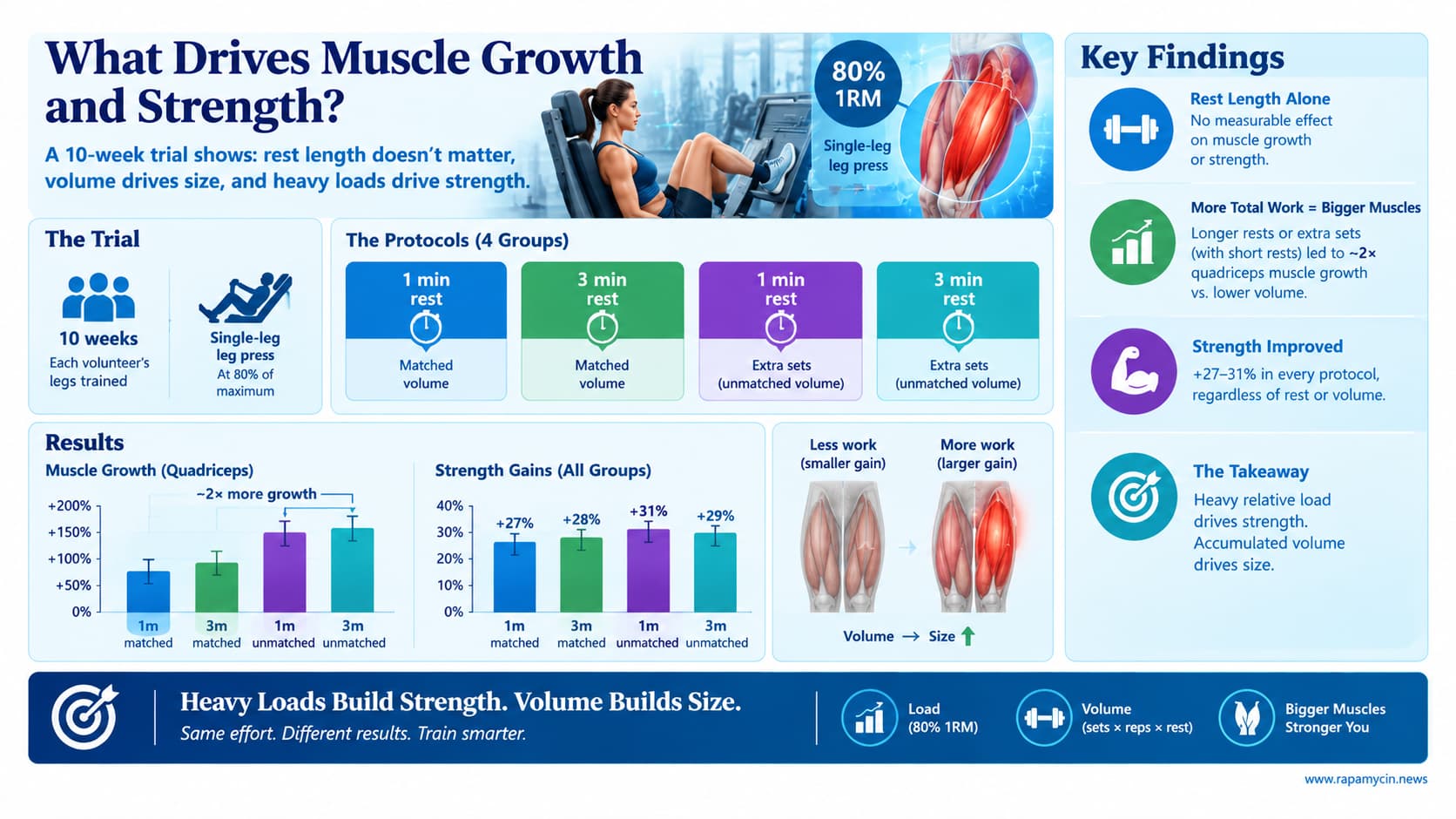
In a 10-week trial, each volunteer’s legs were trained on a single-leg leg press at 80 percent of maximum. The legs used either 1-minute or 3-minute rests between sets, and the total workload was either matched or left unmatched. Rest length by itself had no measurable effect on muscle growth or strength. Legs that did more total work, whether through longer rests or through extra sets with short rests, grew about twice as much quadriceps muscle as legs that did less. Strength improved by 27 to 31 percent in every protocol, regardless of rest or volume. The authors conclude that heavy relative load drives strength and accumulated volume drives size.
For decades, gym lore has said that if you want bigger muscles you should keep rests short, around a minute, and if you want strength you should rest longer. The short-rest advice came from a hormonal story: brief recoveries spike growth hormone and other anabolic signals, which supposedly feed growth. A ten-week trial from Brazil suggests the story has the cause wrong. Rest length itself appears to matter little. What matters for growth is how much total work the muscle does.
Researchers at Paulista University and the University of São Paulo, working with US hypertrophy researcher Brad Schoenfeld, recruited 34 untrained young adults, and 28 finished. Each person’s two legs trained differently on a single-leg leg press at 80 percent of their one-rep maximum, twice a week, with every set taken to failure. One group of legs rested three minutes between three sets. Another rested one minute between three sets. The clever part was the other leg of each volunteer, which copied its partner’s total workload (sets times reps times weight) using the opposite rest interval. A leg resting one minute might keep going for four or five sets until it matched the long-rest leg’s tonnage. A leg resting three minutes would stop once it matched the short-rest leg’s smaller total.
Three-minute rests let people grind out more reps per set, about 16 versus 10, so the long-rest legs lifted roughly 39 percent more total weight over the study. Those legs grew their quadriceps by about 13 percent on MRI, versus about 7 percent for the short-rest legs. The one-minute legs that kept adding sets to match the higher workload grew just as much, nearly 13 percent. The three-minute legs held to the lower workload grew no more than the short-rest legs. Rest interval did nothing on its own. Workload did the work.
Strength told a different story. Every protocol improved leg-press strength by 27 to 31 percent, with no meaningful differences among them. Since every leg trained at the same heavy relative load, the authors argue that load intensity, not rest or volume, drives strength in this setting.
For the longevity crowd, the interest is practical. Muscle mass and leg strength are among the more robust markers of healthy aging, and lack of time is the most common reason people give for not training. The data imply that one-minute rests are fine, provided you add sets to make up the lost reps. By my rough calculation from the paper’s rep counts, the short-rest, extra-set approach delivered the same workload in about 30 percent less time per exercise.
The caveats are real. The volunteers were young novices, who grow muscle readily from almost any program. Only one exercise and one MRI slice were assessed. And the key comparison between high and low workload was made between different people, not between the two legs of the same person, so individual differences in responsiveness could inflate the apparent volume effect. A 2024 Bayesian meta-analysis of rest-interval trials found only a small growth advantage for rests longer than 60 seconds, with unclear effects beyond 90 seconds, which fits the idea that rest matters mainly through the volume it permits. sportrxiv
The take-home is simple: count your work, not your rest.
Actionable Insights
- If you rest one minute between sets, add roughly 50 percent more sets. The short-rest legs needed about 4.5 sets to match what 3 sets achieved with 3-minute rests. Doing so fully preserved muscle growth.
- Volume drives size. Legs that lifted about 39 percent more total weight gained about 4.7 extra square centimeters of quadriceps cross-section in 10 weeks, roughly 13 percent growth versus 7 percent, or about double. The standardized effect size, which I calculated from the reported means and standard deviations, is large (Cohen’s d about 1.3 to 1.5). In plain terms, the average high-volume leg grew more than about 90 percent of the low-volume legs.
- At equal volume, rest length made essentially no difference: 0.3 square centimeters, an effect size near 0.1.
- Strength responds to heavy relative load. All protocols gained 27 to 31 percent on 1RM, about 45 to 53 kg, with no meaningful differences among them.
- The time payoff is real. At equal volume, short rests with extra sets took an estimated 5 minutes per exercise versus about 7.5 minutes.
- If you are older, assume you may need more volume, not less, because aging muscle responds less to the same stimulus.
Context and Source
- Open Access Paper: Volume Load Rather Than Resting Interval Influences Muscle Hypertrophy During High-Intensity Resistance Training
- Institutions: Paulista University (UNIP) and the University of São Paulo, Brazil; CUNY Lehman College, USA; America’s Diagnostics S/A, Brazil (MRI)
- Country: Brazil, with one US co-author
- Journal: Journal of Strength and Conditioning Research
- Impact evaluation: The impact score of this journal is 3.0, evaluated against a typical high-end range of 0 to roughly 15 for sport sciences journals (top general science journals reach 50 to 60+), therefore this is a Medium impact journal.