I think it’s the same reason why people are not dying from CVD in their 50’s anymore (see CVD mortality graph over the past 100 yrs), better fat consumption of more unsaturated fats compared to saturated, even if it’s from processed food, better and more treatment, awareness of risk factors for CVD.
2 Likes
We know about half of the risk factors for dementia:
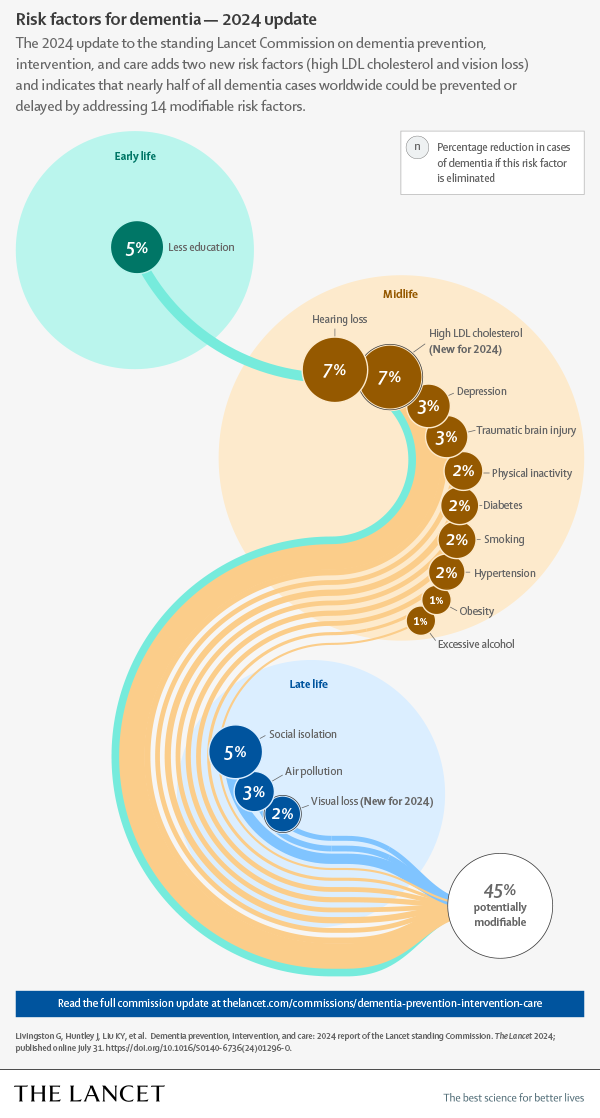
Most have improved over time (better education, earlier and better treatments for hearing loss, cholesterol, diabetes, hypertension, and obesity), people drink and smoke less and air pollution has improved. So the lower incidence is expected. But how low can it go with those preventive measures only?
3 Likes
More playing video games associated with slower brain aging.
The brains of experienced gamers looked an estimated four years younger
On gaming and brain health:
Gaming expertise induces meso‑scale brain plasticity and efficiency mechanisms:
https://www.sciencedirect.com:5037/science/article/pii/S1053811924001289
Gaming and broader of creative activities:
https://www.nature.com/articles/s41467-025-64173-9
@DrFraser @adssx @AlexKChen and others - any aspects of this part of your protocols?
3 Likes
Play novel games, play ones that are RTS, play ones that are mildly uncomfortable, play 1v1’s multiplayer so you can’t count on allies, play games that are shorter rather than longer, and play from a variety of input modalities you havent hard-learned
play games with adaptive rulesets!!
play games that older people don’t prefer playing (don’t just do city-builders or total war). play games that force you to be mindful rather than rote-based
most of all, play games that get you in touch with younger generations (b/c being robust friends with younger generations really is the best bulwark against cognitive aging). But make sure these communities last [the era of online forums was so much better, now discord/reddit/steam communities don’t last as long]. Don’t use gaming as a substitute for social interaction. Don’t play WoW more than a few hours.
play games where you can measure changes in plasticity/probabilistic response over time
Idk if the effects really last (if you only play occasionally, natural aging will wash out any benefits)
But yea, go do HOMEWORLD, XCOM2 [go 1v1 Ramses Alcaide if you can], or Sins of a Solar Empire II, supreme commander, or Ashes of the Singularity 2 once in a while. Get gaming buddies. Starcraft works too but there are so many new games with learning curves. and try a flight-combat game
as petard_rusher once said, “I own at all RTS” [we all played SWGB demo the first time it came out]
and hell, vibe-code an advanced keystrokes=>entropy/complexity analysis visualizer
Try AOE3 [cuz it’s free]
there was a spanish study on how expert gamers had slower-aging brains (selection-effect-maybe)
and track how well TheViper and DauT and TaToH are doing over time [they don’t have great diets]…
and maybe try microdosing psilocybin while you’re at it
if the first 13 minutes weren’t always the same, AOE2 could be ideal, but the first 13 minutes is so repetitive and no one wants to play empire wars/deathmatch, but if you want that game and have any value for time, go for DM]. AI will soon get as better as human players do.
if ur going to do AOE2 DM, don’t do it post-imperial age (tho even post-imperial age is better than RM). at least watch some T90Official regicide rumble games [regicide is way better than RM b/c the start is faster so the first 10 minutes isn’t always the same]. NONSTANDARD SETTINGS [even RM high resources] is way better
I remember when my smart friend [david feldman] used to play Sins of a Solar Empire LAN parties, and even played AI wars [a lot of novel games]. Another friend from UW EEP liked Ark: Combat Evolved…
and go try new kinect or body-aware games. VR/AR games still suck but this will change.
even some UW pathology profs like gaming…
[also try to make the screen flicker subtly at 40hz if u can]
[and don’t spend your youth playing so many games that you don’t adapt to other environments]. for older people who aren’t prone to gaming addiction or escapism, the downside risk is very low
as one ages, it’s way easier to give up on “high-competence” rather than “adaptive competence” fields, so some games can be more robust for this effect
3 Likes
According to Ray Perez, a program officer in the ONR’s warfighter performance department who discussed the findings in the Pentagon Web Radio Webcast, gamers perform “10 [percent] to 20 percent higher, in terms of perceptual and cognitive ability, than normal people that are non-game players.”
2010
I’m playing off and on a game called The Witness right now, it’s a puzzle game with some spiritual elements and unique game engine mechanics involving the player’s viewport. Looking forward to the designer’s new game Order of the Sinking Star, he also created a new programming language with it.
I played way too much FPS games as a kid – I think that made me permanently good at them
Different games for different types cognitive skills. It uses up a lot of time though. VR games might be good for movement and Quest 3 is really good.
2 Likes
Higher SHBG levels in women probably reduce lifelong LBD, stroke risk, and increase lifespan:
1 Like
Some good news, but most Alzheimer mouse models have been really useless and don’t transfer to humans well… so we’ll see where this goes:
New Study Shows Alzheimer’s Disease Can Be Reversed in Animal Models to Achieve Full Neurological Recovery, Not Just Prevented or Slowed
3 Likes
Graphical abstract:
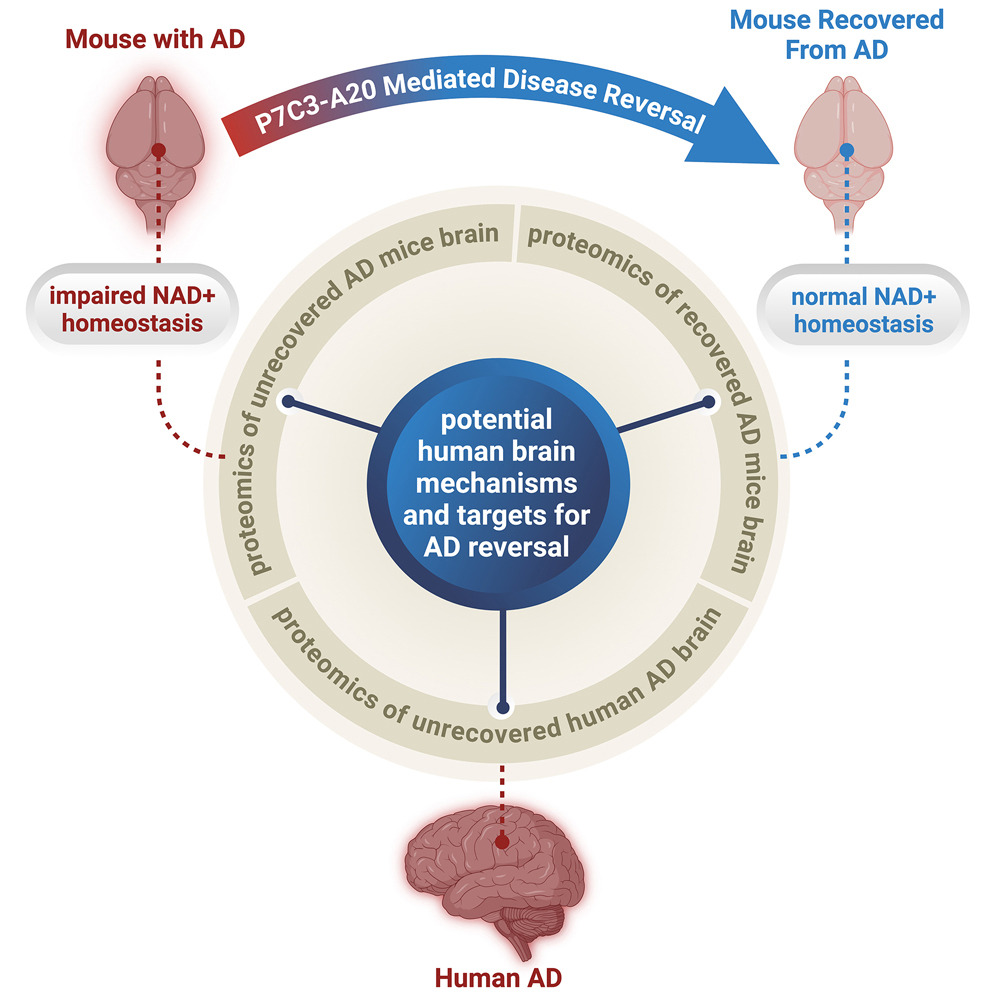
They used P7C3-A20: “a neuroprotective compound that restores NAD+ homeostasis without producing supraphysiologic NAD+ levels”. They got it from “Andrew A. Pieper”.
Where can one source that compound @Steve_Combi?
3 Likes
I will check on that.
In the mean time check this out. There may be a better SMC in the same P7C3- family. P7C3-S243
Also one would want to understand,
Human studies - none
LD50 - none established - well tolerated at high doses in mouse studies
Half-life - none established in humans
Dosing per use - none established for humans
Method of dosing - IP, subQ and oral - in vivo
Dosing schedule - 1 week to 38 weeks
HED - For a 70‑kg human, that is ~225 mg/day , often rounded to ~200–250 mg/day as a theoretical equivalent to the primate neurogenesis study.
This would get quite expensive from most research chemical suppliers, due to the dose size.
Major research suppliers
- Focus Biomolecules: Markets P7C3-A20 as a NAMPT activator/proneurogenic agent (5–25 mg sizes), explicitly labeled “for laboratory research use only; not for human or veterinary applications.”
- Aobious: Offers high‑purity (≈98%) P7C3-A20 under CAS 1235481‑90‑9 in multiple mg quantities with typical storage at 0 to −20 °C and DMSO solubility.
- Other catalog vendors: MedChemExpress, Selleck, MedKoo, LKT Labs, Abbexa, TargetMol, and similar companies list P7C3-A20 as a neuroprotective NAMPT activator for in vitro/in vivo research, again strictly labeled research‑only and not for diagnostic or therapeutic use.
mechanistic comparison vs. other NAD boosters (2).pdf (1.1 MB)
3 Likes
Just received some ACD856 and I’ve taken my first dose. I will be trialling this short term to see how it goes.
1 Like
@adssx I’ve been planning to make P7C3-A20, so if other people are interested I could have some in ~3-4 weeks. In-house confirmation with LC-MS and 3rd-party quantitation w/ qNMR.
P7C3-A20 has also been tested in primates and shown to promote survival of nascent hippocampal neurons without affecting proliferation. I’d speculate that for long-term function this mechanism is safer than proliferative mechanisms (e.g NSI-189) that may accelerate neural stem cell exhaustion.
2 Likes
Obesity and high blood pressure may directly cause dementia
The findings highlight weight and blood pressure control as potentially powerful tools for preventing dementia before symptoms appear.
A new genetic study suggests that obesity and high blood pressure may play a direct role in causing dementia, not just increasing the risk. By analyzing data from large populations in Denmark and the U.K., researchers found strong evidence that higher body weight can damage brain health over time, especially when it leads to elevated blood pressure. Much of the dementia risk appeared to be tied to vascular damage in the brain, which affects blood flow and cognitive function.
3 Likes
Interesting mechanistic insight into the neuroprotection afforded by ApoE2/ApoE3Ch relative to ApoE4:
• ApoE2 and ApoE3Ch reduce neuronal ferroptosis by oxidized lipid efflux via ABCA7
• Lysosomal defects caused by lipid peroxidation are rescued by ApoE2 and ApoE3Ch
• ApoE2 and ApoE3Ch particles protect ApoE4 hippocampi from toxicity
• ApoE2 and ApoE3Ch particles rescue ApoE4 neural activity from excitotoxicity
Summary
Apolipoprotein E (ApoE) mediates the bidirectional transport of lipids between cells. In the brain, this includes the transfer of lipids from neurons to glia. ApoE4, a major risk factor for Alzheimer’s disease, impairs this transport pathway, increasing risk for neurodegeneration. ApoE2 and ApoE3 Christchurch (ApoE3Ch) confer resistance to disease, yet little is known regarding how these variants affect lipid trafficking. Here, we explored how lipoprotein particles containing different ApoE isoforms affect neuronal health. We demonstrate that ApoE2 and ApoE3Ch particles protect neurons from ferroptosis by extracting oxidized unsaturated lipids through the ABCA7 transporter. ApoE4 particles, on the other hand, exacerbate the effects of these toxic lipids, leading to endolysosomal dysfunction. By reducing the oxidized lipid burden in ApoE4 neurons, ApoE2 and ApoE3Ch particles rescue endolysosomal function and restore defects in neuronal activity caused by excitotoxicity. Our findings reveal how ApoE2 and ApoE3Ch help protect neurons from neurodegeneration.
1 Like
Beginning in the late 1990s, nearly 3,000 older adults received brain training as part of a study to evaluate the training’s effect on thinking and memory. Twenty years later, participants continued to reap the benefits.
In the latest follow-up from the Advanced Cognitive Training for Independent and Vital Elderly, or ACTIVE, study, investigators report that participants who received cognitive speed training, plus booster sessions one and three years later, were 25% less likely to be diagnosed with dementia in the next two decades.
3 Likes
new study shows coffee is associated with improved cognition and reduced risk of dementia
Coffee and Tea Intake, Dementia Risk, and Cognitive Function
https://jamanetwork.com/journals/jama/article-abstract/2844764
6 Likes
Based on the NBC News story and the clinical data from the ACTIVE study (Advanced Cognitive Training for Independent and Vital Elderly), the specific software and the criteria for the cognitive intervention are detailed below.
1. The Specific Game Referenced
The news story refers to a cognitive exercise originally known as “Speed of Processing” training. This specific iteration is commercially available as Double Decision.
- Game Name: Double Decision
- Platform: BrainHQ (by Posit Science)
- Scientific Validation: This specific software is the direct evolution of the “speed of processing” intervention used in the ACTIVE study. It was the only intervention (compared to memory and reasoning training) that demonstrated a statistically significant reduction (29%) in dementia risk over a 10-year period.
2. Criteria for “Speed Training” (UFOV)
To meet the criteria of the “speed training” described in the study, a program must specifically target Useful Field of View (UFOV). This is distinct from general “reaction time” games. The training must enforce:
- Divided Attention: Simultaneous identification of a central target (e.g., a car) and a peripheral target (e.g., a road sign).
- Processing Speed: The duration of the stimulus must decrease as the user improves, forcing the visual cortex to process information faster (often down to millisecond exposures).
- Eccentricity: The peripheral target must move further to the edges of vision to expand the functional field of view.
3. Other Programs Meeting the Criteria
While Double Decision is the clinical standard used in the research, other commercially available programs utilize the same specific UFOV mechanics and likely engage similar neural pathways.
-
Lumosity: The specific game Eagle Eye is designed to train the useful field of view.
- Mechanism: It requires the user to identify a central bird while simultaneously pinpointing the location of a second bird in the periphery. This mirrors the mechanics of Double Decision almost exactly.
- CogniFit: This platform offers specific Visual Field training and “Divided Attention” tasks that align with the ACTIVE study’s parameters.
Summary of Options
| Game / Program | Type | Connection to Research | Website |
|---|---|---|---|
| Double Decision | Clinical / Commercial | Direct Match. This is the exact software used in the ACTIVE study (via BrainHQ). | Link to Double Decision |
| Eagle Eye | Commercial | Likely Match. Explicitly targets “Useful Field of View” with identical central/peripheral mechanics. | Link to Lumosity |
| Action Video Games | Entertainment | Functional Match. Research indicates fast-paced FPS games (e.g., Call of Duty) improve UFOV, though they lack the structured adaptive algorithms of clinical tools. | N/A (Commercial Entertainment) |
Knowledge Gap & Academic Note
While Double Decision has the specific longitudinal data regarding dementia risk reduction (the ACTIVE study), it remains a subject of debate whether “likely match” games like Eagle Eye or general action video games confer the exact same long-term neuroprotective benefits without identical dosing and adaptive algorithms. Current consensus suggests the mechanism (UFOV expansion) is the key driver, implying other valid UFOV trainers should theoretically offer similar benefits, but direct comparative trials are limited.
What Makes BrainHQ Effective? The Science Behind the Exercises (2023)
The selected video provides an academic overview of the specific scientific principles behind the BrainHQ exercises, including the “speed of processing” mechanisms discussed in the ACTIVE study.
3 Likes
Any thought on this? 300% improvement in memory of dementia patients sounds to good to be true.
Frankly, I think something like pickleball that involves movement coordination, visual acuity, speed and quick decision making provides exercise and is way more fun.
Also just playing video games like 3D shooters would have similar effects… and again way more fun.
1 Like
Of course it’s too good to be true, Aromatherapy has been around for a long time. I think most of the benefits are placebo. I have tried several different course of aromatherapy and did find any subjective or measureable results. IMO, it is mainly bs.
Common anti-seizure drug (levetiracetam) prevents Alzheimer’s plaques from forming, study shows
Now, in a new study, Northwestern University scientists have pinpointed when and where toxic proteins accumulate within the brains of Alzheimer’s patients—and discovered a decades-old Food and Drug Administration (FDA)-approved drug that can stop the accumulation process before it even begins.
By studying animal models, human neurons and brain tissue from high-risk patients, the team discovered a particularly toxic protein fragment, called amyloid-beta 42, accumulates inside neurons’ synaptic vesicles—the tiny packets that neurons use to send signals. But, when the scientists administered levetiracetam (an inexpensive, decades‑old anti‑seizure drug) to the animals and human neurons, the drug prevented neurons from forming amyloid-beta 42.
“While many of the Alzheimer’s drugs currently on the market, such as lecanemab and donanemab, are approved to clear existing amyloid plaques, we’ve identified this mechanism that prevents the production of the amyloid‑beta 42 peptides and amyloid plaques,” said corresponding author Jeffrey Savas, associate professor of behavioral neurology at Northwestern University Feinberg School of Medicine. “Our new results uncovered new biology while also opening doors for new drug targets.”
https://medicalxpress.com/news/2026-02-common-anti-seizure-drug-alzheimer.html
Paper:
4 Likes