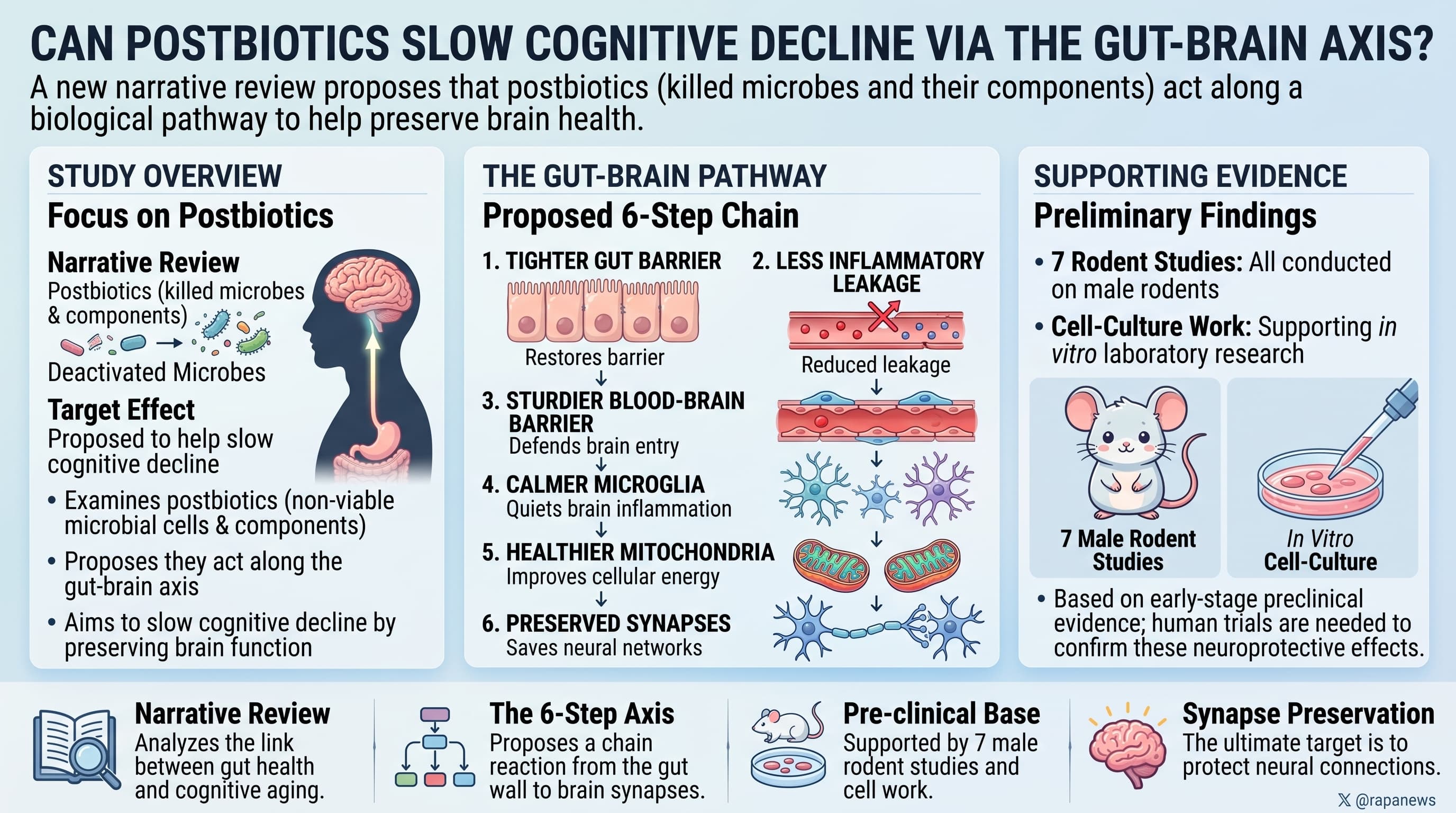
This narrative review argues that postbiotics (killed microbes and their components) could slow cognitive decline by acting along the gut-brain axis. The proposed chain runs from a tighter gut barrier to less inflammatory leakage into the blood, a sturdier blood-brain barrier, calmer microglia, healthier mitochondria and better-preserved synapses. The supporting evidence is seven rodent studies, all in males, plus cell-culture work. The review tabulates no human trials, and the authors themselves conclude that postbiotics are experimental and unproven for cognitive impairment.
Probiotics have a problem: they are alive. Live bacteria must survive manufacturing, shelf storage and stomach acid, and they carry a small infection risk in frail people. Postbiotics sidestep this. They are preparations of heat-killed microbes or their fragments which, according to a new review in Ageing Research Reviews, may still send useful signals to the body after death.
The review, from a team at ISF College of Pharmacy in Punjab, India, asks whether those signals reach the brain. The authors lay out a relay. Dead bacterial cell walls and associated molecules interact with immune receptors in the gut lining. This may tighten the junctions between gut cells and reduce the leakage of bacterial toxins such as lipopolysaccharide into the bloodstream. With fewer inflammatory signals circulating, the blood-brain barrier holds up better, the brain’s immune cells stay calmer, mitochondria produce less oxidative damage, and synapses keep working.
It is a tidy story, and each link has some laboratory support. In rats given a chemical cocktail that mimics aspects of Alzheimer’s disease, heat-killed Bifidobacterium animalis improved maze performance and reduced amyloid build-up over 13 weeks. In mice bred to age quickly, Lacticaseibacillus paracasei improved memory and raised hippocampal dopamine and serotonin. A heat-treated Limosilactobacillus fermentum product protected mice from drug-induced amnesia.
The weakness is the size and quality of that evidence base. The review tabulates seven animal studies. Every one used male rodents. None of the group sizes or the magnitude of benefit are reported in the review, only the direction of change. The models rely on chemical injury or accelerated-aging strains that have a poor record of predicting which treatments work in human dementia. No human trial data are presented.
There is also a definitional tangle. The authors adopt the official consensus definition, under which purified metabolites such as butyrate are not postbiotics. Yet most of the molecular detail in the review, from histone deacetylase inhibition to free fatty acid receptor signaling, comes from studies of exactly those purified short-chain fatty acids. The mechanism described and the product being promoted are not the same thing.
The big idea is plausible and worth testing, since a stable, non-living oral product that reduces gut-derived inflammation would be attractive for older adults. For now, the claim that it protects human cognition is a hypothesis built on rodent mazes.
Actionable Insights
There is no validated human dose, product or protocol in this paper. Anyone buying a “postbiotic for brain health” is running a personal experiment.
Effect size: none can be calculated. The review reports only the direction of results (for example, “improved spatial memory”) without group means, variability or sample sizes. In plain terms, we know the treated animals did better, but not whether they did 5 percent better or 50 percent better. The human effect size is currently unknown, and the default assumption should be zero until trials say otherwise.
Practical points:
- Animal doses were roughly 100 million to 1 billion killed cells per kilogram or per day, for 2 to 18 weeks. These do not translate reliably to human doses.
- The best-supported mechanism in the paper involves short-chain fatty acids, which your own gut bacteria make from dietary fiber. Eating adequate fiber and fermented foods is a lower-cost way to act on the same biology, although it is also unproven for cognition.
- Heat-killed bacterial products are probably low risk for healthy adults, but long-term safety data in cognitively impaired people do not exist.
- Postbiotics are not a substitute for prescribed dementia medications.
- Strain matters. Results from one strain cannot be assumed for another.
Context/Source
- Paywalled Paper: Postbiotics as a therapeutic target in cognitive impairment: Exploring into molecular pathways and neuroprotective effects
- Institution: Departments of Pharmacy Practice and Pharmacology, ISF College of Pharmacy, Moga, Punjab
- Country: India
-
Journal: Ageing Research Reviews, volume 123 (2027), article 103353. Available online 5 September 2026.
Impact evaluation: The impact score of this journal is 12.4, evaluated against a typical high-end range of 0 to 20 for specialty aging and geroscience journals (0 to 60+ for top general science), therefore this is a High impact journal.