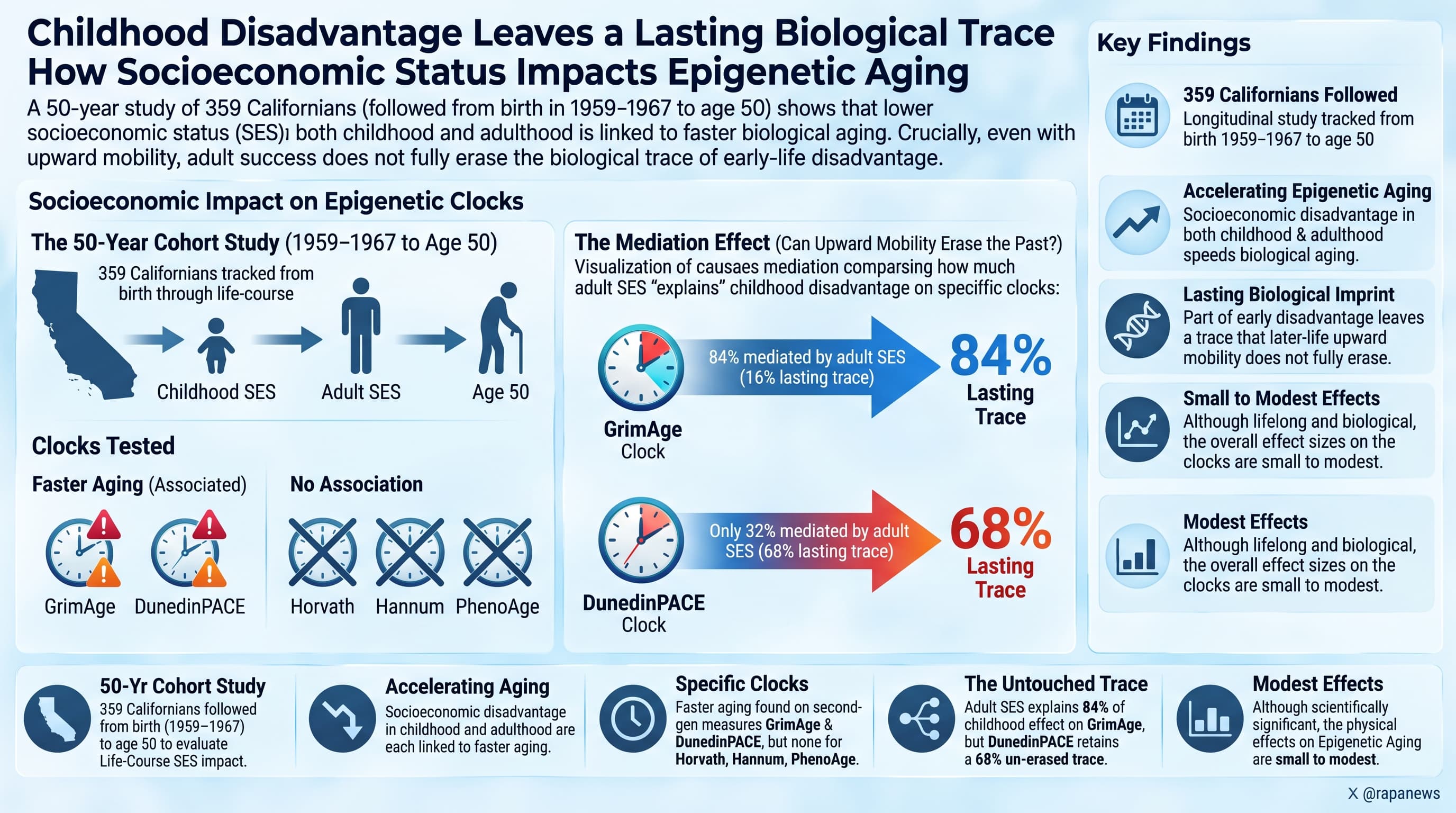
In 359 Californians followed from birth (1959 to 1967) to about age 50, lower socioeconomic status in childhood and in adulthood were each linked to faster epigenetic aging on two second-generation measures, GrimAge and DunedinPACE. Three other clocks (Horvath, Hannum, PhenoAge) showed no association. Using causal mediation models, the authors estimate that adult socioeconomic status explains about 84% of the childhood effect on GrimAge but only about 32% of the effect on DunedinPACE. This suggests part of early disadvantage leaves a lasting biological trace that upward mobility does not fully erase.
A child’s household income in the 1960s may still be readable in their blood half a century later. That is the central claim of a new analysis from Emory and Columbia universities. The team followed several hundred Californians born into a well-known birth cohort and found that those raised in poorer families carried DNA methylation patterns consistent with faster biological aging by about age 50.
The participants are the adult children of women who received prenatal care at Kaiser Permanente in Alameda County between 1959 and 1967, part of the long-running Child Health and Development Studies. Researchers recorded each family’s income, the mother’s education and the father’s occupation at birth, and again when the children were around 10 and 16. At age 50 the same people reported their own education, income, wealth and job status, and 359 of them gave blood for methylation profiling.
The team ran the samples through five epigenetic clocks. Two older clocks, Horvath and Hannum, were trained to predict chronological age. PhenoAge and GrimAge were trained on physiological decline and time to death. DunedinPACE estimates how fast a person is aging right now, with 1.0 meaning one biological year per calendar year.
Only GrimAge and DunedinPACE tracked socioeconomic status. Low childhood status was linked to a GrimAge about one year older than expected and a pace of aging about 5 percent faster. Low adult status showed a similar or larger gap: roughly two GrimAge years and the same 5 percent pace difference. The other three clocks showed nothing.
The more interesting question was why. Is childhood poverty itself written into the epigenome, or does it set people on a path to adult poverty, which then does the damage? The researchers used a causal modeling approach built to handle depression, alcohol use and income as they shift over a lifetime. It estimated that adult status accounted for about 84 percent of the childhood effect on GrimAge, but only about a third of the effect on DunedinPACE. For pace of aging, a residual childhood signal persisted even in a model that imagined everyone reaching a high-status adulthood.
That split matters. It hints that the two clocks read different biology. GrimAge leans heavily on methylation proxies for smoking and blood proteins tied to mortality, so it may track present-day circumstances. DunedinPACE may keep a longer memory of early life. The authors argue this supports early childhood as a sensitive period, and suggests upward mobility can recover some, but not all, of the lost ground.
Caution is warranted. The sample is small and methylation was measured only once. Socioeconomic groups were split crudely at the median.
Still, the result fits a growing body of evidence from Britain, Switzerland and US national surveys: social conditions register in the same molecular markers biohackers use to judge drugs and diets. If a 5 percent change in pace of aging is worth chasing in a supplement trial, it is worth noticing when it shows up between rich and poor.
Actionable Insights
This is an observational study of social circumstances. The practical lessons are indirect.
First, the gaps are real but modest. Growing up in the lower half of the income and education distribution was linked to a GrimAge about 1 year older (plausible range 0.1 to 1.9 years) and a DunedinPACE about 5 percent faster. Being in the lower half as an adult was linked to about 2 extra GrimAge years. In standardized terms these are small to small-moderate effects (Cohen’s d roughly 0.2 to 0.45). Put simply, if you picked one person from each group at random, the lower-status person would have the older-looking clock only 56 to 62 percent of the time, compared with 50 percent by pure chance.
Second, the likely carriers of this effect are things people and clinicians can act on: smoking, untreated depression (more than twice as common in the low adult SES group, 32 versus 14 percent), heavy drinking, and chronic financial stress.
Third, adult circumstances explained most of the GrimAge gap. Midlife improvements still appear to count.
Fourth, if you track your own interventions with GrimAge or DunedinPACE, a shift of 1 to 2 years or 5 percent is about the size of the entire social gradient seen here. Interpret small changes cautiously.
Context and Source
- Open Access Paper: Impact of socioeconomic conditions across the life course on epigenetic age acceleration: evidence from a longitudinal cohort, Published October 2025.
- Institutions: Rollins School of Public Health, Emory University (lead); Mailman School of Public Health, Columbia University; University of Nebraska; Instituto Nacional de Cancerologia (Mexico)
- Country: United States
-
Journal: The Journals of Gerontology, Series A
Impact evaluation: The impact score of this journal is 4.6 (2025 Journal Impact Factor; ranked 4th of 49 in Gerontology), evaluated against a typical high-end range of 0 to 20+ for top aging and geroscience journals, therefore this is a Medium impact journal.