I. Executive Summary
The core thesis presented by Douglas Vaughan, PhD, establishes Plasminogen Activator Inhibitor-1 (PAI-1), encoded by the SERPINE1 gene, as a direct upstream mediator of human organismal aging rather than a passive downstream biomarker of cellular senescence. Historically characterized as a regulator of fibrinolysis via tissue plasminogen activator (tPA) and urokinase plasminogen activator (uPA) inhibition, modern geroscience identifies PAI-1 as a critical hub linking cellular senescence, chronic inflammation, metabolic dysfunction, and immune evasion. Circulating PAI-1 levels rise with chronological age, driven by visceral adiposity, hyperinsulinemia, and pro-inflammatory cytokines like Tumor Necrosis Factor-alpha (TNF-alpha), establishing a feed-forward loop that accelerates multi-organ degeneration.
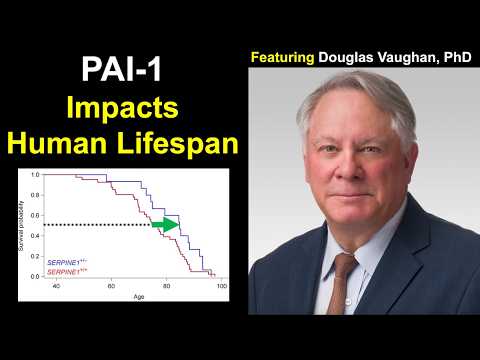
This causal paradigm is validated by human loss-of-function genetics. Longitudinal evaluation of an Old Order Amish kindred in Adams County, Indiana, carrying a rare SERPINE1 null mutation (c.699_700dupTA) demonstrates that heterozygous carriage results in a ~50% reduction in circulating PAI-1 antigen. This lifelong partial deficiency confers profound systemic healthspan advantages, including a median lifespan extension of approximately 10 years, 10% longer leukocyte telomeres, lower fasting insulin, lower hemoglobin A1c, and near-absolute protection against type 2 diabetes. These individuals exhibit preserved cardiovascular compliance, characterized by reduced aortic pulse wave velocity and delayed vascular stiffness. Conversely, absolute homozygous deficiency induces clinical bleeding disorders and spontaneous cardiac fibrosis, defining a narrow therapeutic window where partial, rather than complete, inhibition is mandatory to optimize organismal fitness.
At the molecular level, PAI-1 exerts pleiotropic control over biological pathways by blocking the proteolytic processing of essential signaling peptides. It halts the activation of brain-derived neurotrophic factor (BDNF) and hepatocyte growth factor (HGF), impairing neuroplasticity and tissue regeneration. Furthermore, PAI-1 reinforces cellular senescence via intracellular p53 stabilization and upregulates programmed death-ligand 1 (PD-L1) to shield senescent cells from immune clearance. Epigenetically, these mechanisms map directly onto the Horvath GrimAge clock, where the DNAm PAI-1 estimator serves as the strongest surrogate predictor of all-cause mortality and multi-system comorbidities. Translationally, this validates the deployment of orally bioavailable small-molecule PAI-1 inhibitors like TM5614, which have shown safety in Phase I/II trials and are entering human longevity testing.
II. Insight Bullets
- PAI-1 as a Functional Senescence Driver: PAI-1 is an active, causal mediator of cellular senescence and part of the Senescence-Associated Secretory Phenotype (SASP), rather than a passive downstream marker of cellular aging Vaughan et al., 2024.
- Geroscience Paradigm Target: The core hypothesis mandates that targeting upstream molecular hubs like PAI-1 can delay or compress multi-system morbidities simultaneously, extending healthy human healthspan.
- Biological vs. Chronological Disconnect: Chronological age is cosmically fixed and unyielding, whereas biological age is a mutable, non-linear metric counting multi-system homeostatic changes over time.
- Adiposity as Primary PAI-1 Regulator: Plasma PAI-1 antigen levels correlate directly with body mass index (BMI); visceral adiposity and hepatic lipid accumulation drive the modern epidemic of elevated PAI-1 ResearchGate Source.
- Inflammatory Acute-Phase Induction: PAI-1 operates as an acute-phase reactant; systemic inflammatory cytokines, primarily Tumor Necrosis Factor-alpha (TNF-alpha) and Interleukin-6 (IL-6), strongly induce its expression.
- The SERPINE1 Null Mutation: A rare human loss-of-function founder mutation (c.699_700dupTA) exists within an Old Order Amish community in Indiana, providing a unique population genetics model for geroscience Vaughan et al., 2017.
- Heterozygous Longevity Phenotype: Heterozygous carriers of the SERPINE1 null mutation have a 50% reduction in circulating PAI-1, which extends median lifespan by approximately 10 years Vaughan et al., 2017.
- Leukocyte Telomere Preservation: Lifelong 50% reduction of PAI-1 is associated with approximately 10% longer leukocyte telomeres, demonstrating protected replicative capacity in humans Vaughan et al., 2017.
- Near-Absolute Diabetes Protection: Heterozygous SERPINE1 mutation carriers exhibit lower fasting insulin and lower HbA1c, rendering them highly resilient against type 2 diabetes development compared to unaffected cohort matches.
- Homozygous Cardiac Pathology: Complete absence of PAI-1 (homozygous mutation) results in localized subendocardial bleeding and spontaneous cardiac fibrosis/scarring, proving that complete PAI-1 knockout is highly deleterious.
- Smooth Muscle Origin in Vascular Aging: Single-cell RNA sequencing reveals that the pathologically elevated PAI-1 seen in advancing vascular wall aging originates from vascular smooth muscle cells, not healthy endothelial cells Vaughan et al., 2023.
- Hepatic PAI-1 Knockdown and FGF-21: Targeted hepatic reduction of PAI-1 using siRNA significantly upregulates Fibroblast Growth Factor 21 (FGF-21), demonstrating an intimate connection between fribrinolytic signaling and systemic metabolic adaptation.
- PAI-1 and PCSK9 Co-Regulation: Lowering PAI-1 by half significantly downregulates Proprotein Convertase Subtilisin/Kexin Type 9 (PCSK9) in the liver, identifying PAI-1 as a critical post-translational regulator of LDL receptor clearance.
- GrimAge Epigenetic Hierarchy: In Steve Horvath’s GrimAge clock, the DNAm PAI-1 surrogate is the single most powerful predictor of all-cause mortality, coronary artery disease, and comorbidity accumulation Lu et al., 2019.
- Surrogate Superiority over Direct Plasma Tests: Epigenetic estimators (DNAm PAI-1) often outperform single-timepoint blood draws in predictive power due to the short half-life and massive acute-phase volatility of raw plasma proteins Lu et al., 2019.
- Circadian Volatility Limitations: Plasma PAI-1 concentrations follow a powerful circadian curve, peaking sharply in the early morning and dropping in the late afternoon, requiring rigid standardization for clinical sample processing.
- Serum Sample Invalidation: PAI-1 must be analyzed strictly in anticoagulated plasma; serum tests are completely invalidated by the massive dump of PAI-1 from platelet intracellular granules during active coagulation.
- Neuroplasticity Blockade via BDNF Inhibition: Elevated PAI-1 prevents tPA from cleaving pro-BDNF into its active, mature form, directly arresting neuroplasticity, memory consolidation, and downstream cognitive resilience.
- Immune Evasion via PD-L1 Upregulation: Local tissue PAI-1 accumulation overexpresses Programmed Death-Ligand 1 (PD-L1), constructing an immune checkpoint shield that blocks immune-mediated clearance of senescent cells.
- Regenerative Suppression via HGF Inhibition: PAI-1 actively suppresses the proteolytic activation of Hepatocyte Growth Factor (HGF), thereby halting cell proliferation and downstream organ regenerative kinetics.
- Vascular Elasticity Preservation: Heterozygous SERPINE1 mutation carriers exhibit low aortic pulse wave velocity, indicating lifelong resistance to age-related mechanical vascular stiffening Vaughan et al., 2023.
- The Small-Molecule Inhibitor TM5614: TM5614 (RS5614) is an orally bioavailable, structure-guided small molecule that targets human PAI-1, currently showing safety in phase II trials for hematological and solid tumors Vaughan et al., 2024.
- Transition to Longevity IND Trials: Researchers have applied for an FDA Investigational New Drug (IND) clearance to test small-molecule PAI-1 inhibitors in non-Amish human cohorts to evaluate direct biological clock reversal.
- Inadequacy of Isolated Epigenetic Clocks: Epigenetic age rollbacks are clinically meaningless if they occur in isolation from physical, proteomic, glycomic, and multi-system functional physiological performance assessments.
- Multi-Dimensional Diagnostics Paradigm: The Northwestern Human Longevity Lab integrates deep molecular profiling (OLink proteomics, GlycanAge) with rapid, AI-driven functional stations (ECG machine learning, retinal imaging, and video gait kinetics) to establish valid organ-specific age profiling.
IV. Actionable Protocol
High Confidence Tier (Level A/B Evidence)
- Targeted Metabolic Regulation for PAI-1 Reduction: Visceral fat and hepatic steatosis are the primary drivers of pathologically elevated PAI-1. Comprehensive meta-analyses establish that targeted weight reduction, visceral fat loss, and resolution of hyperinsulinemia drastically lower circulating PAI-1 levels while downregulating systemic inflammatory checkpoints ResearchGate Source.
- Rigidly Standardized Biomarker Surveillance: Due to high biological variation, PAI-1 must never be tested in serum (confounded by platelet dumping). Clinical evaluation must utilize plasma specimens drawn strictly at an identical early morning timepoint to control for its rapid circadian fluctuations. Epigenetic tracking via second-generation mortality predictors (e.g., GrimAge DNAm PAI-1) provides a more stable, long-term reflection of tissue PAI-1 burden than singular blood draws Lu et al., 2019.
Experimental Tier (Level C/D Evidence with High Safety Margins)
- Multi-System Functional and Proteomic Mapping: Clinicians should cross-reference epigenetic age scores with real-world physiological capacity testing. This includes monitoring arterial compliance via aortic pulse wave velocity (a validated indicator of vascular preservation in low PAI-1 phenotypes), alongside deep proteomic panels (e.g., OLink platform), retinal microvascular photography, and AI-guided gait velocity assessments to gauge functional tissue reserves.
- Structured Neuroendocrine Stress Mitigation: Chronically elevated cortisol and sympathetic overdrive trigger acute-phase reactants, including hepatic PAI-1 synthesis. Deploying validated, digital positive-emotion and cognitive stress-reduction architectures can attenuate the systemic inflammatory drive, though direct, long-term clinical trial readouts on biological clocks are still actively accumulating.
- Empirical Precision Nutrition Interventions: Incorporating high-fiber dietary protocols (~70g/day) and evaluating functional food targets such as specific mushrooms (which contain natural trace HMG-CoA reductase inhibitors, ergothioneine, and spermine) to optimize cardiometabolic risk parameters. Longevity-specific dosing ranges for absolute lifespan extension in humans remain speculative and unverified in large-scale randomized controlled trials (RCTs).
Red Flag Zone (Safety Data Absent)
- Unregulated Off-Label Deployment of Small-Molecule PAI-1 Inhibitors: Utilizing investigational PAI-1 small-molecule inhibitors (e.g., TM5614 or RS5614) outside of tightly controlled clinical trial infrastructure is highly dangerous and classified as “Safety Data Absent” for healthy aging cohorts. Complete or excessive titration of PAI-1 introduces severe toxicological risks, including uncompensated clinical bleeding disorders, compromised innate immune surveillance, and catastrophic spontaneous subendocardial cardiac fibrosis. Partial, targeted modulation is mandatory; complete knockdown mimics a deleterious disease state.