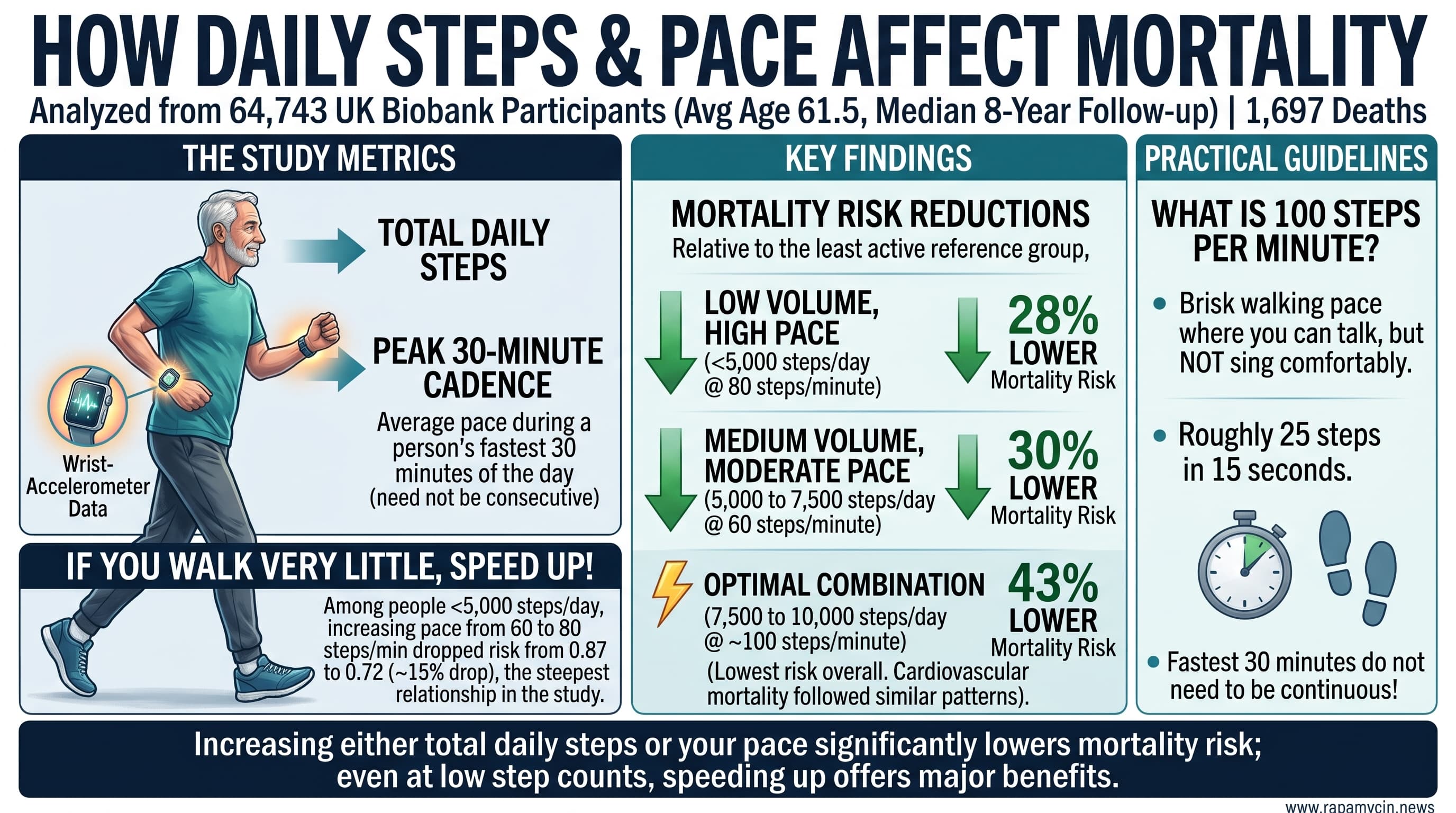
Researchers analyzed wrist-accelerometer data from 64,743 UK Biobank participants, average age 61.5, followed a median of eight years with 1,697 deaths. They measured two things: total daily steps and peak 30-minute cadence, the average pace during a person’s fastest 30 minutes of the day, which need not be consecutive. Relative to the least active reference group, people taking fewer than 5,000 steps per day but walking at 80 steps per minute had 28 percent lower all-cause mortality risk. People at 5,000 to 7,500 steps walking at only 60 steps per minute had a similar 30 percent reduction. The lowest risk overall occurred at 7,500 to 10,000 steps combined with about 100 steps per minute, at 43 percent lower risk. Cardiovascular mortality followed similar patterns.
The 10,000-step target has no scientific origin. It came from a 1960s Japanese pedometer marketing campaign, and the research community has spent the past decade quietly dismantling it. Recent meta-analyses put most of the mortality benefit between 5,000 and 7,000 steps a day, with diminishing returns after that.
What the field has handled less well is pace. Steps are easy to count and intuitive to communicate. Cadence, the rate at which you take them, is harder, and the evidence has been thinner and less consistent. This new analysis from a Sydney-based group that has produced much of the recent accelerometer-and-mortality literature asks the obvious next question: how do volume and pace interact?
The answer is more interesting than either variable alone. The team sorted participants into four step bands and then modeled mortality risk against cadence within each band. For people in the lowest band, under 5,000 steps a day, the relationship with pace was steep and close to linear. Walking faster conferred progressively more benefit, right up to the limits of what was observed. For people already walking a lot, the curve flattened and then turned up slightly, suggesting that past a certain point extra pace adds nothing.
The practically useful comparison sits between two of those bands. Someone taking under 5,000 steps but moving at 80 steps per minute had roughly the same estimated risk as someone taking 5,000 to 7,500 steps at a relaxed 60 steps per minute. These are two different routes to a similar place. That matters because people fail to exercise for different reasons. Someone short on time can walk briskly. Someone who fears falling, or has knee pain, or simply does not want to rush, can accumulate more steps slowly.
The authors use peak 30-minute cadence, which captures the fastest 30 minutes of the day whether or not those minutes are consecutive. This is a thoughtful choice. It means two minutes of brisk walking to catch a bus, repeated fifteen times across a day, counts the same as a half-hour walk. For older adults who struggle with structured exercise, that framing is more achievable.
The lowest risk of all appeared at 7,500 to 10,000 steps with cadence near 100 steps per minute. One hundred steps per minute happens to be the conventional threshold for moderate-intensity walking, and thirty minutes a day of it works out to roughly 200 minutes a week, comfortably inside the 150 to 300 minute guideline range.
The limits are the usual ones for observational work. People who walk fast are healthier in ways no questionnaire captures, and the authors acknowledge that reverse causation cannot be fully excluded despite their precautions. Several of the headline numbers come from sparse cells with confidence intervals wide enough to include no effect, and the paper’s own abstract highlights one such estimate.
The big idea is that cadence and count are partly interchangeable, which turns a single rigid target into a menu of options.
Actionable Insights
This is a well-conducted observational study. It establishes association, not cause. [Confidence: Medium]
- If you walk very little, speed up. Among people under 5,000 steps a day, going from 60 to 80 steps per minute was associated with risk dropping from 0.87 to 0.72, a change of about 15 percentage points. This was the steepest relationship in the entire study.
- If you prefer a slow pace, walk more. At 5,000 to 7,500 steps a day, even 60 steps per minute showed a 30 percent lower risk (HR 0.70, CI 0.58 to 0.86), with tighter confidence intervals than the low-step high-cadence estimates.
- The target worth aiming at: 7,500 to 10,000 steps per day, with about 100 steps per minute during your fastest 30 minutes. That combination gave the lowest risk in the entire analysis (HR 0.57, CI 0.47 to 0.69).
- How to hit 100 steps per minute: it is a brisk walk where you can talk but not sing comfortably. A practical check is roughly 25 steps in 15 seconds. The 30 minutes do not need to be continuous.
- Beyond 10,000 steps, faster is not better. The curve flattened and turned up slightly, though the authors note this uptick disappeared in a sensitivity analysis and may be a statistical artifact of sparse data.
- Calibrate your expectations. These hazard ratios compare against a very inactive reference group. In a cohort with a 2.6 percent eight-year mortality rate, the headline 43 percent reduction translates to roughly 1.1 percentage points absolute, or one death avoided per 90 people, if causal.
Context and Source
- Paywalled Paper: Combinations of stepping intensity and daily step counts against all-cause and cardiovascular disease mortality: insights from a device-based prospective study, Sept. 2026.
- Institutions: School of Health Sciences and Mackenzie Wearables Research Hub, Charles Perkins Centre, University of Sydney; Turner Institute for Brain and Mental Health and Victorian Heart Institute, Monash University; Save Sight Institute; Sydney Local Health District; Universidad Europea de Madrid
- Countries: Australia (lead), Spain
- Journal: British Journal of Sports Medicine (BMJ Group, for the British Association of Sport and Exercise Medicine)
- Impact evaluation: The impact score of this journal is 16.2 (2025 Journal Impact Factor; CiteScore 21; ranked 1st of 133 in Sports Sciences), evaluated against a typical high-end range of 0 to 60+ for top general science, therefore this is a High impact journal.