Ha, I currently have them in an opaque Tupperware incase the housekeepers want to clean out the fridge. They already know the wine fridge looks like a drugstore! :).
I do think I’ll keep the hydra peak for the reason that vertical storage will free up more room for food!
@Kelman
If you want, I can send you a link to where I bought mine and describe to you how to use it.
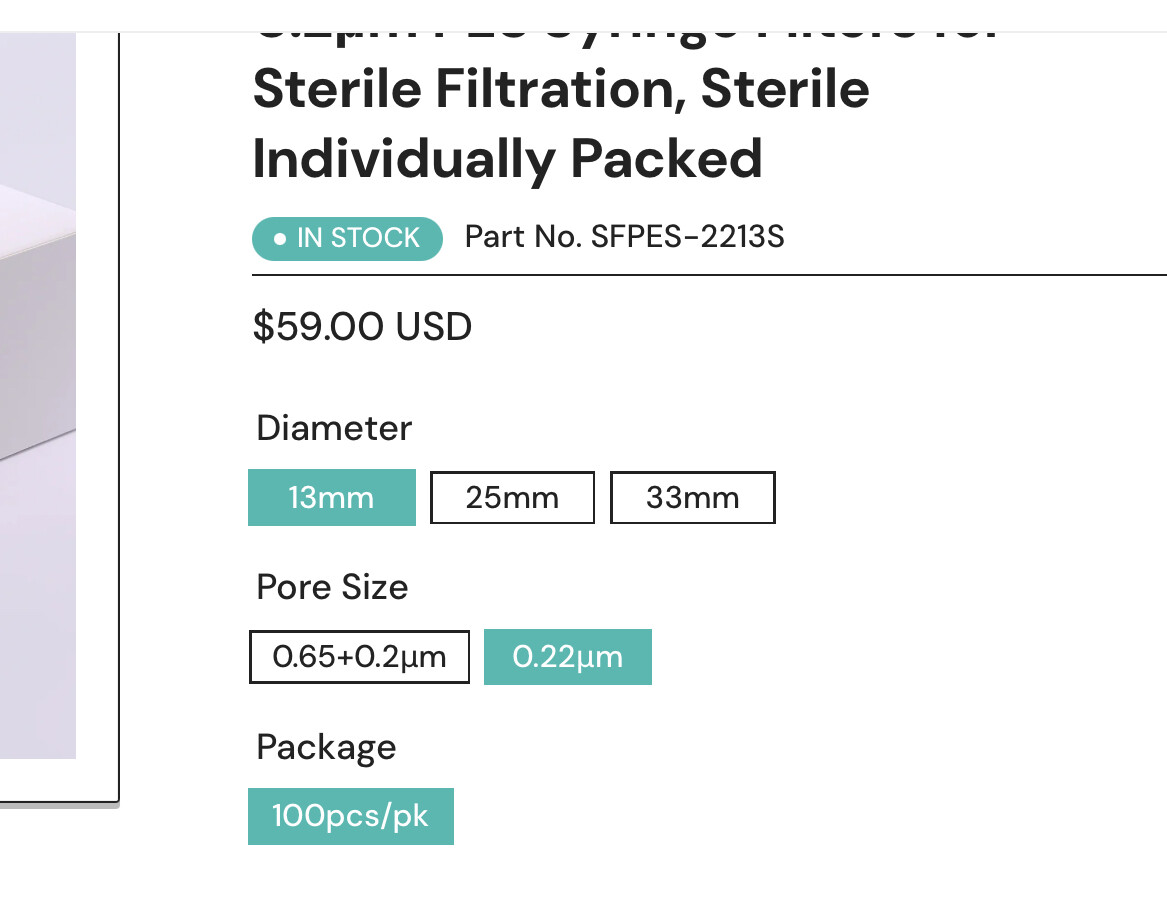
You would add the water to your peptide in the vial it came in, as usual. Then you pull of it into a syringe… and then you take the needle off and put a PES filter on the syringe… and then you attach a clean needle on top of the filter…and then you inject it all into a brand new sterile vial. Tada!
The peptide then just ran through the filter and it catches potential contaminants as an added layer of safety
(Just paying it forward because another forum member taught me everything I know!)
Sub-Micron type filters have different properties related to the “charge” of the contaminant being filtered. If you don’t use a filter that is compatible with the intended target, things you don’t want can still get through.
This is an often overlooked aspect of doing science, without knowing what the science is This bit me in the ass… hard. I had asked for some endotoxins to test a filter that is commonly used and it was an excruciating experience, which made me look into this aspect of filtering.
It’s not the size of the pores that is ultimately important. It’s the charge (electrical charge) of the thing you are trying to remove. If you don’t know the charge of the contaminant, the size of the pores may not help at all is the point. This is fairly well detailed in the PDF I attached
And it cones down to the target contaminant, there is no one size, one charge filter that fits all. That’s why there are a variety of specific filters for filtering in the lab.
Amazon is not going to tell us which one is best, you would need to go to a filtration company website to see how this works. I spent many hours sorting through this after my experience.
Heres the thing, being paranoid about this is one thing, doing it rationally is another. Because of my personal experience with injecting a very tiny amount of endotoxin, I now know how that feels, there is NO subtly to it. It will put you on the couch and in agony for several hours and you will puke your guts out.
I was not concerned at all about my supply and now I know for sure my supply has no endos because I test ever batch personally with my own body before I ship to any customer. I wonder how many others in this field do that for their clients
All hydrophilic I am a good pharmacist also. I know my drugs extremely well and am well versed in endotoxins as it is the biggest reason horses die and founder.
Endotoxins are so small that they pass right through these filters, even the 0.22 micron ones, so if you’re using a filter it’s mainly to guard against potential bacteria and fungal contamination. That being said, human tolerance for endotoxins is quite high and the experts on this topic repeatedly claim it’s not a major concern because we’re continually exposed to much larger amounts of endotoxins from other sources on a daily basis.
Yes they go right thru the filter but people are much more tolerant than animals with the exception of the dog which takes alot to affect. It is the cell wall of dying gram negative bacteria and horses can’t handle micrograms. The amount is what’s important and if there are bacteria in the sample you increase the concentration of endotoxin immensely. A limit of 0.25 EU/mL is appropriate for most systems. Great always to have a discussion.
And that is why the charge of the filter is critical if removing’s endo’s is the goal. Endo’s are negatively charged which means you need a positively charged filter. This charge will trap endo’s on the surface and in the matrix of the filter.
This also tells us that all those filtering their peptides may not be removing any endo’s, if they are using the typical filter found on Amazon. Most filter are negatively charged… Which then tells us that the overall peptide supply chain is pretty clean. And another reason I don’t waste my time doing 3rd party testing as I trust the reports from my supplier to be accurate and the results speak for themselves.
The reason nobody does this is because many of the peptides in common use, including the incretin mimetics (“GLPs”) are also negatively charged and would be trapped inside of a positively charged filter.