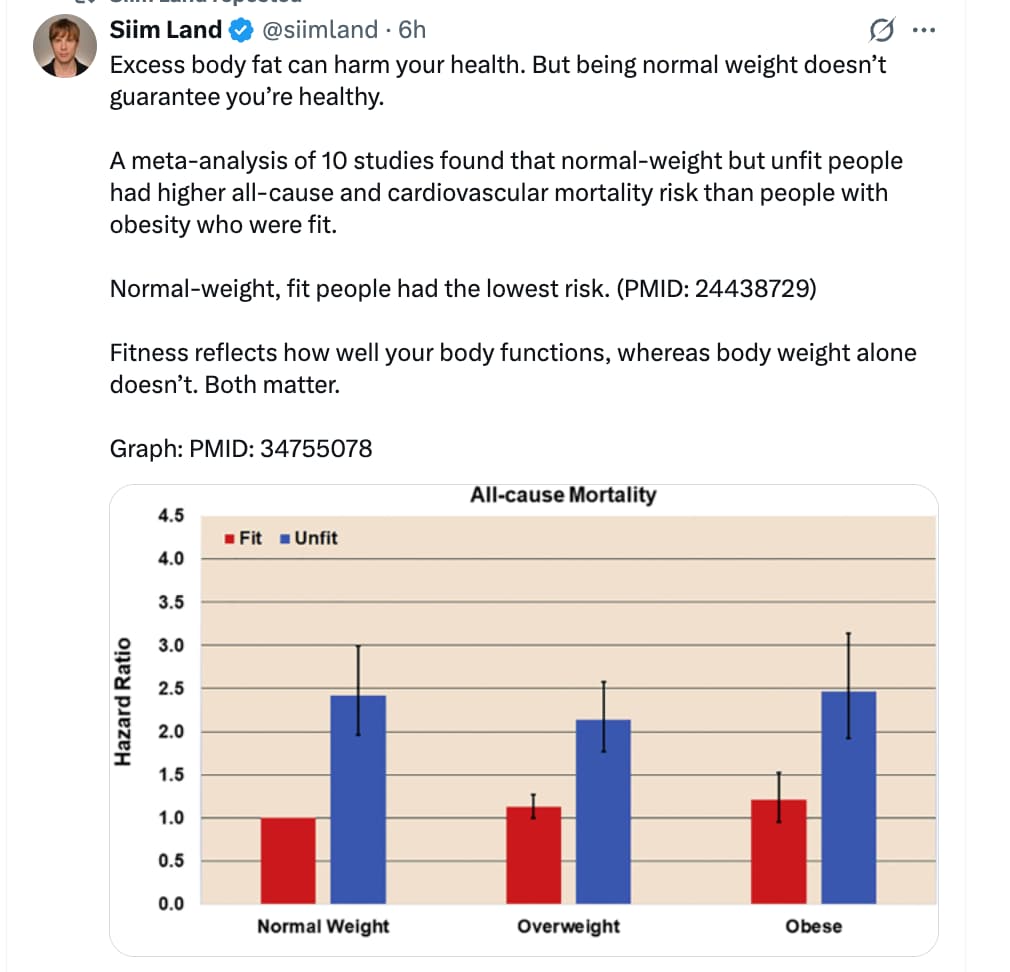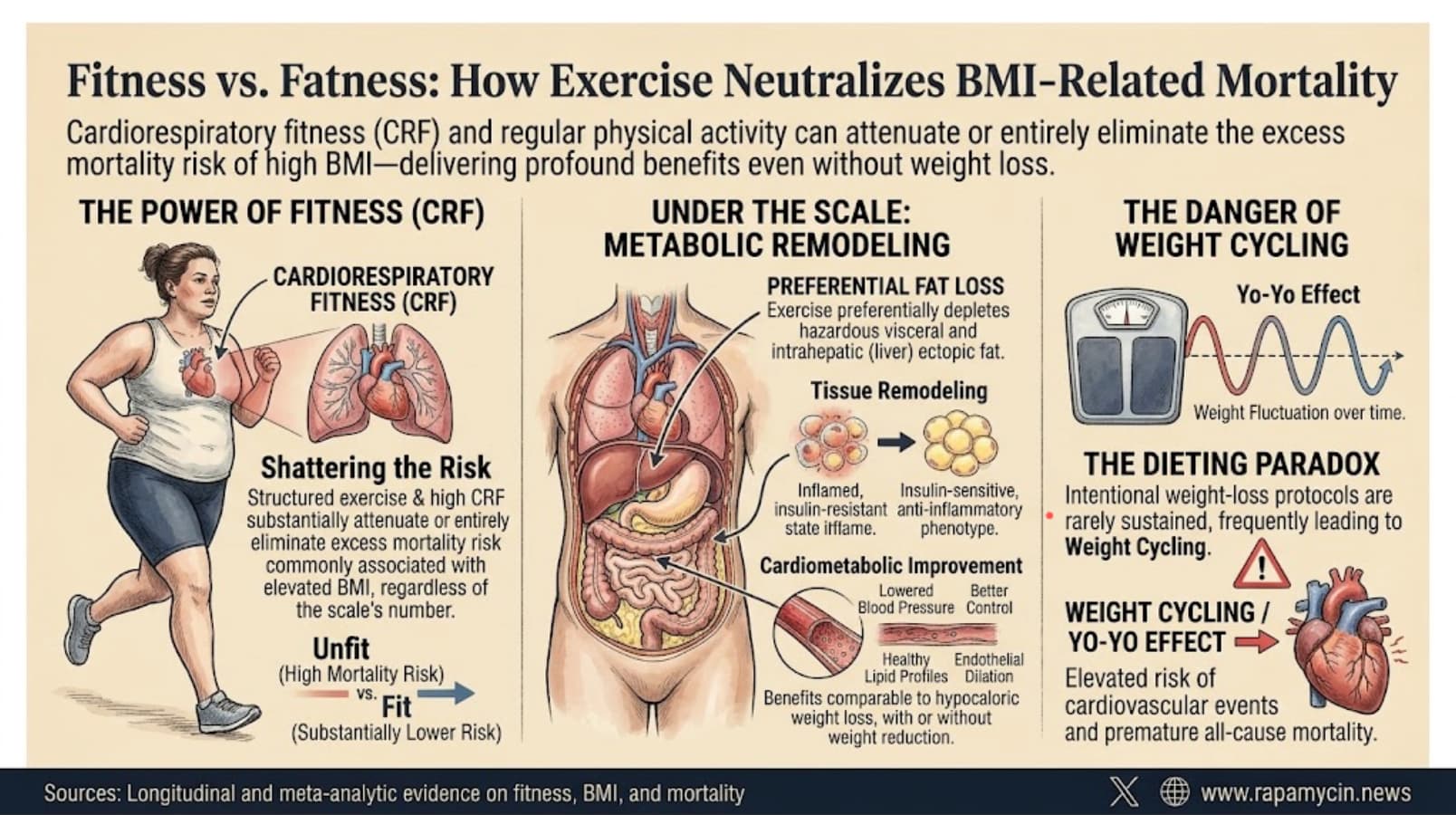
Cardiorespiratory fitness and regular physical activity substantially attenuate or entirely eliminate the excess mortality risk commonly associated with elevated body mass index. Longitudinal and meta-analytic evidence indicates that structured exercise yields cardiometabolic improvements in resting blood pressure, glycemic control, lipid profiles, and endothelial dilation comparable to hypocaloric weight loss programs, even in the complete absence of total body weight reduction. These benefits arise largely because exercise preferentially depletes hazardous visceral and intrahepatic ectopic fat depots while simultaneously remodeling adipose tissue into a more insulin-sensitive, anti-inflammatory phenotype. In contrast, intentional weight-loss protocols rarely sustain weight reduction and frequently lead to weight cycling, an outcome strongly linked to elevated cardiovascular events and premature all-cause mortality.
For over four decades, clinical practice and public health messaging have operated under the premise that carrying excess weight is lethal, and that shedding pounds through dietary restriction represents the primary intervention for restoring longevity. Over this exact span, adult obesity rates have tripled and the prevalence of intentional weight-loss attempts has surged to record levels. Glenn Gaesser and Siddhartha Angadi present evidence that this weight-centric paradigm has failed. Rather than continuing to demand weight reduction that physiology fiercely resists and rarely maintains, public health must pivot toward a weight-neutral framework centered on physical activity and cardiorespiratory fitness.
The foundational finding emerging from large-scale prospective cohorts is that cardiorespiratory fitness rewires the mortality equation. When aerobic capacity is measured, the apparent mortality penalty of an elevated body mass index largely disappears. Individuals categorized as obese who maintain moderate or high levels of cardiorespiratory fitness exhibit all-cause mortality rates comparable to, or lower than, unfit individuals within the normal weight bracket. Sedentary behavior and low aerobic fitness represent the dominant drivers of premature cardiovascular and all-cause death, far surpassing body mass index in predictive power.
This reality exposes critical weaknesses in conventional dietary weight-loss programs. Meta-analyses of randomized clinical trials evaluating intentional weight loss fail to demonstrate consistent, reproducible survival benefits. For example, the Look AHEAD trial in patients with type 2 diabetes was stopped early for futility because intensive caloric restriction and weight loss failed to reduce cardiovascular events or all-cause mortality compared to standard care. Compounding the problem, the typical consequence of restrictive dieting is weight regain, leading to chronic weight cycling. Repeated fluctuations in body mass correlate with significant clinical harm, elevating all-cause mortality risk by 41 percent and cardiovascular mortality by 36 percent, while doubling the risk of myocardial infarction in high-risk groups.
Dynamic exercise accomplishes the cardiometabolic goals of weight reduction without requiring sustained caloric deficits. Supervised exercise protocols lower systolic blood pressure, improve glycated hemoglobin, and enhance arterial flow-mediated dilation to degrees equivalent to or exceeding standard weight-loss trials, even when participants lose less than a single kilogram of total body mass.
The underlying physiology explains this disconnect. Exercise selectively targets ectopic fat depots, including visceral abdominal adipose tissue and intrahepatic lipids, which represent the true culprits of systemic insulin resistance and atherogenesis. For an identical 5 percent loss of total body mass, exercise training achieves a 21.3 percent reduction in visceral fat, compared to only 13.4 percent achieved via caloric restriction. In addition, regular muscular work stimulates local mitochondrial biogenesis and beneficial endocrine signaling across adipose tissue, transforming fat from a pathological reservoir into a metabolically functional endocrine organ. Treating cardiorespiratory fitness as a non-negotiable clinical vital sign provides a direct, sustainable path to reducing morbidity and extending lifespan.
Actionable Insights
Sustained longevity does not require reaching an idealized weight on a bathroom scale. Shifting from the lowest 20 percent of cardiorespiratory fitness into the next fitness category reduces all-cause mortality risk by 30 to 60 percent (Relative Risk 0.40 to 0.70). In absolute functional terms, gaining 1 MET of aerobic capacity, which is roughly equivalent to increasing your sustainable brisk walking pace by 0.5 to 1.0 miles per hour, cuts cardiovascular mortality by 19 percent (Hazard Ratio 0.81) and all-cause mortality by 14 to 29 percent (Hazard Ratio 0.71 to 0.86). This degree of fitness improvement can be achieved in as little as 8 weeks of interval or continuous endurance training without altering body weight.
Rather than cycling through hypocaloric diets that risk muscle loss and long-term rebound, individuals should accumulate 150 to 300 minutes per week of moderate-intensity activity, or 75 to 150 minutes of vigorous aerobic training, alongside at least two weekly resistance training sessions targeting all major muscle groups. Dynamic exercise selectively strips visceral fat by 21.3 percent with only a 5 percent body weight shift, protecting vascular elasticity and lowering resting blood pressure by 5 to 7 mmHg in hypertensive adults.
Context and Source
- Open Access Paper: Obesity treatment: Weight loss versus increasing fitness and physical activity for reducing health risks, Published 2021 Sep 20.
- Institutions: College of Health Solutions, Arizona State University, Phoenix, Arizona; Department of Kinesiology, School of Education and Human Development, University of Virginia, Charlottesville, Virginia
- Country: United States of America
- Journal: iScience (Cell Press)
- Impact Evaluation: The impact score of this journal is 5.8, evaluated against a typical high-end range of 0 to 60+ for top general science, therefore this is a Medium impact journal.