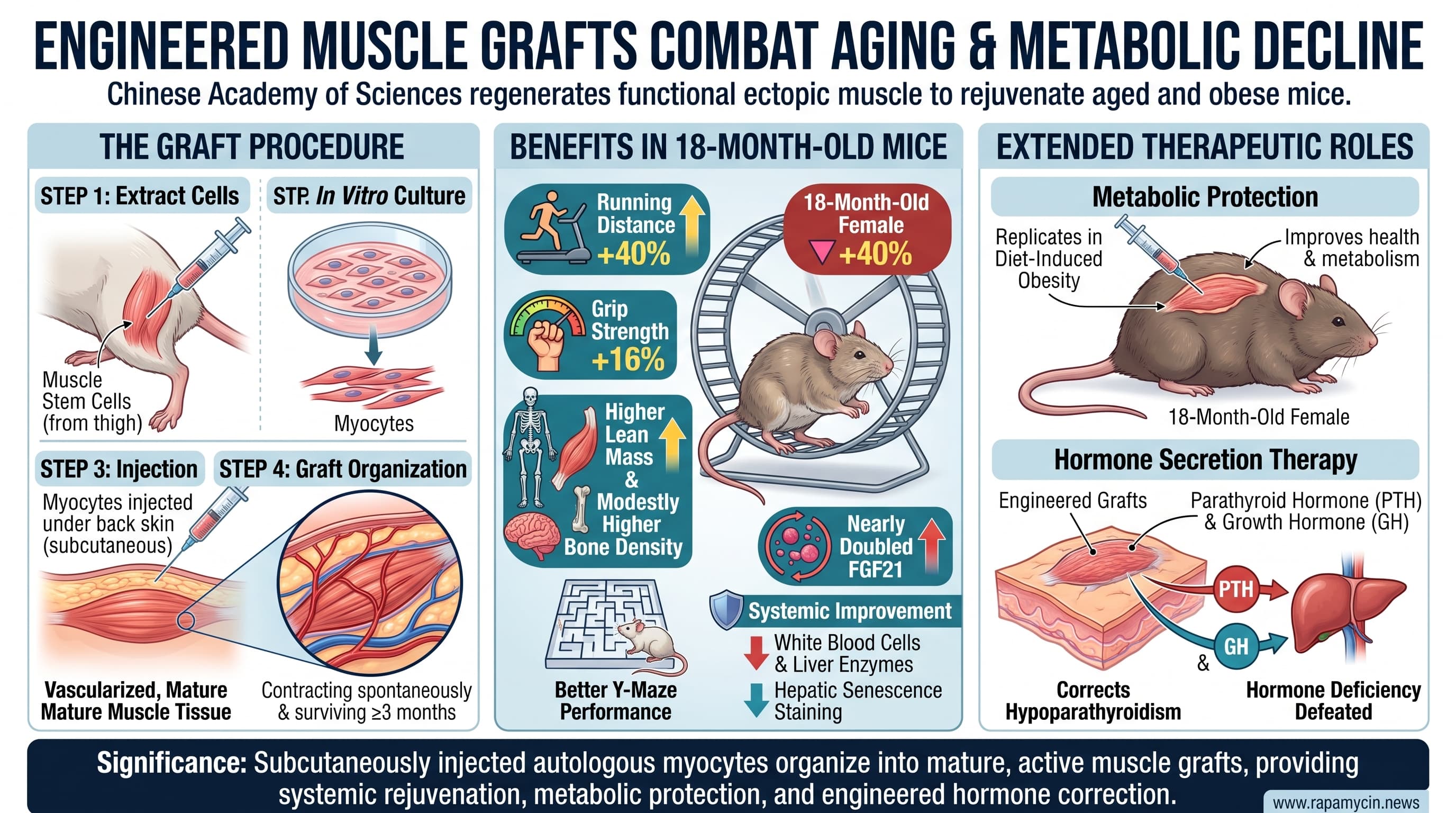
Researchers at the Chinese Academy of Sciences took muscle stem cells from a mouse’s own thigh, grew and differentiated them in culture, then injected the resulting myocytes under the skin of the animal’s back. The cells organized into vascularized, mature muscle tissue that contracted spontaneously and survived at least three months. In 18-month-old female mice, these grafts were associated with higher lean mass, roughly 40 percent greater running distance, 16 percent higher grip strength, modestly higher bone density, lower white cell and liver enzyme levels, reduced hepatic senescence staining, better Y-maze performance, and nearly doubled circulating FGF21. Similar metabolic benefits appeared in diet-induced obese mice. The team also engineered grafts to secrete parathyroid hormone or growth hormone, correcting experimental hypoparathyroidism.
Exercise is the closest thing geroscience has to a universal intervention. It improves muscle, bone, metabolism, mood and cognition at once, and it does so partly because contracting muscle is an endocrine organ, releasing a stream of signaling proteins called myokines into the bloodstream. The field has spent two decades trying to bottle this. Most attempts pick one myokine, irisin or BDNF or FGF21, and try to deliver it as a drug. The results have been underwhelming, which suggests that the benefit may lie in the whole secretome rather than any single component.
This paper takes a different route. Instead of delivering a molecule, it delivers the organ.
The procedure is conceptually simple. Take a small biopsy from the animal’s own quadriceps, isolate the muscle stem cells, expand them in culture, push them one step down the differentiation path into myocytes, then inject them under the skin of the back in a gel scaffold. What happens next is the surprising part. The cells do not die, which is what usually happens to transplanted myoblasts. They organize into recognizable muscle tissue with multiple fiber types, recruit a blood supply from the host, and begin contracting. Not in response to a nerve signal, because there is no nerve. They contract on their own, visibly, continuously, for months.
A small patch of muscle twitching under the skin would be a curiosity if nothing else followed. Something else followed. In 18-month-old mice, animals carrying these grafts ran noticeably farther on a treadmill and gripped harder than sham-operated controls. Their lean mass held up better and their fat mass dropped. Bone density was slightly higher. Liver enzymes fell, senescent cells in the liver declined, and the fibrous collagen that accumulates in aging liver was reduced. White blood cell counts and inflammatory gene expression in distant muscle moved toward the levels seen in young animals. In a Y-maze test the grafted mice showed more interest in the novel arm, and fewer degenerating neurons appeared in their hippocampus.
The proposed explanation is endocrine. The graft is a factory. Serum FGF21 nearly doubled, BDNF rose, and the graft tissue itself showed elevated myokine gene expression alongside suppressed inflammatory genes. The authors argue, reasonably, that newly built muscle free of the accumulated damage in old fibers might secrete more effectively than the animal’s own aged tissue.
Then comes the clever extension. Because the graft is built from cultured cells, those cells can be genetically modified before implantation. The team inserted genes for parathyroid hormone and growth hormone. Mice with their parathyroid glands surgically removed, a model of a real human surgical complication, had their blood calcium and phosphate partially corrected by a graft secreting the hormone continuously. That is a different proposition from the anti-aging claim: a living, slow-release hormone depot made from a patient’s own cells.
Two things should restrain enthusiasm. The investigators state plainly that they were not blinded to which mice received grafts, and several of the headline outcomes are exactly the kind that unblinded assessment distorts: how far a mouse runs when prodded, how hard it grips, how long it lingers in a maze arm.
Insights
What the data do offer is a calibration of how large an effect contracting muscle mass can produce. In 18-month-old mice, grafts were associated with 43 percent greater running distance, with a standardized effect size around 1.1, and 16 percent higher grip strength at an effect size near 1.4. For reference, researchers call 0.8 a large effect. Lean mass rose about 5 percent and fat mass fell about 13 percent. These are the magnitudes achievable from adding a small amount of continuously active muscle, and they are in the same range as exercise training studies in aged rodents. The implication, which is actionable, is that the mechanism being exploited here is the same one available free through resistance training and walking. The graft is a substitute for people who cannot exercise, not an upgrade for people who can.
The one biomarker worth noting is FGF21, which nearly doubled at an effect size around 2.2, the largest measured anything in the paper. FGF21 rises with fasting, exercise, and cold exposure, and is the single most plausible mediator of the systemic effects reported.
Treat the hormone-delivery result as the more near-term application. A cell-based depot secreting parathyroid hormone continuously addresses a real clinical problem, post-surgical hypoparathyroidism, better than the anti-aging framing does.
Context and Source
- Paywalled Paper: Contractile myografts confer systemic anti-aging benefits
- Institutions: State Key Laboratory of Organ Regeneration and Reconstruction, Institute of Zoology, Chinese Academy of Sciences, Beijing; University of Chinese Academy of Sciences; Beijing Institute for Stem Cell and Regenerative Medicine; National Clinical Research Center for Orthopedics, Sports Medicine and Rehabilitation, Chinese PLA General Hospital, Beijing.
- Country: China
- Journal: Nature Aging (Springer Nature)
- Impact evaluation: The impact score of this journal is 25.0, evaluated against a typical high-end range of 0 to 60+ for top general science, therefore this is a High impact journal.