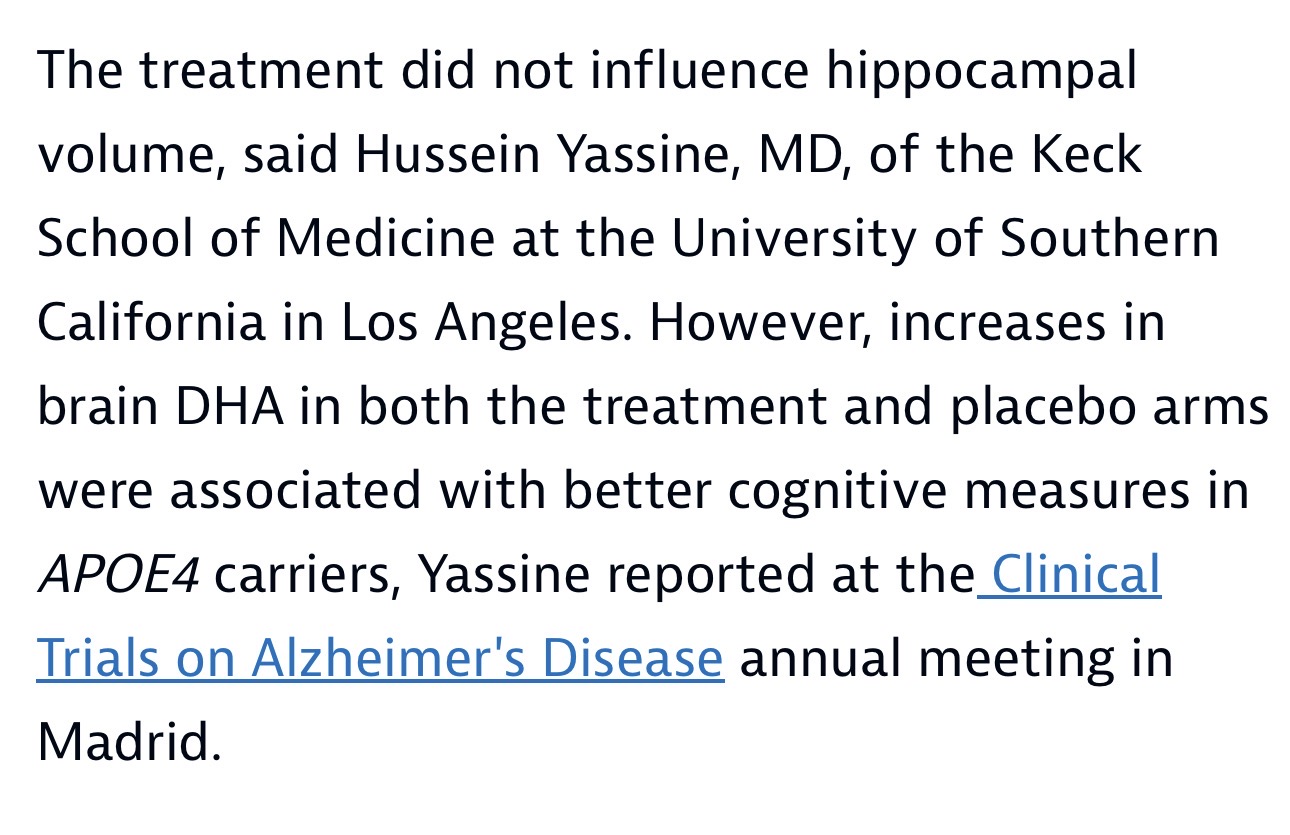
Thanks a lot @zebit0 for doing the work! I’ll do it later with ChatGPT 5.5 and send the link. I agree with Gemini’s and Claude’s conclusion (unfortunately!).
1 Like
The research review left me thinking: maybe get my omegacheck or omega quant test done (since I’m mostly plant based and eat zero fish), but unless well out of or quite low range, then I’m not getting more Sport Research fish-oil for now on.
The issue on medicines is that if something is sold as a medicine then it is subject to the medicinal regulations. I had not spotted that the pure EPA contained also about 10% DPA. To what extent that is reasonable I don’t know. I would think most people have some DPA in their diet and taking too much might be an issue.
My guess is that with distillation it becomes hard to get below 10% DPA.
No: in the US there are plenty of pure EPA only products with 0 DHA. Sometimes the same brand sells pure EPA in the US only and 90% EPA in Europe only.
Is that an issue? Maybe not.
Regarding other “experts”, think about what Charlie Munger said: “Show me the incentive and I’ll show you the outcome.” Do you think someone who has recommended omega 3 supplementation for years if not decades to thousands of followers has an incentive to look at the evidence against omega 3 supplementation?
Similar for your stance. You’ve selected only negative studies to support your view since obviously this is something you feel strongly about. Unfortunately, that’s not the entire picture and honestly nobody knows the answer. Had you presented an argument with equal emphasis on both sides of the data I’d be less critical of your approach. There is a big gap between arguing lack of benefit vs actual harm. Especially when your basis is a rat study with massive doses in an artificial environment and a poorly controlled human study with previous study from the same database showing the exact opposite. Everyone is tearing apart the Stanfield study for its shortcomings, but this ADNI PET study is being taken as the fact. I spent an entire 10 minutes grabbing the studies below. Not that hard to show the data isn’t as lopsided as you present.
It’s not hard to cherry pick studies:
“DHA supplementation improved both memory and reaction time in healthy young adults: a RCT.” 2013
“Oxidative stress in endurance cycling is reduced dose-dependently after 1 month of re-esterified DHA supplementation.” 2020 - Doesn’t seem very pro-oxidant in this study?
Effects of DHA supplementation on hippocampus volume and cognitive function in older adults with MCI. 12 month double blind RCT. 2017. DHA improved test scores, hippocampus volume, global cerebral volume
Modulation of blood cell gene expression by DHA supplementation in hypertriglyceridemic men." 2011
Association of DHA supplementation with Alzheimers disease stage in APOE4 carriers. A Review." 2017
A randomized, crossover, head-to-head comparison of eicosapentaenoic acid and docosahexaenoic acid supplementation to reduce inflammation markers in men and women: the Comparing EPA to DHA (ComparED) Study. DHA more effective at modulating inflammation than EPA.
Dietary Docosahexaenoic Acid-Rich Supplementation Decreases Neurotoxic Lipid Mediators in Participants with Type 2 Diabetes and Neuropathic Pain. 2024
The effect of omega-3 fatty acids on a biomarker of head trauma in NCAA football athletes: a multi-site, non-randomized study. 2021.
This is exactly what I did. As you can see here I was initially thinking that one should supplement with DHA or EPA based on the omega 3 test and that both were beneficial: Omega 3 for neuroprotection: EPA vs DHA? (I later updated that post)
I changed my mind after a careful review of the literature.
Of course you can find papers pointing to the other direction. But not all papers are equal. A large, long, high-quality RCT done by Tier 1 institutions and published in a Tier 1 journal such as VITAL-DEP will always be better than an old low-quality association study for instance.
For instance you cited Effects of DHA Supplementation on Hippocampal Volume and Cognitive Function in Older Adults with Mild Cognitive Impairment: A 12-Month Randomized, Double-Blind, Placebo-Controlled Trial
This was a randomized, double-blind, placebo-controlled trial in Tianjin, China. 240 individuals with MCI aged 65 years and over were recruited and equalized randomly allocated to the DHA or the placebo group. Participants received 12-month DHA supplementation (2 g/day) or corn oil as placebo.
A total of 219 participants (DHA: 110, Placebo: 109) completed the trial. The change in mean serum DHA levels was greater in the intervention group (+3.85%) compared to the control group (+1.06%). Repeated-measures analyses of covariance showed that, over 12 months, there was a significant difference in the Full-Scale Intelligence Quotient (ηp2 = 0.084; p = 0.039), Information (ηp2 = 0.439; p = 0.000), and Digit Span (ηp2 = 0.375; p = 0.000) between DHA-treated versus the placebo group. In addition, there were significant differences in volumes of left hippocampus (ηp2 = 0.121, p = 0.016), right hippocampus (ηp2 = 0.757, p = 0.008), total hippocampus (ηp2 = 0.124, p = 0.023), and global cerebrum (ηp2 = 0.145, p = 0.032) between the two groups.
2016, tier 2 (or 3) Chinese university (back then) but great journal.
They used corn oil as placebo which had been criticized in some cardiovascular trials.
But since then we have the larger (n=365) and longer (2y), done by USC that found… Nothing! 2g/day of DHA for 2 years has no impact on cognition or hippocampal volume (placebo was “50% corn oil and 50% soy oil”, I don’t know how much better that is vs 100% corn oil)
And we have other meta-analyses and papers that found… Nothing! Or even detrimental impact. So this 2016 paper is mostly discarded (unless you come up with a theory explaining why the 2016 one found benefits while all others did not, could be the enrolled population, the genes, the product used, etc.).
2 Likes
Btw you cited “Association of DHA supplementation with Alzheimers disease stage in APOE4 carriers. A Review.” 2017", authored by Hussein N Yassine, the lead PI behind the failed PreventE4 trial. It seems that now Yassine has given up on omega-3 supplementation.
1 Like
-
Fish oil, omega-3s: Many studies were subsidized and heavily promoted by both the fish industry and the supplement industry. Mainly derived from observations that many long-lived populations ate a lot of fish. Then, making the leap, it must be the Omega-3s.
-
The negative consequences could make you worse off than taking none at all.
-
Just eat more fish; this is a more proven benefit without the negative consequences.
-
Look at your supplement list. Do you want to add one more iffy supplement?
My point is that there is insufficient evidence of any benefit to warrant adding it to my supplement list, especially since the consequences could be detrimental to my aging brain if the “good” studies turn out to be wrong.
3 Likes
Here’s ChatGPT 5.5 Thinking Extended Deep Research. It took 58 minutes and 401 searches to output the result. I specifically mentioned the studies you listed @Shady. I mentioned others on the “anti-omega 3” side but I forgot VITAL-DEP and PreventE4 (I later mentioned them). Still, the conclusion is roughly aligned with what I said: ChatGPT - Omega-3 and Mental Health
Bottom line: EPA may have a niche role in depression treatment; DHA/fish oil for cognition or dementia prevention remains unproven.
For a supplement that is so hyped and has been studied for years, if not decades, this shows it’s useless.
3 Likes
@zebit0 I also don’t eat fish (and am apoe3/4), so I’m forever feeling overwhelmed re this topic. Based on all of Adssx’ good work, if I ate fish, I don’t think I’d even supplement at this point….but I don’t, so as you suggest, I suppose the omega index should be our guide (me guessing).
In his recent omega YouTube, Brad Stanfield mentioned the issue with oxidation and how it causes harm. I asked Claude Opus and ‘he’ said algae oil is much less likely to oxidize. But having said that, there is only one source of epa only algae oil… so here I stand between a rock and hard place.
I did start taking Accentrate LPC which is fish oil, but I’ve since learned it is not a slam dunk, so I’m not sure I’ll repurchase.
2 Likes
Honestly it makes sense bc of how massively PUFA they are - at least supplement with choline and nexlizet instead…
New relevant Nick Norwitz video:

1 Like
So the guy recommends what is exactly proven not to work based on the PreventE4 trial: 2g/day of DHA for 2 years has no impact on cognition or hippocampal volume (PreventE4) - #60 by adssx
1 Like
Continuing your ChatGPT session (thanks for the link) specifically for those like @Beth and me who do not eat fish, came up with the following:
People who do not eat fish usually have much lower blood levels of the long-chain omega-3s EPA and DHA, because conversion from plant omega-3 (ALA from flax/chia/walnuts) into DHA is inefficient. The main rationale for supplementation is therefore nutritional replacement and normalization of omega-3 status — not proven cognitive enhancement. Studies consistently show vegetarians and especially vegans have substantially lower EPA/DHA levels than omnivores.
For most non–fish eaters without depression, the most reasonable approach is a mixed EPA+DHA supplement (often algae-based), typically ~250–500 mg/day combined. A DHA-dominant mix (for example ~2:1 DHA:EPA) is biologically plausible because DHA is the major structural omega-3 in the brain and retina, and dietary DHA is otherwise nearly absent without seafood. EPA-heavy formulas are more relevant to depression treatment, where meta-analyses suggest modest benefit mainly from EPA-predominant products.
However, evidence for cognitive or dementia prevention remains weak. The recent PreventE4 randomized trial gave high-dose DHA (2 g/day) to cognitively healthy adults at elevated Alzheimer’s risk. DHA clearly increased cerebrospinal-fluid DHA biomarkers, showing brain target engagement, but did not improve cognition or brain imaging outcomes over 24 months.
Key studies:
- Vegetarian/vegan omega-3 status: PubMed review
- Depression meta-analysis: Translational Psychiatry meta-analysis
- PreventE4 trial: SSRN preprint
1 Like
The PreventE4 trial specifically looked at people with “low dietary DHA intake (<200 mg/day)”. And even in those people DHA supplementation failed to move the needle! So even for people who don’t eat a lot of fish, the case for omega 3 supplementation is weak (or most likely non-existant).
1 Like
As expected of Norwitz.
3 Likes
I don’t pay much attention to Norwitz, but given that he is in his early 30s, supplements with DHA-rich foods (e.g…sardines), and has two copies of APOE4, perhaps his reasoning is that one has to start many years before Alzheimer’s symptoms typically appear in APOE4 carriers – as the effects of Omega-3 supplementation are gradual and it’s too late if one waits to start later in life.
I personally am more interested in seeing the results of clinical trials on the effects of choline on APOE4 carriers (that is being carried out by people from MIT, as I recall).
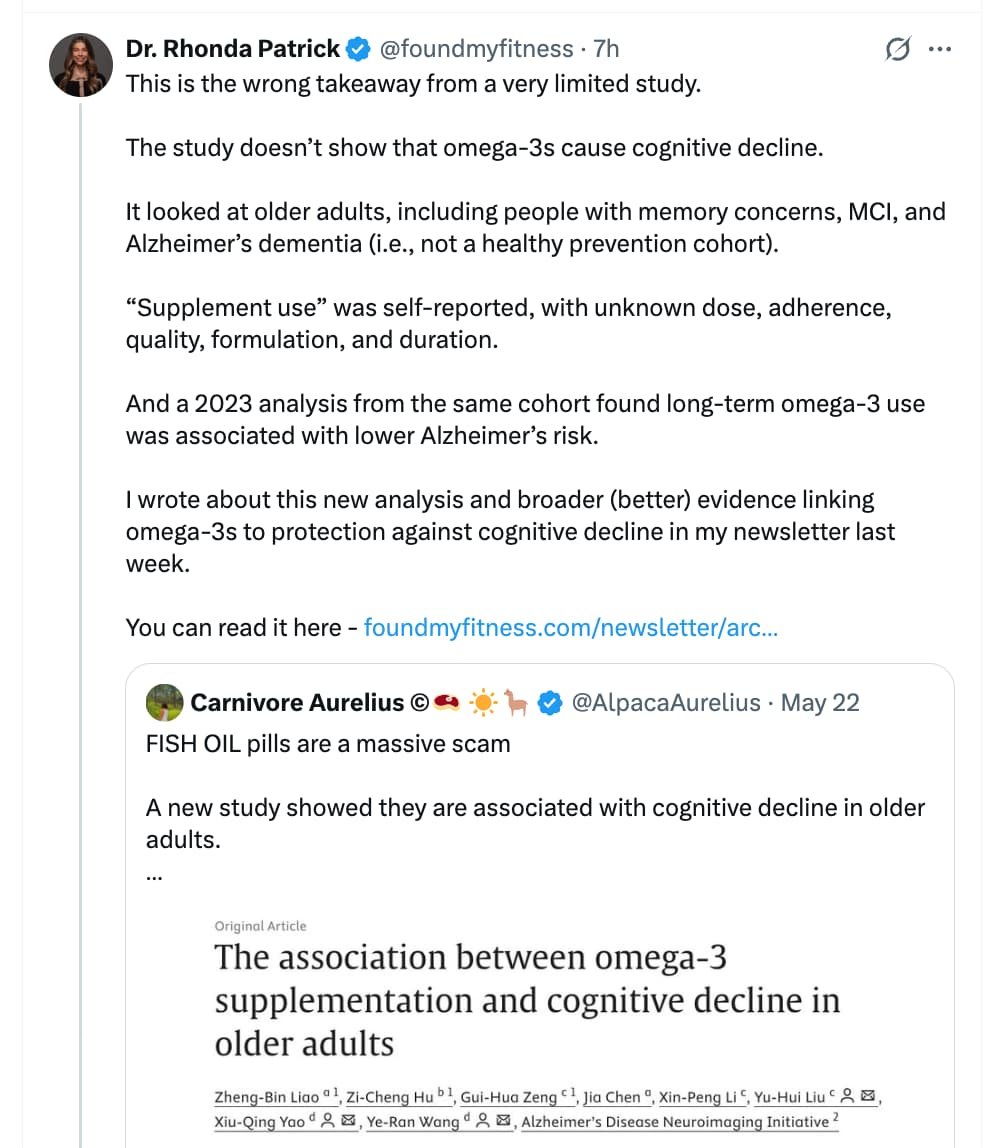
Yassine’s commentary on the study would disagree with you. He stated that improvements in DHA status showed cognitive improvements in the DHA and placebo group in apoE4 carriers. Naturally DHA can increase in the placebo group through diet rather than supplementation. Nice that correlated with improvement. I also posted that previous study that showed improvements in brain structure/function with DHA. Only a 2 year study. Lifetime adequate levels may have larger effect. Hard to think of a mechanism that would benefit APOE4 and harm everyone else but I’m sure you’ll find something.