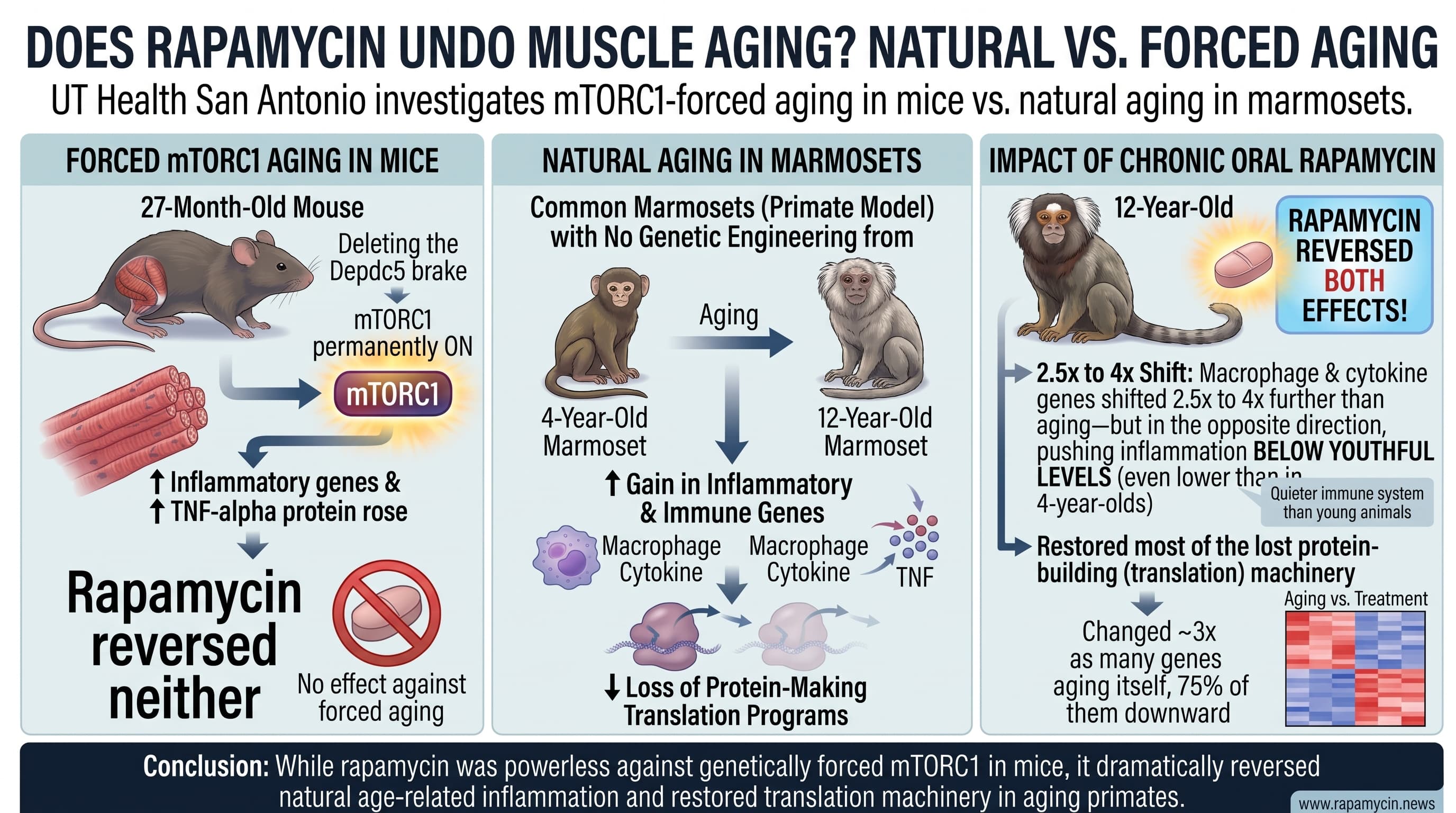
Researchers at UT Health San Antonio asked whether forcing the cellular growth sensor mTORC1 permanently on accelerates muscle aging, and whether rapamycin can undo it. In 27-month-old mice carrying a muscle-specific deletion of the mTORC1 brake Depdc5, inflammatory genes and TNF-alpha protein rose, and rapamycin reversed neither. The more encouraging half of the study used common marmosets, a small primate, aging normally. Between four and twelve years old these animals gained inflammatory gene expression and lost the gene program that builds protein-making machinery. Chronic oral rapamycin reversed both. It shifted macrophage and cytokine genes two and a half to four times further than aging had shifted them, restored most of the lost translation program, and changed about three times as many genes as aging itself.
For fifteen years the longevity field has had a reliable story about mTORC1. The protein complex senses nutrients, drives growth, and suppresses cellular housekeeping. Turn it down with rapamycin and mice live longer. The story has always run in one direction, though: almost every study tests what happens when you inhibit mTORC1. Remarkably few ask the reverse question. If less mTORC1 is good, is more mTORC1 actively bad, or merely the absence of a benefit?
This paper asks the reverse question in old animals, which is where it matters. The team used a genetic trick to remove DEPDC5, part of the GATOR1 complex that normally shuts mTORC1 down when amino acids run short. Without that brake, mTORC1 in muscle runs constitutively. They flipped the switch at 22 months of age, which is roughly a 65-year-old human, and looked five months later.
The answer is that more mTORC1 is actively bad, at least at the level of signaling. Knockout muscle lit up with inflammatory and immune gene programs. TNF-alpha protein roughly doubled. Genes governing blood vessel formation went down. This was not simply the muscle looking older; the comparison group was the same age, living in the same room, eating the same food. The inflammation was stacked on top of normal aging, not a substitute for it.
In this knockout mouse model the researchers expected rapamycin to wipe out that inflammation. It did not. Rapamycin reversed the vascular gene changes and about a third of the differentially expressed genes overall, but the inflammatory transcripts and the TNF-alpha protein stayed elevated. The likely explanation is mechanical: rapamycin only partially inhibits mTORC1. It shut down S6 phosphorylation but left 4E-BP1 phosphorylation untouched, which is a known limitation of rapamycin as opposed to the newer ATP-competitive mTOR inhibitors. Whatever drives the inflammation apparently runs at least partially through the branch rapamycin does not reach.
A second experiment is a more natural experiment with aged marmosets.
A second experiment supplies the counterweight, and it is the more encouraging half of the paper. The researchers examined muscle from common marmosets, a small monkey that reaches old age around twelve years. These animals are a primate species (the same as humans) and were not engineered, so the information is much more relevant to people than the previous mouse part of the study. The marmosets simply got old. Comparing twelve-year-olds against four-year-olds, aging raised inflammatory and immune gene programs in muscle while lowering the genes that build the cell’s protein-making machinery. Marmosets given rapamycin for years showed the reverse on both counts.
The supplementary data reveal the size of that reversal, and it exceeds the aging effect it opposes. Across macrophage activation genes and tumor necrosis factor cytokine genes, rapamycin shifted expression roughly two and a half to four times further than aging had shifted it, in the opposite direction. It recovered most of the protein-synthesis gene program that age had eroded, which is a curious thing for a drug that inhibits protein synthesis to accomplish. It altered about three times as many genes as aging itself, three quarters of them downward. The drug was doing a great deal inside that tissue, and most of what it did ran against the direction of aging.
Rapamycin did not stop at returning inflammatory genes to youthful levels. It pushed them below. Macrophage activation and cytokine production in treated old marmosets sat lower than in young animals. Whether running an aged immune system quieter than a young one amounts to protection or to exposure is a question this work raises and cannot settle.
Actionable Insights
The marmoset arm is the half of this study with real translational weight, and it points in a favorable direction. Unlike the mouse experiment, which forced mTORC1 on genetically, the marmosets simply got old the ordinary way. Comparing 12.1-year-old animals against 4.2-year-old animals, six per group with sexes balanced, aging raised inflammatory and immune gene programs and lowered protein translation gene sets. Chronic oral rapamycin reversed both. That is the pattern a person taking rapamycin would actually hope for: not the suppression of an artificial lesion, but the partial normalization of a primate’s own aging muscle transcriptome.
The dose is interesting to note. Marmosets received roughly 1 mg/kg daily, five days a week. Body-surface-area normalization gives a human equivalent near 0.19 mg/kg, about 13 mg daily for a 70 kg adult, or roughly 65 mg weekly. That is approximately ten times the 5 to 7 mg weekly most longevity protocols use, and not something doctors recommend due to risks of immune suppression.
The marmoset arm is the translationally meaningful half of this study, and the supplementary figure lets it be quantified. These were primates aging normally, 12.1 years against 4.2 years, six per group with sexes balanced, not a genetic model.
Reconstructing the z-scores from the heatmaps gives the following:
| Gene set | Young | Old | Old + Rapa | Effect of age | Effect of rapamycin |
|---|---|---|---|---|---|
| Cytoplasmic translation | +0.17 | -0.26 | +0.09 | -0.43 | +0.35 |
| Macrophage activation | +0.07 | +0.18 | -0.25 | +0.11 | -0.43 |
| TNF superfamily cytokine production | +0.03 | +0.20 | -0.23 | +0.17 | -0.42 |
Three magnitudes matter here. First, rapamycin moved all three gene sets by almost exactly the same amount, about 0.42 z units, and that is 2.5 to 3.8 times larger than what aging itself had done to the inflammatory sets. The drug did not merely hold the line against aging, it moved the tissue considerably further than aging had moved it.
Second, it restored 82 percent of the age-related loss in cytoplasmic translation gene expression. Aging cost 0.43 z units and rapamycin returned 0.35 of them. That a translation inhibitor restores the youthful translational gene program is counterintuitive and worth noting.
Context and Source
- Open Access Paper: Constitutive Activation of Skeletal Muscle mTORC1 Drives Pro-Inflammatory Gene Expression in Skeletal Muscle of Aged Mice, 2026 Nov 6.
- Institution: Department of Cellular and Integrative Physiology and the Barshop Institute for Longevity and Aging Studies, Long School of Medicine, University of Texas Health Science Center at San Antonio, with the Geriatric Research Education and Clinical Center, South Texas Veterans Healthcare System.
- Country: United States
- Journal: Aging Cell (Wiley, on behalf of the Anatomical Society)
- Impact evaluation: The impact score of this journal is 7.1 (Journal Impact Factor, Clarivate), evaluated against a typical high-end range of 0 to 60+ for top general science, therefore this is a Medium impact journal.