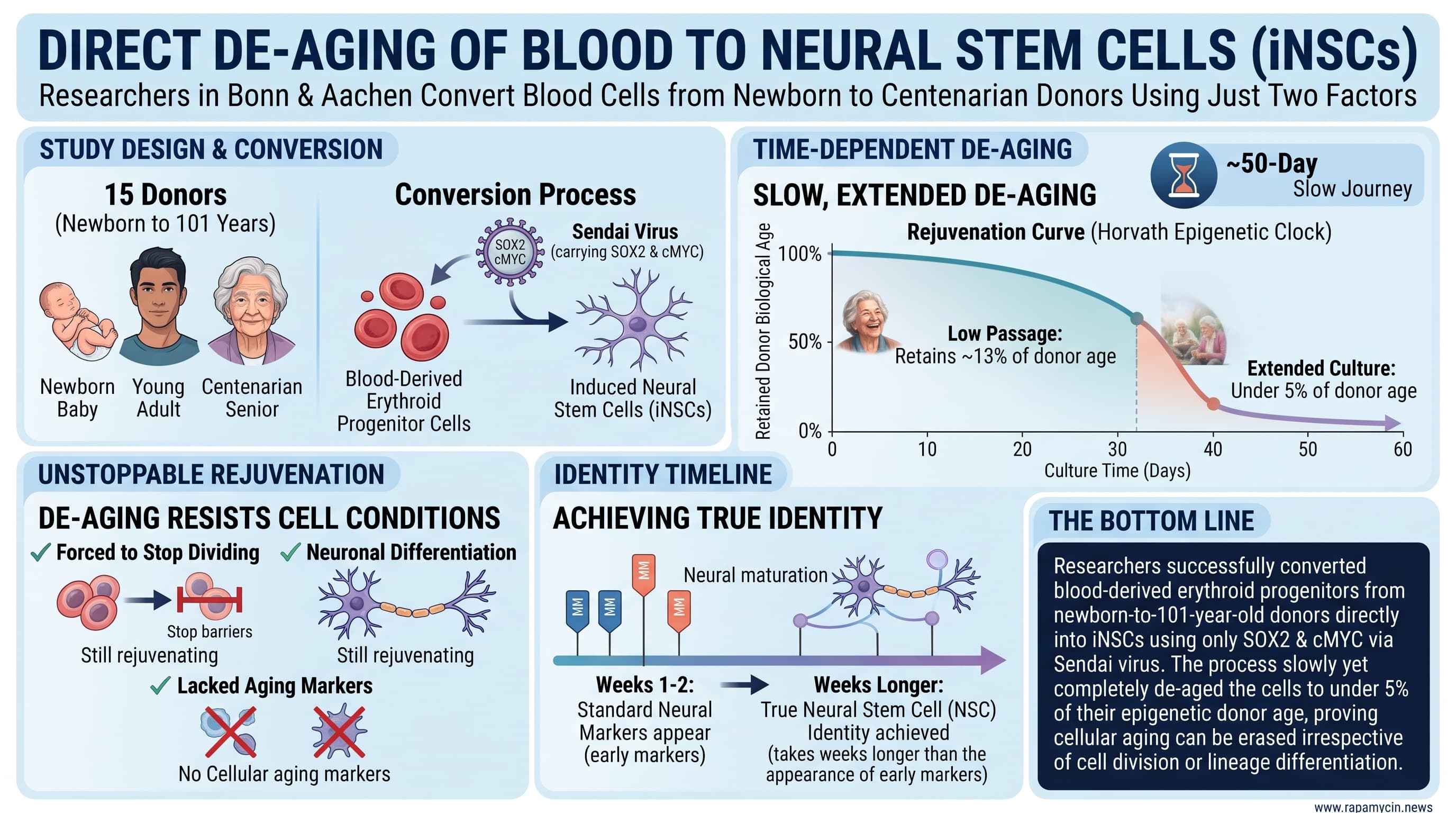
Researchers in Bonn and Aachen converted blood-derived erythroid progenitor cells from 15 donors aged newborn to 101 years directly into induced neural stem cells using only two transcription factors, SOX2 and cMYC, delivered by Sendai virus. Using Horvath’s skin-and-blood epigenetic clock, the resulting cells retained about 13 percent of donor age at low passage and under 5 percent after extended culture. The de-aging was slow, taking roughly 50 days, and continued even when cells were forced to stop dividing or pushed to become neurons. The converted cells also lacked conventional cellular aging markers. Acquisition of a true neural stem cell identity took weeks longer than the appearance of standard neural markers.
Cellular reprogramming has become the most dramatic trick in aging biology: take a cell from an old person, add transcription factors, and its molecular age markers reset toward zero. The usual route runs through an induced pluripotent stem cell, which erases not just age but identity, and carries tumor risk. An alternative is direct conversion, jumping straight from one adult cell type to another. The question has been whether that shortcut also resets age, and if so, how.
A German team took blood from 15 donors spanning the entire human lifespan, from newborns to a 101-year-old. From each sample they grew erythroid progenitors, immature red blood cell precursors that are easy to obtain. They then delivered two genes, SOX2 and cMYC, using a virus that leaves no permanent trace, and coaxed the cells into becoming neural stem cells. From the same starting material they also made conventional pluripotent stem cells and derived neural stem cells from those, giving a matched comparison.
Measured with a standard epigenetic clock, the directly converted cells from the 101-year-old registered a biological age of only a few years, and after extended culture under 5 percent of donor age. Donor age no longer predicted the clock reading.
Two findings stand out. First, the reset was slow. In pluripotent reprogramming, the clock resets in about 20 days. Here it took roughly 50, with some lines reaching only 20 percent of donor age after seven weeks. That slowness is scientifically valuable: it opens a long window to watch the process and ask what drives it.
Second, slowing or stopping cell division did not stop it. The team suppressed proliferation two ways, with glycerol and with thymidine, and also forced the cells into non-dividing neurons. The epigenetic clock kept running backward regardless. That argues against the common assumption that dilution of methylation marks through repeated division explains the reset.
The de-aging was not just a clock reading. Compared with their matched pluripotent-derived counterparts, the converted cells showed no differences in nuclear lamina proteins, senescence genes, autophagy flux, DNA damage or mitochondrial reactive oxygen species. Gene expression differences between young and old donors fell from about 1,871 genes in the starting blood cells to twelve after conversion.
The caveats are real and the authors state most of them. There is no “truly aged” neural stem cell to compare against, and the clock reads lower in brain tissue than in blood, so some apparent rejuvenation may reflect tissue type rather than age reversal. Group sizes in the time-course work are three donors. Oxygen conditions changed partway through. And whether the cells briefly touch a pluripotent-like state, with the tumor risk that implies, was not settled.
This is not a treatment. It is a laboratory system for dissecting how a cell forgets its age, which is exactly what the field needs before rejuvenation becomes medicine.
Actionable insights
This is cell-culture work on human cells in dishes, with no therapy and no human dosing. What it should change is how you read rejuvenation claims. Three points carry practical weight:
Epigenetic clock readings are not biological age. The authors say plainly that the clock is a proxy. They backed theirs up with lamin proteins, senescence genes, autophagy, DNA damage and mitochondrial ROS. When a company or study reports only a clock number, that is weaker evidence than it looks.
Clock readings depend on tissue type. The authors note the clock reads lower for neural tissue than blood, so part of their apparent reset may reflect becoming a neural cell rather than becoming young. The same logic applies to consumer epigenetic age tests: comparing results across different sample types or labs is unreliable.
Rejuvenation is slow even under maximal intervention. Forced expression of two powerful transcription factors took about 50 days to reset a cell. Claims that a supplement or short protocol reversed years of biological age in weeks should be read against that.
Effect size for context: cells from a 101-year-old went from a clock reading matching their chronological age to roughly 5 to 13 percent of it, a reduction of roughly 87 to 95 percent. Transcriptomic age differences dropped from 1,871 differentially expressed genes to 12, a 99 percent reduction.
Context and source
- Open Access Paper: Protracted Fate Acquisition and Epigenetic De-Aging During Induced Neural Stem Cell Conversion of Human Blood Cells
- Institutions: University of Bonn Medical Faculty and University Hospital Bonn (Institute of Reconstructive Neurobiology, lead), with RWTH Aachen University Medical School and LIFE & BRAIN GmbH
- Country: Germany
- Journal: Aging Cell, 2026
- Conflicts: Three authors have commercial ties. One is founder and CEO of a bioinformatics company; one co-founded Cygenia GmbH, which sells epigenetic analysis services, the exact methodology central to this paper; the senior author co-founded LIFE & BRAIN GmbH.
- Impact evaluation: The impact score of this journal is 7.7, evaluated against a typical high-end range of 0 to 60+ for top general science (roughly 0 to 25 within aging biology, where Nature Aging sits at 25.0), therefore this is a Medium-to-High impact journal.