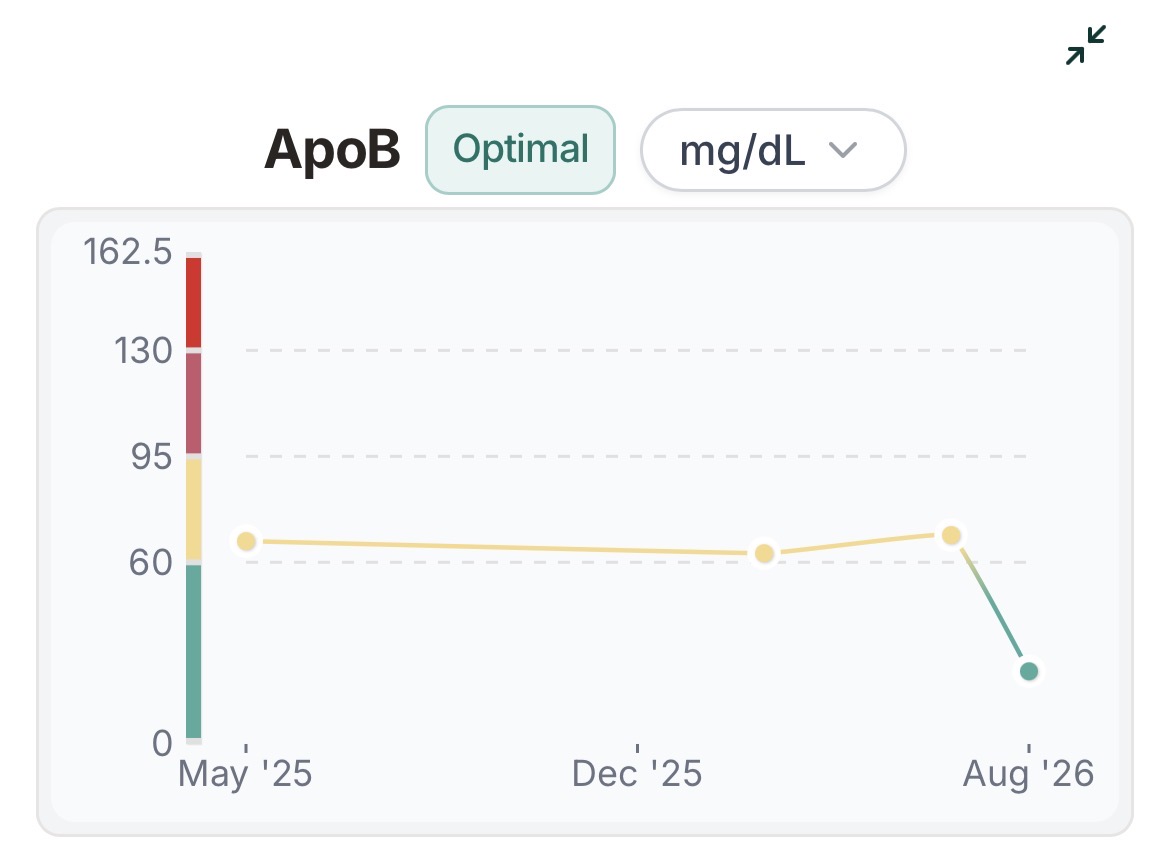
I thought I’d share my results adding repatha to my bempadoic acid / ezetimibe stack. No statin due to intolerance. I was trending with apoB of 60-70. With repatha for 1.5 months I’m now at 24. It’s a bit shocking but I feel no side effects so I’m good to go. Hba1c has also dropped to 5.3 (down from 5.8 a year ago). Edit: LDL 56 —> <10 (“calculated using the Martin-Hopkins
calculation”)
16 Likes
I can agree with statement in principal, but I don’t practice it. The reason is one of cost/benefit. To do a good test would to my thinking require a Cleerly test to check for both soft and calcified plaque. The cost would be about $1,000 from what I have seen, and you may need to multiple Cleerly tests over time to get a trend line. So perhaps multiple thousands of dollars.
Or I can just take stations, ezetimibe, and bempadoic acid and see my ldl-c and apo-b at sub 50 levels , with no obvious side effects, for about $20 per month, and live without clear knowledge as to weather I am wasting a little money and exposing myself to some seemingly small risk if unmeasurable side effects over the long term.
How would you evaluate this decision?
My goal is to live as long and healthy a life as possible, and my understanding of plaque accumulation is that it is likely the total area under the lifetime curve that matters (LDL-c, apo-b), and I keep inflammation low, so however long I live I don’t want cardiovascular issues to be the limiting factor… So this seems to be the lowest risk and lowest cost approach fore over the long term, especially given that heart disease is the number one killer of males in the USA.
11 Likes
The key to disentangling the divergent views in this discussion - all well reasoned - boil down to perception of risk.
We are all perceiving the different risks in different ways in a situation where there is no “riskless” conclusion. Every choice presents a risk.
As I stated before, I’m not anti-statin. If I had any evidence of progression of CVD based on testing then I would be aligned with your view. Statins/Ezetimide/Bemp Acid are all well-understood meds with solid treatment histories. If you have a KNOWN PROBLEM, then the prudent thing is to treat it given the quality of what’s currently available.
The question is what you should do if you know based on testing that you have no problem, or if you’ve never tested to determine if you have a problem?
Certain members advocate “crushing it” based on results from large population research without first testing to know what’s happening in your N=1. I disagree.
I happen to fall in the camp of having tested with no meaningful CVD - and certainly no progression - since I undertook testing. In fact, my hard plaque has reduced slightly between tests, but the amount is so small to begin with that it could just be a rounding error.
Given no meaningful CVD (possibly even declining) at age 65 based on multiple tests, all with reasonably high accuracy (despite claims in this thread to the contrary), what is the smart path forward??
The answer depends on your perception of risk for each choice, exactly as first stated at the beginning of this answer.
My belief is our current understanding of human biology will look somewhat close to the stone-age in not so many years given the rapid pace of learning. Humans have a peculiar characteristic of believing we know more than we do. Our egos mistake the vastness of our knowledge (particularly when highly educated) as definitive because we’re oblivious to the vastness of our ignorance. We only see what we know. The outliers in research results are constantly showing us how little we understand. FAR, FAR, FAR more remains unknown than is known. And every new breakthrough over time further reduces risk.
So my view is to not monkey with anything that isn’t broken (based on testing) because each treatment has multiple systemic impacts. If my CVD is actually zero to slightly in decline at age 65 based on testing, then it’s reasonable to conclude my risk of death is most likely to come from trauma or cancer, not CVD. I’ve almost died skiing, mountain biking, road cycling, severe heat stroke crossing a desert, and more. It’s almost unbelievable that I’m still alive given how close I’ve come to death multiple times. CVD is low on my totem pole of risks.
To further minimize the already very small CVD risk, I can repeat the CTCA test every three years to monitor any changes, as well as track my blood markers annually for any meaningful change. Again, all the above are improving right now, so there’s no prudence to “treating” a non-problem that’s improving without intervention.
Others in this thread see it differently. They view taking the meds as “preventative,” but what are you actually preventing if there’s no evidence of disease for your personal system?
The next question is what is this preventative protocol doing to other aspects of your biology? Advocates would claim it’s fully tested, and the risks are known. I disagree. I think the risks they currently measure are known, but far more remains unknowable. If the drugs are powerful enough to “crush it” on the lipids, then it’s reasonable to assume there are powerful systemic effects because everything adjusts to this influx of drugs and changed composition. Nothing happens in isolation in a biological system.
My views is shaped by two applicable sources of experience:
(1) My adult lifetime spent developing systematic trading and risk management models for the financial markets (another dynamic, complex, interdependent system). I’ve seen many really smart, well-educated, well-reasoned people (like those in this thread) blow up entire portfolios time and time again because they thought they knew more than they did. They failed to see the risk of all that they don’t know, and all that remains unknowable. My training was unusual because it taught me to always guard against what I don’t know, and treat what I do know as suspect. These failed portfolio managers accepted risks they didn’t understand based on the limited knowledge they had, mistaking that limited knowledge as more comprehensive than it actually was. Again, this is a common human problem that’s positively correlated with education.
(2) I recognize the value and importance - but also the limited applicability - of large population study results to my individual biology. Ultimately, as this field comes out of the dark ages that it’s currently in, the only path forward will be personalized medicine. I’ve shared elsewhere how my A1c numbers have no relevance to conventional A1c analysis based on large population studies. Similarly, if I ended up in an emergency situation, my daughter (an emergency medic) has told me that my resting heart rate around 40 would cause alarm bells based on standard training. How much applicability is there to all the lipid research for my N=1 situation when the study population represents the general population (eating a SAD, metabolic disorder, chronic inflammation, out of shape, blood pressure problems, on and on…)
I"m not going to blind myself by ignoring the research as irrelevant, but I’m also not going to blindly assume it applies to me. I study the research as it’s published to learn what I can, and to understand tendencies. But I’m always careful at pretending that I know more than I do. Inside every one of those studies and average results are massive outliers in the data, and those outliers matter because you might be one of them (quite frequently, I am!).
Short story made too long already, I view the risk/reward of ingesting powerful drugs as unfavorable when there’s no known problem to treat for my N=1. I fully understand that statins have been heavily studied, large populations use them so those risks that are understandable given our current state of the art.
But that doesn’t equate to riskless. The chances of drugs powerful enough to have those powerful lipid-lowering effects carrying no other meaningful risk is highly unlikely. Human biology has so many self-correcting mechanisms and adjustments that aren’t fully understood… yet. I have a hard time buying the idea that I can dramatically lowering my LDL and APOb without causing a variety of systemic adjustments and compensations. Maybe it’s true, but I’d give it low odds and a negative expectancy outcome.
Regarding the cost of each approach, as long as the CTCA test shows zero plaque problem, then the Cleerly analysis is just a waste of money. Not necessary at all. So that means your statin/ezetemide/etc. treatment net-net cost might end up being a smidge more than one CTCA every three years. They’re certainly comparable in cost to where it’s not a meaningful difference in the whole scheme of things.
And regarding the concerns for dementia/Alzheimers raised in this thread, it’s called “type 3” diabetes for a reason. The best science knows now is that disease symptoms are preceded many years by damage to the microvasculature of the blood brain barrier. Some will disagree that the Neuroquant/MRI is a good test for that, but it’s an indication that when clear, aligns with all the comorbidities of blood pressure, metabolic health, chronic inflammation, and general CVD to imply reduced risk. Of course, if I had a family history of demential/AD then I might lean more the other way. However, I’m encouraged by recent research in applying magnetic resonance, Ibogaine, and various other treatments having nothing to do with statins/LDL/etc. to improve brain health. I think it’s reasonable to anticipate a variety of breakthroughs in dementia treatment/prevention over the next several years now that they’re targeting research in productive directions.
Bottom line is I don’t buy the idea that pumping an existing healthy system with powerful medications that cause equally powerful systemic effects qualifies in any way as “preventative” when that individual’s N=1 shows there’s nothing to prevent. My reasoning (based on the vastness of all that’s unknown and unknowable) says that approach is adding unknowable risk, not reducing it.
I get that others disagree. Cronos Tempi has explained that position clearly. We agree to disagree on how to interpret what’s known, unknown, and unknowable from the research provided, and that has led us to different risk/reward analysis.
In my mind, every year that I can safely avoid unnecessary treatments is another year where science improves and potential breakthroughs may occur that are safer and produce superior results. That certainly appears true with the latest developments in isolated branches of dementia research, and I’m confident it will prove true as they disentangle the comorbidity issues clearly demonstrated by the CVD research so that we can get beyond large population, generalized results to conclusions that are personally applicable. Until then, we have testing to determine our N=1 strategy.
Finally, I want to be clear that this logic is somewhat unique to cardiovascular health in its many forms (CVD, dementia, etc.) because of the nature of the data anomalies and comorbidity complications. It does not apply to Mtor/Rapamycin, for example.
In other words, there are many people who live long, full, healthy lives and never experience any CVD or dementia. It’s not a given based on aging, which is why I was suggesting testing first. Some people never develop a problem due to a combination of reasons that the current state of the art in science has yet to disentangle.
Other aging processes are universal enough (aligning with Cronos Tempi’s view about how biology being flawed in the sense of certain aging processes) that “preventative” treatment to control that specific aging process and maintain general health at a high level is prudent. I include Rapamycin and Mtor in this category.
However, I don’t include CVD and statins into that “general preventative” category applying to everyone reading this thread. That’s why I chimed in.
I think the anomalies in the data shows this is far more complex than general population research conclusions will indicate. We are far more ignorant on this topic than certain experts would imply. The proof of the lack of definitive science is both the anomalies in the data and the controversy in this thread. Controversy can only exist in the absence of definitive scientific proof. Therefore, the only prudent path forward is to test first to determine your N=1 situation.
There’s literally no reason not to test first. You have to know your plaque level and stenosis to determine a prudent path of action. You might need an immediate triple-bypass, or you may never need anything at all. The knowledge that comes from testing is what determines the prudent risk/reward analysis for your N=1 situation. The alternative is flying blind.
Hope that clarifies!
6 Likes
I might be interesting to to get your genetic testing done. Maybe you are one of the ones with genetic pksc9i and that would explain your clean arteries! And confirm that you should not pursue medication for this. It would also confirm to the rest of us that we should pursue medication!
1 Like
You’re missing the point…
Genetic test or not, it only makes sense to test first. Otherwise, you are flying blind. You have no idea what condition you should treat, or not.
Knowing my genetics changes nothing to the points made in this thread and should impact nothing in your decision framework. You must test first to know if you are close to a triple-bypass or totally clear with zero issue (or somewhere in between). Knowing will inform your treatment protocol.
Why anyone would oppose this logic baffles me, but is likely related to the self-selection bias in this community. Why anyone would prefer medication first when they have no idea what there existing CVD status is makes no sense.
FWIW, Matt Kaeberlein always said to pursue the four pillars first as the foundation for everything else that gets added on, and that seems to be ringing true in my household. My wife just got her first CTCA (no Cleerly) - completely different genetics and an APOE4 - and she has zero soft plaque and zero hard plaque. She’s totally clear as well. Because of here clear condition and APOE4, we will be pursuing a mild medication protocol (yet to be determined) for her to get her APOb a bit lower (as opposed to nothing for me).
The most likely cause of our both being clear is either dumb-luck and total statistical anomaly, or our lifelong diet and exercise habits (as Matt reliably asserts).
Heading out to Peru for a month of trekking in Andes, so no follow up responses for a month…
Hope that helps!
2 Likes
Actually neither. Don’t forget only about 25% of people die of CVD which leaves about 75% that die of other causes. If you ask me, I’d say your case is way more common than cases where people will show/have developed substantial plaque. Otherwise, everyone would drop dead from CVD at 40-60 years old LOL. As an anecdotal note my two siblings and their spouses got tested and three of them had none and one of them had some, about 10% blockage in one of the arteries and they are all 60-72 years of age, and they have never been at a gym. So, the scaremongering (by some online doc’s) that we will all die tomorrow morning because our LDL-c level is at 90 seems a bit exaggerated LOL.
While I agree with you that testing first and then deciding on a protocol is the best way to go, but even if I didn’t test for plaque (thus no way of knowing if I have any) and my APO-B and LDL-c were elevated, I’d still try to lower them regardless. I would prefer all my vitals to be either normal or optimal. Having said that I’m equally against the extreme view that we have to totally destroy the LDL-c/Apo-b levels. I’m perfectly fine with 60-70 for both. I happen to believe that while APO-B and LDL-C are important indicators, there are others that are even more important for overall health and longevity. ie. I’d rather have FG, Insulin and Hs-CRP and the hormones at optimal levels, while I wouldn’t necessarily care so much if my LDL-C/APO-B were on the high end of normal. That’s my two pennies
2 Likes
50% of men and 50% of women experience any CVD event past middle age however. So it’s about quality of life as well.
I think an interesting discussion would be about how to prevent plaque in the first place, rather than just treating when plaque is there, which is later on in the disease process and that’s when plaque and risk start cascading. Low lipids is key, but it’s very likely not enough as most people develop plaque (absent total hypobetalipoproteinemia).
3 Likes
Part of what to do is based on difficulty as well as potential CVD. Taking a pill every day to destroy LDL is potentially pretty easy.
If you have no side effects, the medication is cheap and the known long term consequences are reduced ACM and reduced cancer, then why wouldn’t you take it?
Even with little CVD risk, there isn’t a lot of reason to not take a statin.
Now, if it causes you problems, that is a totally different story.
We know that most people have plaque eventually. This plaque is found in every artery in the body (as far as I know). This includes arteries to the kidneys, the legs, the brain etc. Small arteries that can’t be imaged easily as well as large that can. Interestingly, the upper extremities are usually spared but they still can get plaque.
We focus on the heart because that is the greatest cause of death but this plaque is everywhere.
On autopsy data, plaque is found in nearly everyone over 80 years old.
9 Likes
What are your thoughts on triglycerides?
The obvious concern here is negative health outcomes due to the statin.
If you begin taking a statin at age 20, assuming you had no significant risk factors for CVD, and we assume you have ~ 60 years of life left, we are not really sure whether your health outcomes will be improved on a statistical basis. It is a data-free zone.
We don’t have anything like a robust data set of seemingly healthy 20 year olds being prescribed a statin in the first place, so we don’t have medium-term outcomes for this population, let alone long-term outcomes.
The point is that there are no known long-term consequences for this population, positive or negative, whereas your post posits entirely positive known long-term consequences.
Obviously if we knew those consequences, the rest of your chain of logic is perfect. But considering we do not know the long term consequences, your foundation is not solid. It is based on your (likely correct in my opinion) speculation.
FYI, I do take a statin, but I am nothing like a seemingly healthy 20 year old with no known risk factors. Medically I look a lot like the group studied in primary prevention trials. So no extrapolation of results needed for my case.
1 Like
The healthy 20 year old with no risk factors is a good question.
I personally wouldn’t do it with a LDL less than 100 and I don’t think many would. And that might be the right answer or it might not be.
That being said, the long term risks are pretty well known. Sure, 60 years of usage is not known. And there could be something that shows up but I don’t think it is likely.
Diabetes risk would probably win out over any benefit for the average random 20 year old. But I would probably take my chances if that weren’t the case - like if we had statin like data for Repatha.
The system is setup for do no harm and minimizing liability. Each individual can ignore some of that if they have access.
Also, it is really hard to model risk / benefit without knowing what technology will bring over 60 years. Any guesses would probably favor doing less for prevention but who knows…
1 Like
Data-free zone depending on which question you ask and if it’s the right one.
For 60 yrs with someone with low levels, many cases would be treated that wouldn’t have had any problem with ASCVD.
But if you instead focus on the causal aterogenic process, you can prevent the plaque from building up in arteries in the first place no matter the lifespan.
There’s a question of healthspan as well, where an “event free” 60 yr period might still involve higher risks of dementia or speculative lower exercise performance from arteries narrowing from plaque.
1 Like
Great example rolling around on the table for all of us to consider. So far as we know in 2026, LDL-C is not the cause of anything bad. I say that not to introduce a new topic but to point out how easily it is to be certain of one’s premise(s) in argumentation. Be mindful of how fragile they can be in the world of unsettled science. Even in settled science every now and then.
1 Like
Related to this thread, this new topic: Your Organs Do Not Age Together: AI Reads 25,000 Tissue Slides and Finds the Body Ages in Waves
it’s me same person because I had my original “Kelman” account connected to my work email, and I no longer work there so had forgotten my psw and no other way (i.e. phone) to reset the psw so I had to create this new one “Kelman1”.
anyway, LOL to the rolling on table part. As far as LDL-C not being part of anything bad you have almost convinced me about it. Just had my test three days ago and my LDL-c is stubbornly exactly where it was in March at 85 (which had moved down from 135 in November). anyway, I wanted to chase it down to 60-70 level, but you have convinced me (for now at least) to stay put at 85 (I do 2mg pita, and 10mg Eze five days a week since last November. Btw, stop/rest everything for two days.)< I reserve the right to change my mind and try to lower it 10-15 points in the future if I so decide LOL
Holly molly my T shot up like crazy in last 5-6 months and not 100% sure why. I was at 387 in April (520 last November) and now at 700 with no T treatment, no exercise, nothing. I’ve been between 350-530 naturally (last 10 years or so), but never did anything to specifically increase it. I’m kind of lost as to why all the sudden decided to jump. And even my free T doubled from 68 to 133. Weird but I’m happy about it/I’ll take it.
My T levels shot up from around 300 to 600 when I started on Rapa 3 years ago. My FSH and LH levels continue to be at 4x the upper limit and my Endocrinologist had no explanation after ruling out a pituitary tumor via MRI’s, other than to suggest rechecking for a pituitary tumor in another year: nothing has shown up since, but by T (and FSH, LH) levels remain elevated, even after I went on Praluent a year ago, dropping my Apo-B from around 80 to 35.
When did you start on Rapa ?
PS : My T levels used to be around 600-700 when I was younger until they fell below 300 by age 62.
PPS: Interestingly the Google AI says that Rapamycin reduces the Lydic cell efficiency, reducing Testosterone output and the Pituitary gland compensates by raising FSH and LH : in most males the T levels rapidly recover to the original (pre Rapa) levels, but in some males the T-levels settle at a higher level.
2 Likes
been doing rapa for last 2-3 years.
Do you have ApoB or LDL particle count metrics behind those LDL-C numbers?
yes, I do. ApoB=72, and rest below. BTW I’m lucky my LPa is a very desirable 13. So, not going to have a CVD event anytime soon, and most likely NEVER LOL.
HDL-Cholesterol
Aug 29, 2026
47mg/dL
Normal
Triglycerides
Aug 29, 2026
77mg/dL
Optimal
Total Cholesterol
Aug 29, 2026
147mg/dL
In range
HDL as % of Total Cholesterol
Aug 29, 2026
32%
In range
Total Cholesterol/HDL Ratio
Aug 29, 2026
3.1ratio
Optimal
LDL/HDL Ratio
Aug 29, 2026
1.81ratio
Optimal
LDL-Cholesterol
Aug 29, 2026
85mg/dL
Normal
VLDL-C (Calculated)
Aug 29, 2026
15mg/dL
Optimal
Non-HDL Cholesterol
Aug 29, 2026
100mg/dL
Optimal
Triglyceride/HDL Ratio
Aug 29, 2026
1.64ratio
Optimal
Lp(a)
Aug 29, 2026
13nmol/L
Optimal
I agree, mostly. You could toss a few of your key metrics into a Risk-adjusted ApoB model and likely be fine managing to that single metric.
The formula:
RW-ApoB (mg/dL) = 0.736 * ApoB (mg/dL) + 11.65 * (TG (mmol/L) + 0.215 * Lp(a) (nmol/L)
. . . puts more than half of the MACE risk into a single tracking metric with (as thought contemporaneously) no loss and some benefit.
Not covered in this metric are conditions exemplified by a person with “perfect” lipid metrics drops dead of a MACE. A few of those cases await explanation or involve unusual, one-off circumstances but most of them involve long term high systemic inflammation. I’m very close to concluding that inflammation, rather than being an accelerant of MACE, is actually in the causal chain. Making this case, however, involves many arguments and footnotes. For now, it seem certain sustained elevated inflammation strongly exacerbates MACE. What to track? GlycA covers more of your risk bases than other inflammation metrics.
RW-ApoB and GlycA low? If yes, monitor and move on to something else.
1 Like